

How Budget Limiting Works?
Budget limiting consists of an ordered list of rules. Each rule defines which requests it applies to and how much they can spend. When a request comes in, the AI Gateway evaluates it against the rules from top to bottom. Two things happen during evaluation:- Budget tracking for all matching rules. If a request matches multiple rules, the cost is counted against every matching rule.
- The first matching rule controls allow/block. The first rule whose conditions match the request decides whether it goes through or is rejected.
Key distinction: The allow/block decision comes from the first matching rule, but budget tracking happens for every matching rule. This is what makes layered budget controls possible.
Why Rule Order Matters?
Because the first matching rule controls the allow/block decision, the order of rules determines priority. Place higher-priority rules (overrides, exceptions) above lower-priority rules (general defaults). Example: You want every developer to have a $10/day budget, but the ML team should get $100/day. Place the ML team rule above the default rule. When an ML engineer makes a request, the $100 limit applies (first match). When any other developer makes a request, the $10 limit applies. In both cases, the cost is tracked against all matching rules.Setting Up Budget Rules
To configure budget limiting, navigate to AI Gateway → Policies → Budget Limiting in the TrueFoundry dashboard. Click Add New Budget Limiting Rule to create a rule. The form has the following fields: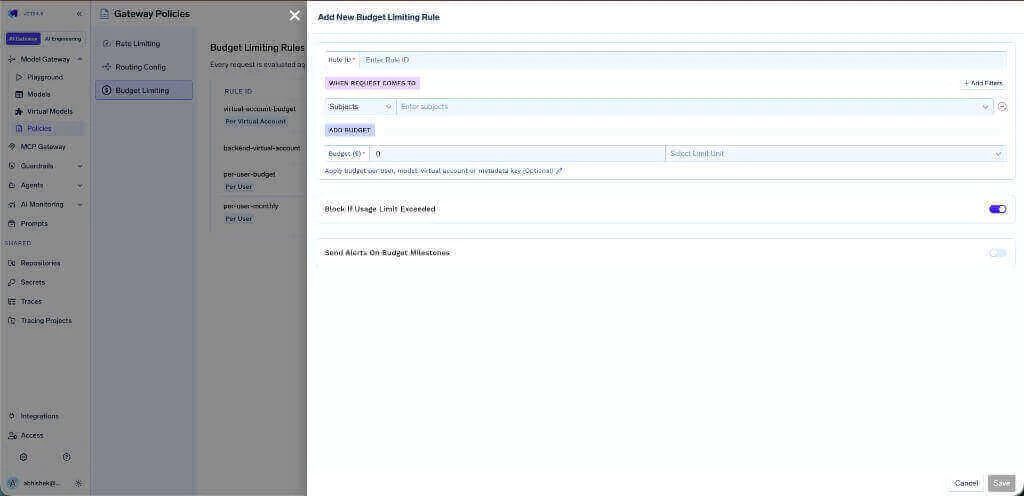
Rule ID
A unique identifier for the rule. This is used in logs, metrics, and API responses to identify which rule acted on a request. Choose a descriptive name likeper-user-daily or ml-team-budget.
When Request Comes To (Filters)?
Defines which requests this rule applies to. You can filter by one or more of the following. All selected filters use AND logic — a request must match all filters to be matched by the rule.
Use the + Add Filters button to add models or metadata filters alongside subjects.
If you leave all filters empty (no subjects, no models, no metadata), the rule matches every request. This is useful for setting default budgets that apply to everyone.
Budget
Set the spending limit and time period:- Budget ($): The dollar amount for the budget limit.
- Limit Unit: The time period over which the budget applies. Choose from:
- Cost per day — resets at UTC midnight
- Cost per week — resets on Monday at UTC midnight
- Cost per month — resets on the 1st of each month at UTC midnight
Apply Budget Per (Optional)
By default, a single budget is shared across all requests matching the rule. For example, a $100/day rule with ateam:engineering filter means the entire team shares a single $100 pool.
To create separate budgets for each individual within the matching group, use the “Apply budget per” option. Available values:
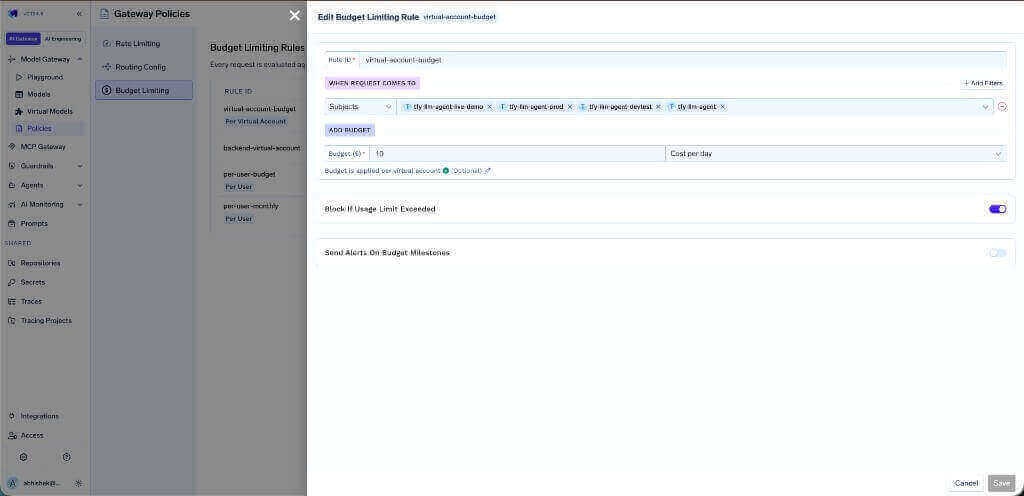
Block If Usage Limit Exceeded
Controls whether the rule enforces the budget or runs in audit mode. In YAML, this is theaudit_mode field (with inverted semantics — toggle ON corresponds to audit_mode: false).
- ON (default) — Enforcement mode: Requests are rejected with a budget-exceeded error once usage crosses the limit.
- OFF — Audit mode: Requests are allowed through even when the budget has been exceeded.
What audit mode preserves?
Audit mode only changes the allow/block decision. Everything else continues to behave exactly as in enforcement mode:- Usage tracking — the rule’s counter increments on every matching request, so the dashboard reflects real spend.
- Milestone alerts — alerts at 75%, 90%, 95%, and 100% still fire on the configured notification channels when thresholds are crossed.
- Layered evaluation — the rule still participates in tracking for all matching rules, and it still acts as the first matching rule for downstream rule order.
When to use audit mode?
Audit mode is designed for low-risk rollouts and observability:- Validating a new budget before enforcing. Deploy the rule in audit mode first, watch real traffic for a full budget period, and confirm the limit is calibrated correctly before switching to enforcement.
- Establishing a spend baseline. When you don’t yet know what a reasonable cap is, run a deliberately tight rule in audit mode to see how often real traffic would exceed it.
- Soft governance on critical paths. When visibility (alerts, dashboards) matters more than hard cutoffs — for example, a new model rollout where blocking would impact an SLA.
Send Alerts On Budget Milestones
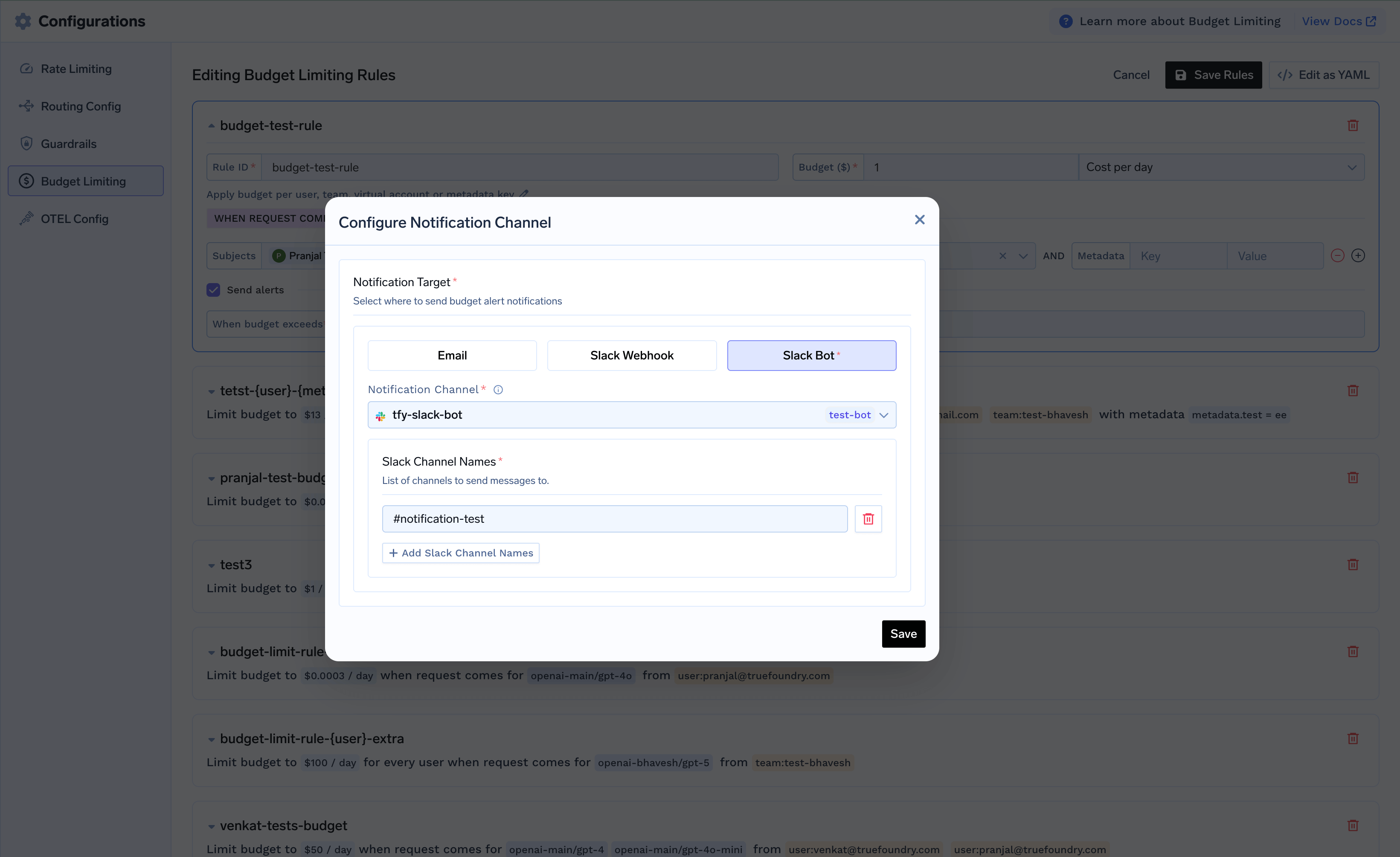
Configure notifications when budget usage crosses specified thresholds. Set one or more percentage thresholds between 0 and 100 (e.g.50%, 80%, 100%) and choose a notification channel (email, Slack webhook, or Slack bot).
Alert configuration details
Alert configuration details
Available thresholds: Any percentage value between 0 and 100 (for example
50%, 75%, 90%, 100%).Each threshold triggers once per budget period. When a new period starts (day/week/month), alerts reset and can be sent again. Alerts are checked every 20 minutes.Notification channels:- Email — Send alerts to one or more email addresses via a configured email notification channel
- Slack Webhook — Send alerts to a Slack channel via a webhook notification channel
-
Slack Bot — Send alerts to specific Slack channels via a bot notification channel
Viewing Budget Usage
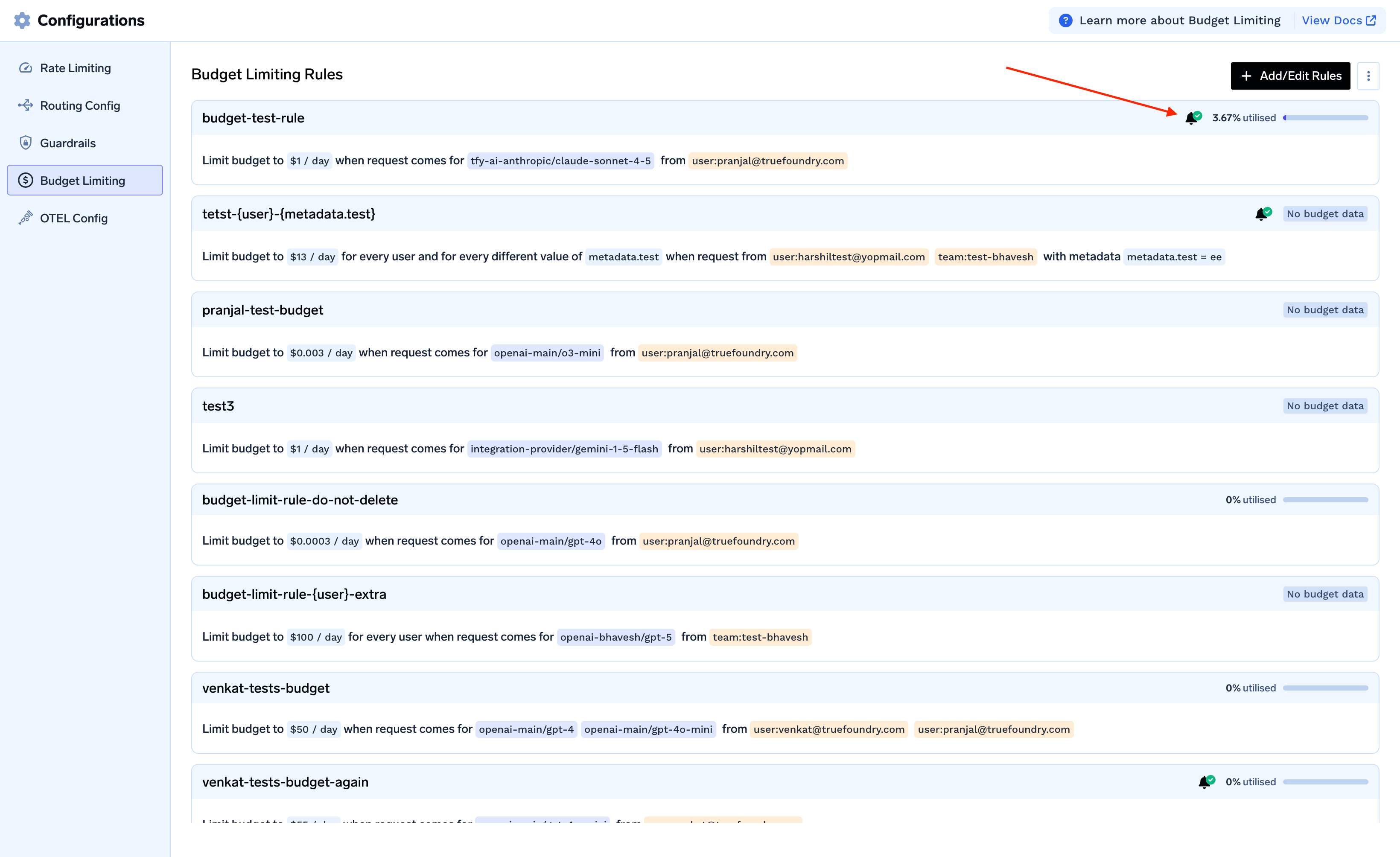
You can monitor budget usage directly on the budget configuration page. Each rule card displays:- Current usage amount and percentage
- Budget limit and remaining budget
- Period start time (when the current budget period began)
Budget exceeded response
When a budget is exceeded, the AI Gateway returns HTTP429:
x-tfy-applied-rules header naming the rule that was breached:
Practical Examples
Per-developer budgets with team overrides
Per-developer budgets with team overrides
Give every developer a $10/day budget, but allow the ML team $100/day. Place the override rule above the default.
How it works:
- ML team member → matched by rule 1 (first match, $100 limit applies). Budget is also tracked against rule 2.
- Any other developer → rule 1 doesn’t match, rule 2 matches ($10 limit applies).
Model-level cap with per-user limits
Model-level cap with per-user limits
Cap total GPT-4 spending at $500/month, while giving each user a $10/day limit.
How it works:
- A user calls GPT-4 → cost is tracked against both the per-user budget and the model-wide budget. The per-user rule controls allow/block.
- The model-wide cap acts as a safety net — even if individual users are within their limits, total GPT-4 spending is capped at $500/month.
Virtual account budgets
Virtual account budgets
Set spending limits per virtual account (useful when multiple teams or applications share the AI Gateway).
Each virtual account gets an independent $1000/week budget, tracked separately.
Project-based budgets using metadata
Project-based budgets using metadata
Track spending per project by using metadata sent in the
X-TFY-METADATA header.Each unique
project_id value gets its own $100/day budget. Requests must include the header:YAML Configuration
Budget rules configured via the UI can be exported as YAML. This is useful for version control, programmatic management, or copying configurations across environments.YAML structure reference
YAML structure reference
Example: Layered budget config
Example: Layered budget config
Example: Budgets with alerts
Example: Budgets with alerts
Example: Comprehensive multi-rule config
Example: Comprehensive multi-rule config
Migrating to Budget Limiting V2
Budget Limiting V2 replaces the ordered-rule model on this page with independent rules. In V1, rules are evaluated top to bottom and the first matching rule controls allow/block. In V2, every matching rule is evaluated and the request is blocked if any matching rule is breached. V2 also adds tenant- and team-scoped budgets, multiple limit periods per rule, and lifetime budgets that never reset.1
Audit your V1 rules
Review each V1 rule and note its filters, limits, and whether it acted as an override or a default. In V2, rules that previously relied on ordering will all apply together.
2
Recreate rules in V2
Go to AI Gateway → Policies → Budget Limiting and create equivalent rules. Use warn-only mode first if you want to validate spend patterns before enforcing.
3
Validate with warn-only mode
For rules where the limit is uncertain, start with Block If Usage Limit Exceeded turned off. Monitor usage for a full budget period, then switch to enforcement.
4
Disable V1 rules
Once V2 rules are enforcing correctly, disable the corresponding V1 rules. Both systems run in parallel during the transition, so disable V1 rules only after confirming V2 coverage.