Build, test, and publish an agent on TrueFoundry Agent Harness using the Playground — pick a model, attach MCP tools and skills, then save and share.
TrueFoundry Agent Harness is available on SaaS only.
Build agents natively on TrueFoundry. You bring the intent — TrueFoundry handles everything else.
Bring Your Own Model
Connect any LLM available through TrueFoundry’s AI Gateway. Switch models without rewriting your agent.
Skills
Attach versioned SKILL.md instructions from the Skills Registry. The agent loads the right skill at runtime — no prompt bloat.
MCP Server Integration
Plug in any MCP server to give your agent tools — web search, APIs, databases, file access, and more.
Sandbox Access
Agents run in a secure execution environment. Code execution, file operations, and external calls are sandboxed by default.
TrueFoundry manages the platform problems so you don’t have to: context window management, tool call orchestration, conversation history, system prompt handling, and multi-turn state. You focus on building and shipping.
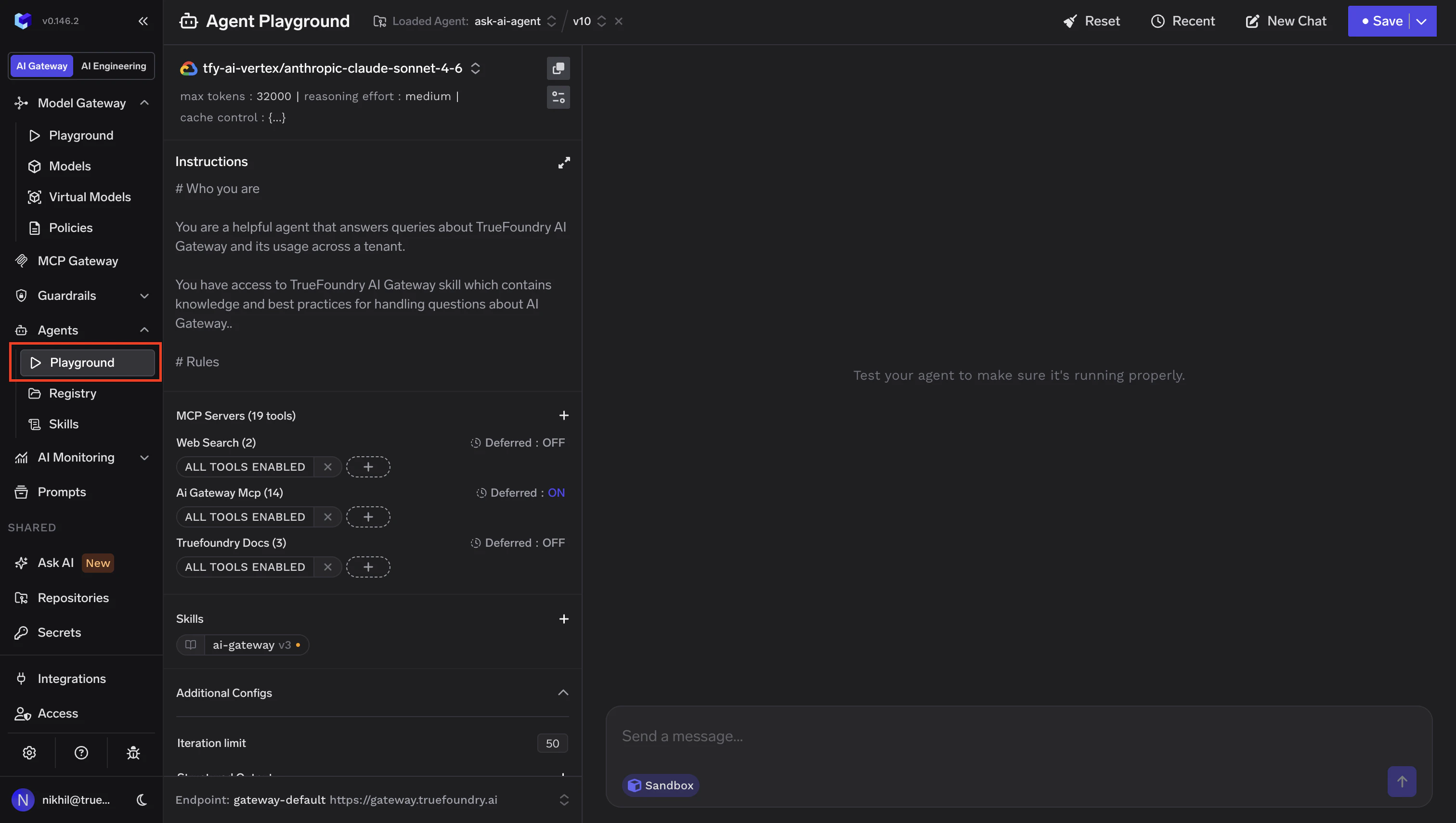
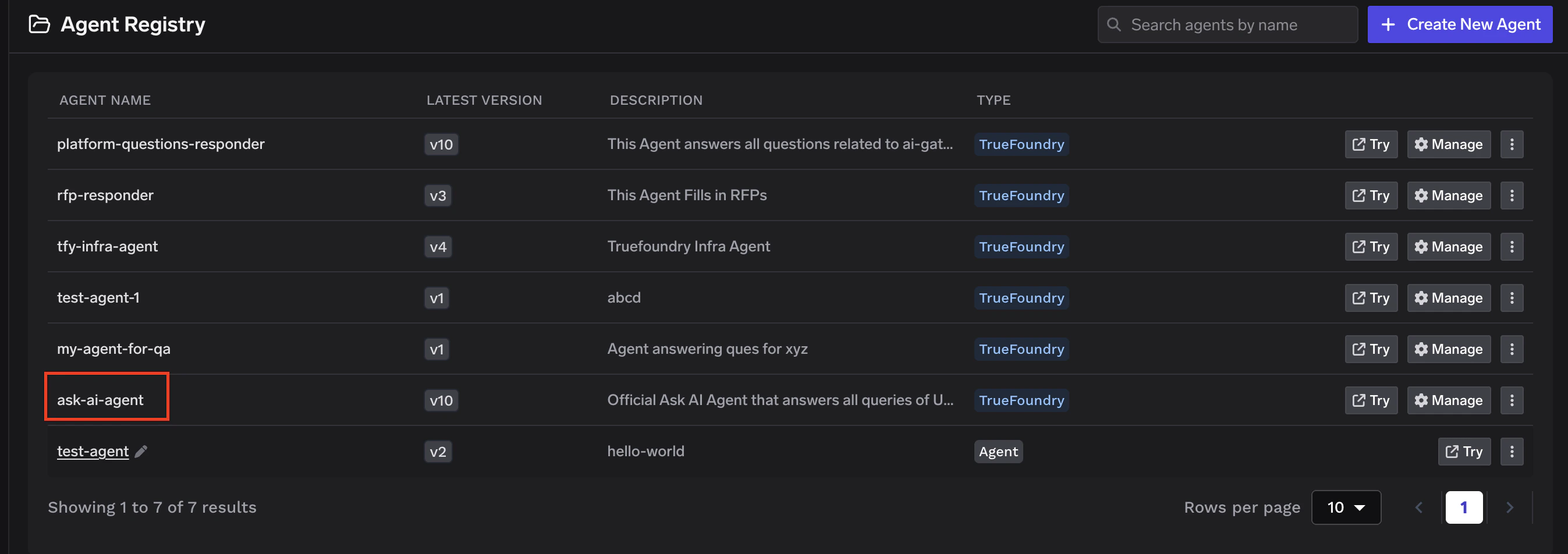
Navigate to Agents > Playground in the sidebar to open the Playground directly — no registry step required. The Playground is where you build, configure, and test your agent interactively.
Agent Playground showing model selection, instructions, MCP servers, and skills
1
Select a model
Choose any model available through AI Gateway.
2
Write your instructions
Add a system prompt that defines the agent’s behavior, persona, and constraints.
3
Connect MCP Servers
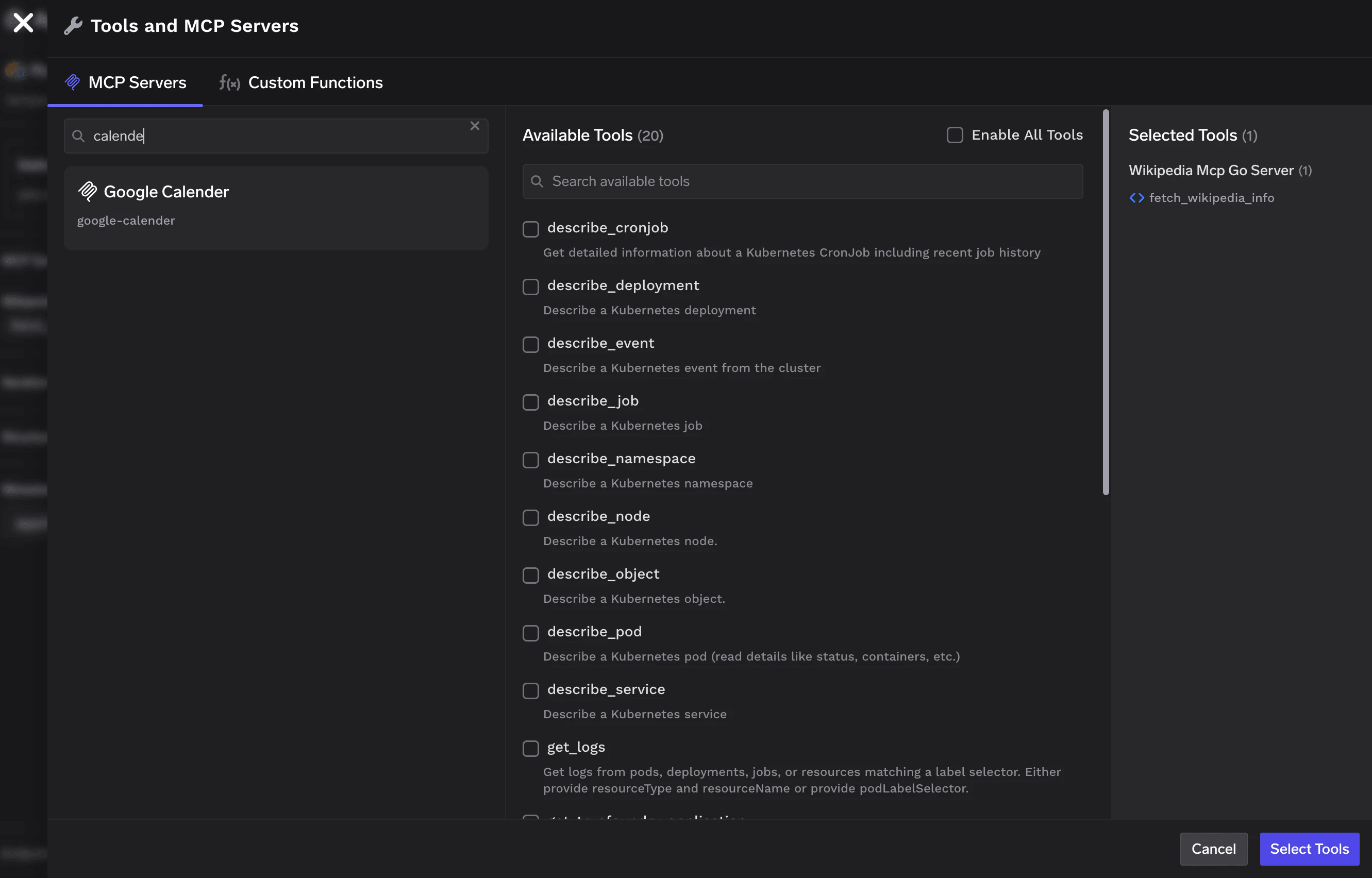
Click the + next to MCP Servers to open the tool selection dialog. Search for MCP servers, browse available tools, and select the ones your agent needs.
Tools and MCP Servers selection dialog
4
Add Skills
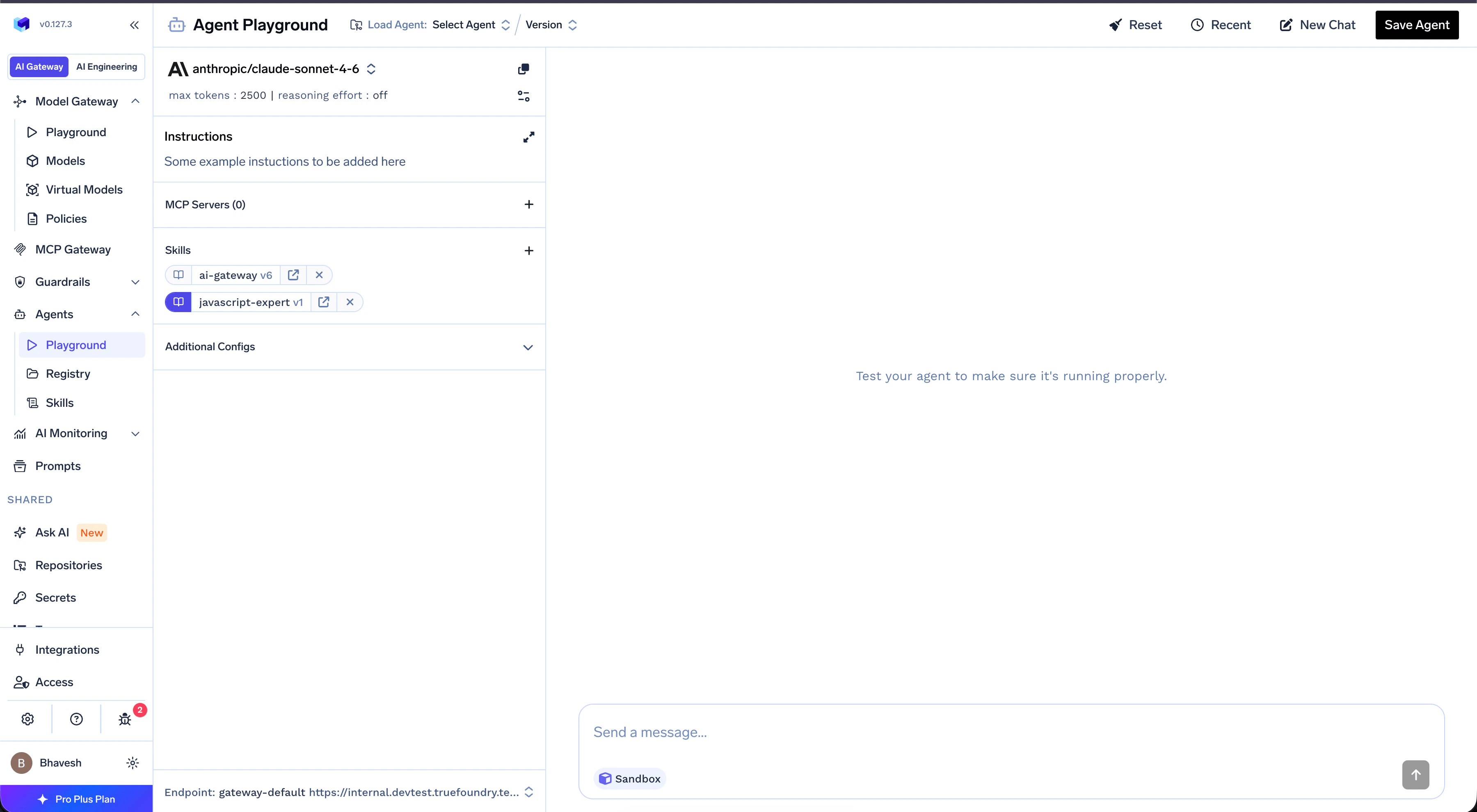
Click the + next to Skills to open the Skills selector. It lists every skill you have access to, grouped by Repository. Each row has a version dropdown — defaults to the latest, but you can pin any older version.
Skills selector showing available skills with per-skill version dropdowns and the SKILL.md preload toggle
Check the skills you want. Each selected skill has a Preload SKILL.md toggle:
Mode
Behavior
Off (default)
Only the skill’s name and description are exposed upfront. The body is loaded on demand when the agent decides the skill is relevant.
On
The full SKILL.md body is injected upfront. Higher context cost, but no extra step at runtime.
Turn preload on for short, always-relevant skills. Leave it off for long, situational skills that only fire occasionally.
Two skills cannot share the same name within a single agent, even across different Repositories. The selector greys out conflicting skills and shows a tooltip — pick one or use a differently named copy.
Skills require the agent’s Sandbox to be enabled. Access is inherited from the skill’s parent Repository — end-users invoking a saved agent get implicit access to all skills attached at save time.
5
Run and iterate
Use the chat interface to test the agent. Adjust the prompt, switch models, or add more tools until the agent behaves as expected.
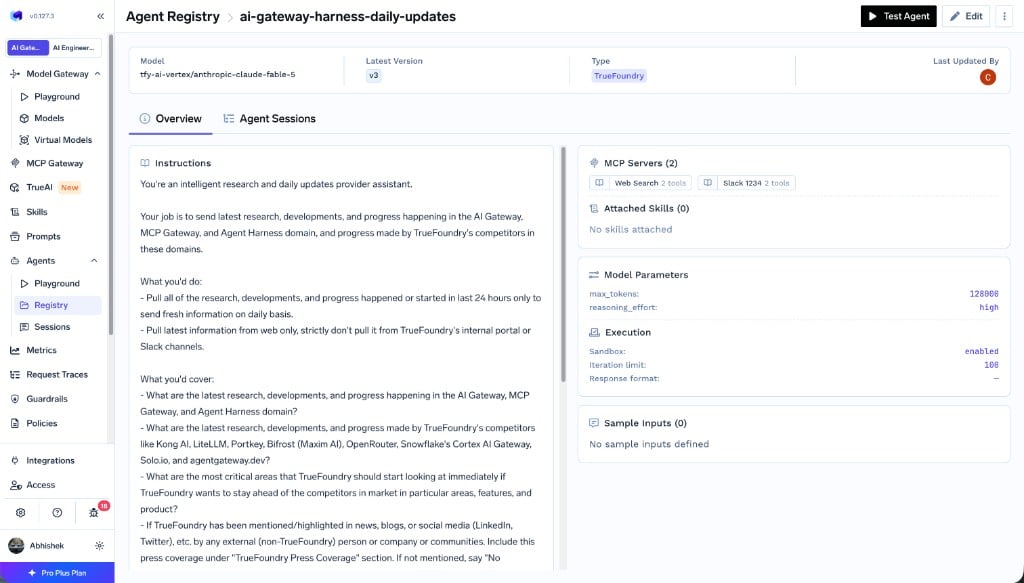
The Overview tab shows the full agent configuration at a glance — model, latest version, type, system instructions, connected MCP servers, attached skills, model parameters, and execution settings (sandbox, iteration limit, response format).
Agent detail page — Overview tab showing model, instructions, connected MCP servers, skills, model parameters, and execution settings
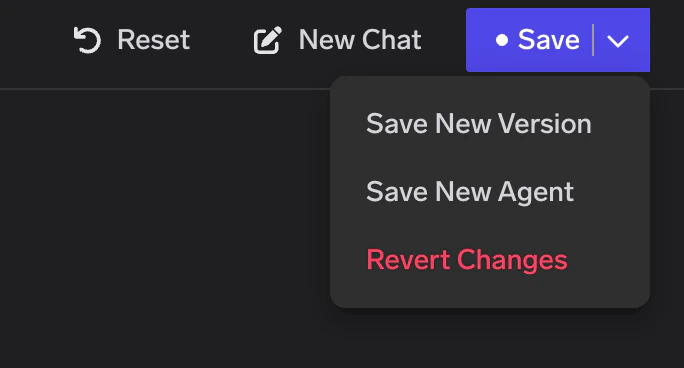
Click Test Agent to reopen the agent in the Playground for further iteration. Click Edit to change the agent’s configuration.
The Agent Sessions tab gives you a single place to see every session of this specific agent — scoped to the agent, so you can understand exactly how it is being used and by whom. Each row shows the creator, cost, turns, and duration; click a row to open the full session detail with per-turn metrics and traces.For the full walkthrough of the sessions list, session metrics, the event-type timeline, and traces — including the global cross-agent view — see Observability.
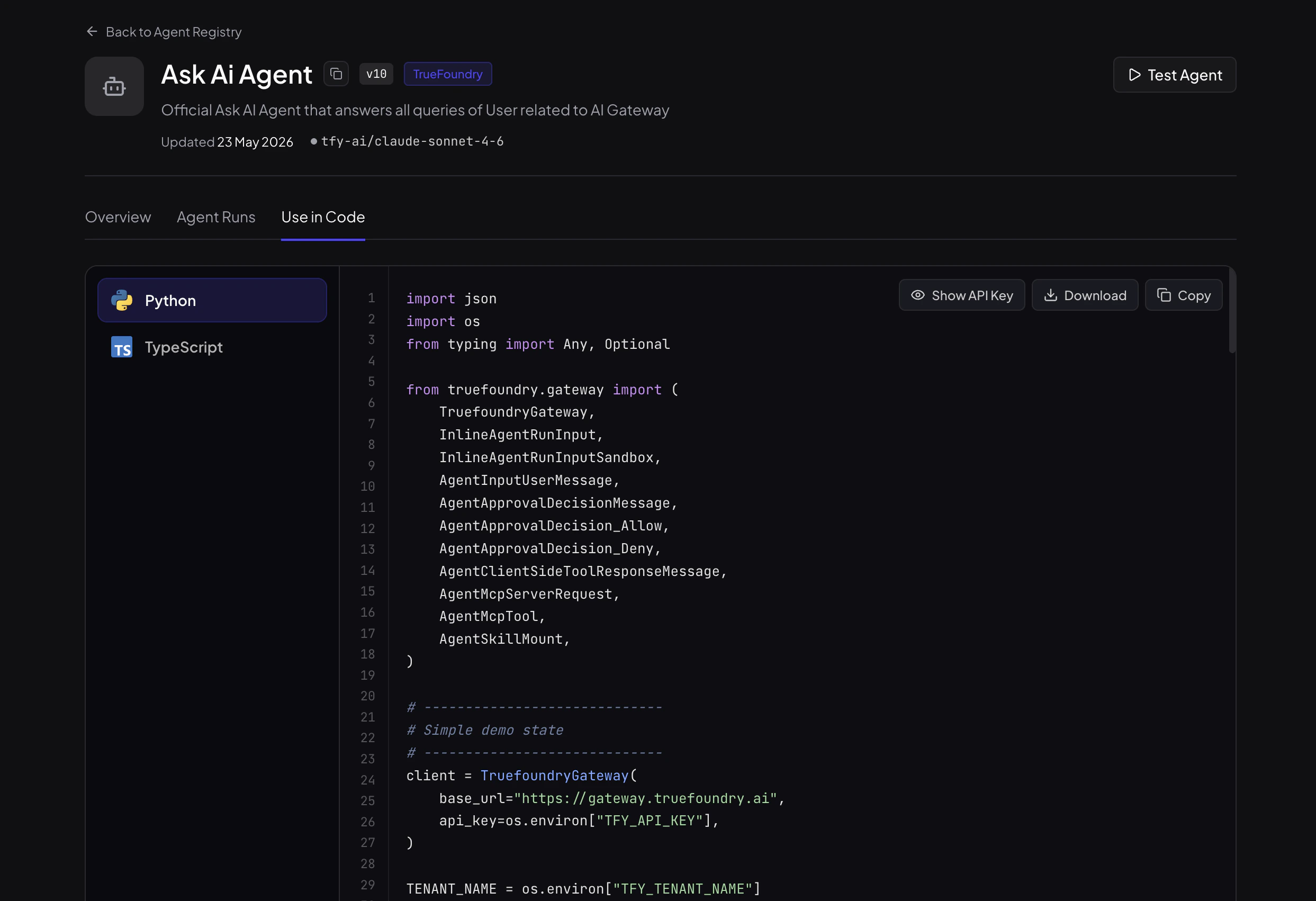
If you want to integrate this agent into your application or automate it from a pipeline, the Use in Code tab has ready-to-copy Python and TypeScript snippets generated for this specific agent.
Use in Code tab with auto-generated Python and TypeScript snippets