Get instant access to a live TrueFoundry environment. Deploy models, route LLM traffic, and explore the full platform — your sandbox is ready in seconds, no credit card required.
9.9
Agent Security Is a Systems Problem: From Prompt Injection to Runtime Control
A major 2026 survey of LLM-agent security reaches a conclusion enterprise teams should take seriously: once a model can use tools, retain state, and act on behalf of someone else, security is no longer mainly a prompt-filtering problem. It becomes a systems problem spanning information flow, delegated authority, and persistent state.
Security Framework Notes and Key Takeaways
Source and independence note. This article is grounded in Yuchen Ling, Shengcheng Yu, Zhenyu Chen, and Chunrong Fang, Toward Secure LLM Agents: Threat Surfaces, Attacks, Defenses, and Evaluation (arXiv:2606.10749, revised August 23, 2026), which synthesizes 247 papers. The mapping from the survey's security framework to TrueForge and TrueFoundry products is TrueFoundry editorial analysis; the paper does not evaluate or endorse TrueFoundry.
The infrastructure thesis: secure agents need more than model-level safety. The runtime should make trust boundaries and state transitions explicit; shared gateways should enforce identity, access, policy, credentials, budgets, guardrails, and evidence at model, tool, and agent boundaries; and systems of record should remain authoritative for business state and side effects.
Key Takeaways
Prompt injection is only one part of the problem. The survey finds tool-mediated control-flow hijacking remains prominent, while persistent-state corruption and multi-agent propagation are increasingly important.
Agent security has three coupled dimensions. Information enters the agent, authority lets it act, and persistent state lets an attack outlive the original interaction.
Controls need to compose across layers. A sandbox, guardrail, approval workflow, or gateway is useful, but none establishes security for the entire agent by itself.
TrueForge maps to the runtime boundary. It provides the execution loop, context management, tools, sandboxing, approvals, sessions, and events for agents built on it.
TrueFoundry Gateways map to shared control planes. AI Gateway governs routed model calls; MCP Gateway governs routed tool/data access; Agent Registry establishes identity, ownership, and access for registered agents, while broader Agent Gateway controls can add quotas, budgets, and traces for routed agent traffic.
Provenance-aware state remains an application responsibility. Persisting events is not the same as proving the integrity or trustworthiness of every piece of memory or business state.
1. Why Agent Security Is Different From LLM Safety
The survey starts from a simple architectural fact: an LLM agent does more than generate text. It may plan, invoke tools, browse, execute code, update state, and coordinate with other agents. Those capabilities turn model outputs into inputs to software control flow.
That changes the failure mode. A malicious instruction hidden in a web page can influence a later tool call. A poisoned tool result can become context for another decision. A compromised memory entry can survive the original session. A delegated credential can turn a bad plan into a real side effect. In a multi-agent system, the same contaminated information may propagate beyond the agent that first encountered it.
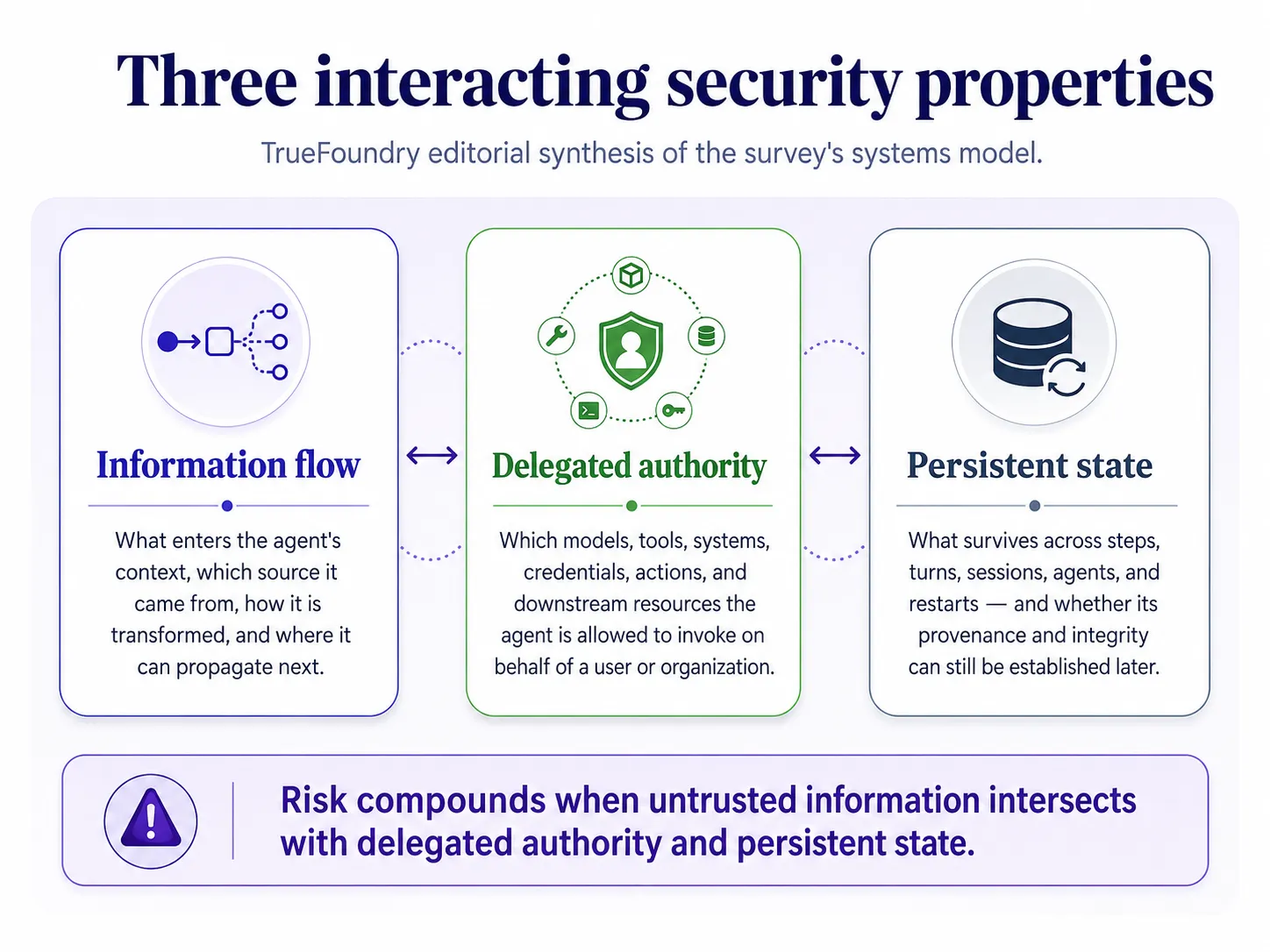
The survey therefore frames agent security around three interacting properties:
Figure 1. TrueFoundry editorial synthesis of the survey's systems model. Risk compounds when untrusted information intersects with delegated authority and persistent state.
The useful implication is that secure-agent architecture should not ask only, “Did we block the malicious prompt?” It should also ask: what could that content influence, what authority could the resulting trajectory exercise, and what state could the trajectory leave behind?
2. The Attack Surface Runs Through the Whole Agent Lifecycle
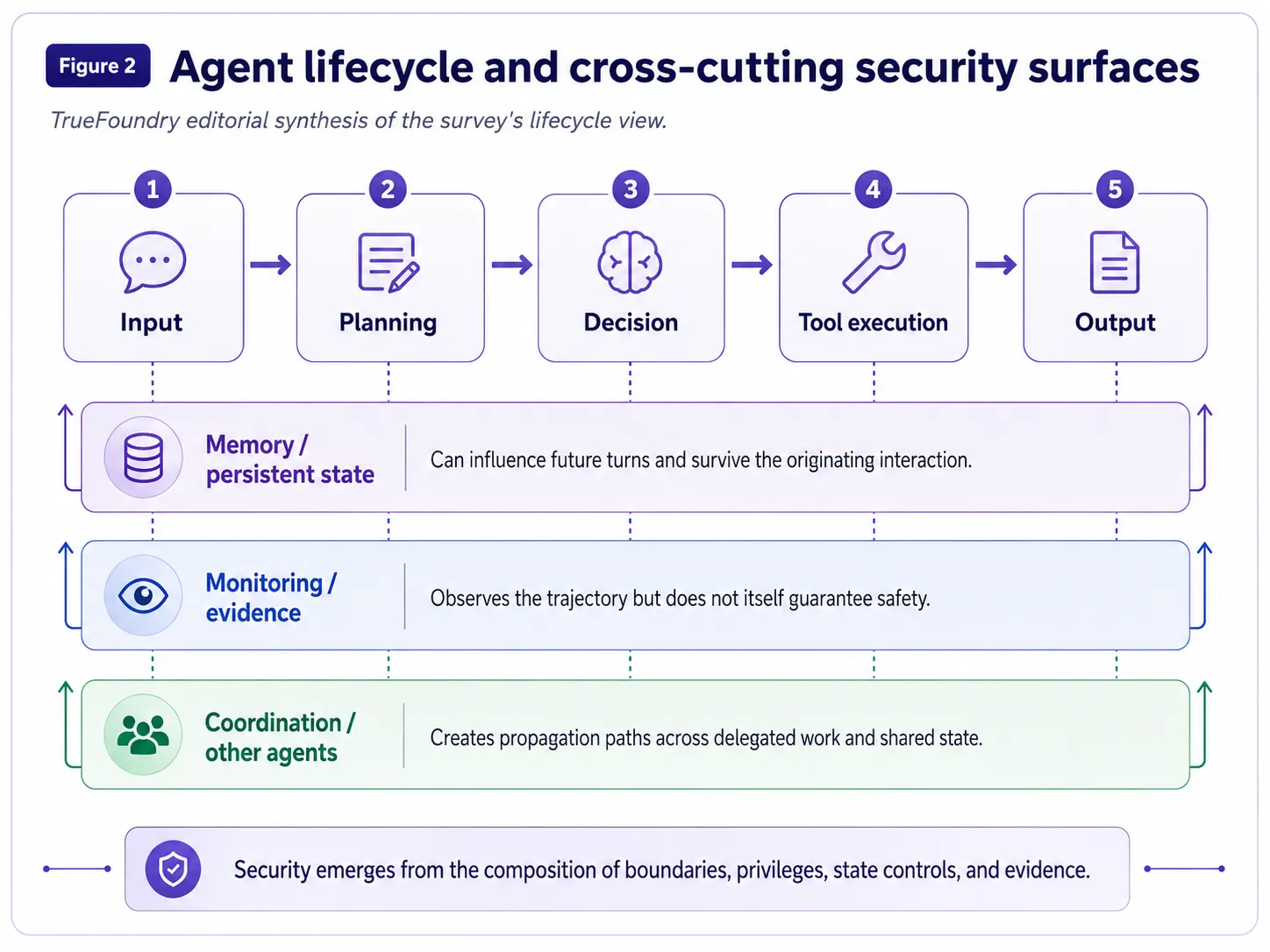
Ling and coauthors use a lifecycle-based, systems-oriented framework rather than a flat list of attack names. Operationally, it is useful to separate the core action path—input, planning, decision, tool execution, and output—from cross-cutting surfaces such as memory, monitoring, and multi-agent coordination, because those surfaces can influence or observe multiple stages of the run.
Figure 2. The core lifecycle is Input → Planning → Decision → Tool Execution → Output. Memory, monitoring, and coordination are cross-cutting surfaces that can influence or observe multiple stages rather than simply occurring afterward.
This lifecycle perspective also explains why defenses can be “weakly compositional,” as the survey puts it. A content filter may block one class of malicious text but do nothing about over-privileged credentials. A sandbox may contain code execution but not prevent an authorized API call. An approval gate may stop one side effect but not a poisoned memory write. A trace may make an incident observable without preventing it.
Security therefore emerges from the composition of boundaries, privileges, state controls, and evidence.
3. Mapping the Survey to TrueForge and TrueFoundry
The cleanest product mapping is not “TrueFoundry solves agent security.” It is to ask which part of the survey's systems model each layer can realistically govern.
Security Requirements Table
Security requirement from the survey
Natural control surface
TrueForge / TrueFoundry role
Important boundary
Explicit trust boundaries
Runtime + model/tool/agent interfaces
TrueForge separates the loop from its sandbox and external services; AI/MCP/Agent Gateway surfaces can centralize routed access
Traffic or state that bypasses those boundaries is not governed by them
Principled privilege control
Identity, access, credentials, approvals
AI Gateway access policy; MCP server/tool authorization and downstream credentials; Agent Registry access; TrueForge approval checkpoints
Approval does not replace standing authorization
Provenance-aware state
Sessions, events, application metadata, systems of record
Persisted telemetry is not automatically a cryptographic or semantic proof that memory is trustworthy
Containment
Execution environment
TrueForge sandbox-as-tool isolates code/files/shell operations and keeps model/MCP credentials in the harness
A sandbox does not constrain an externally authorized tool unless policy does
Runtime mediation
Model/tool boundaries
AI/MCP guardrails, access controls, approvals, budgets, and rate limits on routed traffic
No single guardrail detects every attack family
Deployment-realistic evidence
Runtime and gateway observability
TrueForge events plus TrueFoundry model/tool/agent metrics and traces
Downstream system logs remain necessary to prove authoritative side effects
4. Information Flow: Treat External Context as Untrusted Data—and Preserve Provenance
One of the survey's most important reframings is that prompt injection is an information-flow problem. The dangerous instruction may come from a user, but it may just as easily come from a retrieved document, a web page, a tool response, another agent, or a persistent memory entry.
That means the architecture should distinguish where information came from from what the model infers it means, and preserve provenance where that distinction matters downstream.
TrueForge: make the runtime boundary explicit
TrueForge is an open-source agent harness that provides the model/tool loop, context management, sandboxing, approvals, sessions, and events. Its sandbox-as-tool design is particularly relevant to the survey's trust-boundary argument: the agent loop and model/MCP credentials remain in the harness, while code, files, and shell execution happen in an isolated environment provisioned when needed.
This is a useful separation of concerns. The sandbox can be treated as a lower-trust execution surface without also becoming the store of agent credentials or conversational authority.
MCP Gateway: inspect and govern the tool boundary
TrueFoundry MCP Gateway adds a shared boundary between agents and enterprise tools. Current documentation describes centralized registry and discovery, OAuth/token management, server/tool access control, pre- and post-tool guardrails, approval workflows, and request/response auditability for traffic routed through the Gateway.
That matters because a tool result is not merely data. It can become new context that influences subsequent planning. Post-tool inspection therefore has a different role from pre-tool authorization: one controls whether the tool may run; the other can inspect what information comes back into the agent loop.
5. Delegated Authority: Least Privilege: Keep Agent Authority No Broader Than the Task Requires
The survey's second axis is delegated authority. Agent systems are risky not only because models can be manipulated, but because a manipulated model may be holding real authority on behalf of a user, team, application, or service.
This is where least privilege needs to become an architectural property rather than a prompt instruction.
Product Component Definitions
AI Gateway
Centralizes model access, API keys, rate limits, budgets, routing, guardrails, and observability for model traffic routed through it.
MCP Gateway
Centralizes MCP server/tool discovery, user authentication, tool authorization, outbound credentials, guardrails, approvals, and audit for routed tool calls.
Agent Registry / Gateway
Provides registry-backed identity, ownership, collaborator-based access control, and routing for registered agents. Broader Agent Gateway controls can add quotas, budgets, and centralized tracing for routed agent traffic. The dedicated On-Behalf-Of workflow remains documented as Coming Soon, so this article does not treat full OBO exchange semantics as generally available today.
TrueForge
Can pause a run at selected human checkpoints and preserve the session state needed to continue after approval or denial.
The most important design principle is that these controls answer different questions. Authorization says whether an actor may use a capability. Guardrails constrain requests or results. Human-in-the-loop (HITL) inserts human judgment at a selected moment. Budget and rate limits constrain economic and operational authority. None is a substitute for the others.
6. Persistent State: A Security Surface That Outlives the Prompt
The survey highlights persistent-state corruption as an emerging concern. That matters because agents increasingly outlive a single prompt or HTTP request. They preserve conversations, files, memory, summaries, tool results, plans, and sometimes learned preferences across long workflows.
TrueForge's SDK makes this runtime state legible through an explicit hierarchy of Agent → Session → Turn → Event → Delta. Sessions can survive reconnects and restarts, turns chain within a session, and events expose what the runtime is doing—including MCP initialization, model messages, tool responses, approval requirements, and turn completion.
That is valuable for security because it gives operators an inspectable history. But observability should not be confused with provenance guarantees.
State-Security Rule Note
State-security rule: if a memory or state element can influence a future action, record enough provenance to answer where it came from, which principal or process wrote it, what policy allowed the write, which version was active, and whether the state has been superseded or rolled back. TrueForge and gateway traces can provide parts of that evidence; the application's memory layer and systems of record must supply the rest.
This is especially important when a system compacts context. A summary can be operationally useful without preserving every trust-relevant detail. Teams should decide deliberately which provenance fields must survive compaction, memory promotion, and cross-agent transfer.
7. Multi-Agent Systems Turn Local Compromise Into Propagation Risk
The survey identifies multi-agent propagation as a growing research concern. Once agents exchange messages, delegate work, or call one another, a compromised output can become another agent's trusted input.
At that point, the relevant security question is not merely “is Agent A safe?” It is:
Which agents may invoke Agent A?
Which agents may Agent A invoke?
What identity travels with a delegation?
Which user or service is ultimately represented?
Which tools and data remain reachable after delegation?
How does trace context survive across the chain?
TrueFoundry's Agent Registry currently documents verifiable agent identity, ownership, collaborator-based access control, and routing for registered agents. Broader Agent Gateway and observability surfaces can add quotas, budgets, and centralized tracing for routed agent traffic. The Registry documentation also exposes identity-provider-backed mappings, but the dedicated On-Behalf-Of delegation workflow is still explicitly marked Coming Soon; this article therefore does not treat full OBO exchange semantics as generally available today.
But the same boundary remains important: an agent registry does not determine the application's workflow topology, and agent-to-agent connectivity is not automatically safe simply because the peers are registered. Authorization and delegation policy still have to constrain the graph.
8. Why “Defense in Depth” Is Not Enough Unless the Defenses Compose
Security teams often say “defense in depth,” but the survey's weak-composability finding points to a harder requirement: the defenses must agree on the same trust and authority model.
For example:
A sandbox may isolate code, while an over-privileged MCP credential still allows a destructive remote API call.
A gateway may block an unauthorized tool, while poisoned session state still changes which authorized tool the agent chooses.
A human approval may validate an action, while the underlying arguments change before execution unless the approval is bound to the actual request.
A trace may record every call, while downstream audit logs are still required to prove what the system of record actually changed.
A better operating model is to treat every consequential edge in the agent system as having four questions:
This is where TrueForge and the TrueFoundry Gateways are complementary. The harness governs execution inside the agent loop. Gateways centralize policy on model, tool, and agent traffic intentionally routed through them. Systems of record retain authority over the final business side effect.
9. Security Evaluation Has to Look Like Production
The survey's final warning is methodological: existing benchmarks still underrepresent long-horizon, stateful, and deployment-sensitive risks. That means a one-turn jailbreak test is not enough evidence that an agent is safe to operate for hours, retain state, use tools, or coordinate with peers.
A production-oriented security evaluation should vary more than the prompt. It should test:
indirect instructions arriving through tools and retrieved content;
state poisoning that becomes relevant several turns later;
credential and permission boundaries under realistic identities;
approval expiry, retries, and resume behavior;
sandbox escape assumptions and out-of-sandbox tool authority;
multi-agent propagation and delegation depth;
model/provider changes and fallback routes;
trace completeness across harness, gateway, and downstream systems.
For agent security evaluations, runtime configuration, tool topology, persistent state, identity, and mediation policy are part of the evaluated system—not incidental implementation details.
10. What TrueForge and TrueFoundry Do—and Do Not—Claim
The survey is useful precisely because it discourages silver-bullet thinking. The same should apply to product architecture.
That every external system's own authorization or data integrity is correct
Agent Registry / Gateway
Registry-backed agent identity, ownership, access controls, and routing; broader Agent Gateway controls can add quotas/budgets and tracing, while the dedicated OBO workflow remains documented as Coming Soon
That the application's multi-agent topology or delegation policy is automatically correct
Application + systems of record
Business semantics, authoritative state, domain-specific policy, final side effects
They still require their own security controls and auditability
The strongest architecture is therefore not “put a gateway in front of the agent.” It is a set of explicit trust boundaries whose responsibilities are narrow enough to reason about and whose evidence can be correlated after the fact.
11. The Practical Security Review
Consequential Agent Workflow
For one consequential agent workflow, ask:
Which inputs are untrusted, and how are they labeled or isolated?
Which model, tool, data, agent, and network resources are reachable?
Which identity is presented at each hop?
Where are credentials held, and can generated code access them?
Which actions require explicit approval, and what exactly is the approval bound to?
Which state can persist beyond the turn, and what provenance travels with it?
Can contaminated state propagate to another agent or user?
What does the harness log? What do the gateways log? What must the downstream system log?
What happens on retry, fallback, reconnect, timeout, or partial failure?
Has the workflow been tested over the same timescale, statefulness, identities, and tool permissions it will use in production?
If those questions cannot be answered, the problem is not that the organization needs one more prompt filter. It needs a clearer agent security architecture.
TrueForge — Introduction. Current documentation for the open-source agent harness, execution loop, approvals, context management, persistent sessions, and sandbox-as-tool model.
TrueForge — Setup Sandbox. Current documentation for sandbox isolation, on-demand provisioning, and keeping model/MCP credentials in the harness.
TrueFoundry — AI Gateway. Current documentation for model access, routing, rate limits, budgets, guardrails, and observability.
TrueFoundry — MCP Gateway. Current documentation for MCP registry, authentication, token management, tool access, guardrails, approvals, and audit.
TrueFoundry — Agent Registry. Current documentation for registering agents, establishing identity and ownership, collaborator-based access control, routing, and agent tokens.
TrueFoundry — Agent Gateway. Current public product surface for agent-level quotas/budgets, access controls, and execution tracing.
Product behavior is described from current public TrueForge and TrueFoundry documentation as of August 28, 2026. The survey's taxonomy and research findings are attributed to its authors. The product mapping and architecture recommendations are TrueFoundry editorial analysis and should not be read as claims made or endorsed by the survey authors.
TrueFoundry AI Gateway delivers ~3–4 ms latency, handles 350+ RPS on 1 vCPU, scales horizontally with ease, and is production-ready, while LiteLLM suffers from high latency, struggles beyond moderate RPS, lacks built-in scaling, and is best for light or prototype workloads.










.webp)

.png)
.png)
.png)
.png)
.png)
.png)
.png)
.png)
.png)
.png)
.png)


