Blank white background with no objects or features visible.

Hello, EMEA! TrueFoundry is growing our footprint across Europe, the Middle East, and Africa. Read more. →

What Is Agent Authentication?

By Ashish Dubey

Updated: November 9, 2026

Published: November 2, 2026

Agent authentication is the process of verifying an AI agent’s identity before it is allowed to act. The agent presents a credential — typically a short-lived, signed token — and a verifier validates that credential’s issuer, audience and signature to confirm the agent is who it claims to be, rather than a spoofed or unauthorized caller.

In one line: agent authentication answers “is this really that agent?” — the identity check that must pass before any authorization decision is made.

Why does agent authentication matter?

Autonomous agents call tools, data sources and other agents without a human in the loop. If you cannot verify which agent is making a request, you cannot attribute actions, apply per-agent policy, or stop an impostor. The failure modes are concrete:

  • Spoofing. Without strong authentication, anything that can reach your tools can claim to be a trusted agent.
  • Shared secrets. When many agents share one API key, authentication tells you only “someone with the key” called — not which agent, and you cannot revoke one without breaking all.
  • Standing credentials. Long-lived keys that never expire are a durable attack surface; short-lived, verifiable credentials shrink the blast radius.

Strong agent authentication is the foundation the rest of agentic IAM is built on — you cannot authorize or audit an agent you cannot first identify.

Want to see agent authentication enforced on every request?

How does agent authentication work?

  1. Credential issuance. The agent is registered as a non-human identity and issued a credential — often an OAuth 2.0 client, an OIDC token, or an attested workload certificate.
  2. Presentation. On each request, the agent presents its credential to the verifier (commonly a gateway sitting in front of models, tools and MCP servers).
  3. Validation. The verifier checks the signature, the issuer, the audience, and expiry — confirming the token was minted by a trusted authority, for this recipient, and is still valid.
  4. Short lifespans & rotation. Credentials are kept short-lived and rotated, so a leaked token is useful only briefly.

Enforcing this at a single control point — rather than in every agent and server — is what the MCP gateway authentication model provides.

Agent authentication vs agent authorization

The two are often confused. Authentication is about identity; authorization is about permission. Authentication always comes first.

Agent authenticationAgent authorization
Question it answersWho is this agent?What is this agent allowed to do?
ChecksCredential signature, issuer, audience, expiryPolicy, scopes, least privilege, delegation
OrderFirstAfter authentication
OutcomeVerified identity (or rejected)Allow / deny / step-up for a specific action
Authenticate your agents with short-lived, verifiable credentials — see it live.

Examples of agent authentication

  • OAuth 2.0 / OIDC: the agent holds a client credential or token; the verifier validates it against the issuer. Used, for example, when adding Okta OAuth to an MCP server.
  • Mutual TLS (mTLS): the agent presents a client certificate proving its identity at the transport layer.
  • SPIFFE/SPIRE SVIDs: attested, short-lived workload identities issued to agents based on where they run — see securing AI agents with SPIFFE and SPIRE.
  • Gateway-issued agent credentials: the control plane registers each agent and issues it a scoped, short-lived credential validated on every call.

How TrueFoundry authenticates agents

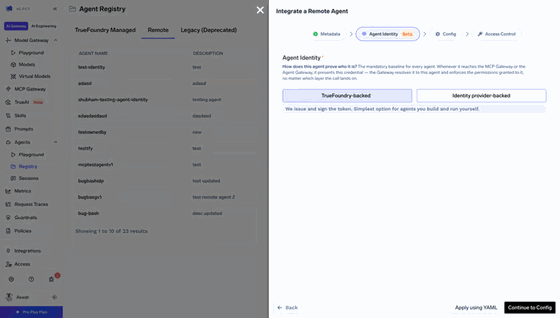
When you register an agent in TrueFoundry, you choose how it proves who it is: a TrueFoundry-backed credential (TrueFoundry issues and signs the token — the simplest option) or an identity-provider-backed credential (the agent authenticates through Okta, Entra or another IdP). Either way, the agent presents that credential at the Agent Gateway or MCP Gateway on every call, and the gateway resolves it to the registered agent and the permissions granted to it.

Registering an agent’s identity in TrueFoundry: “how does this agent prove who it is?” — a TrueFoundry-backed or identity-provider-backed credential, validated on every request.

Each request carries two credentials — the user’s token and the agent’s token — so the gateway authenticates both:

Authorization: <user token>
x-tfy-agent-authorization: <agent token>

For identity-provider-backed agents, the gateway validates the token’s signature against the configured jwks_uri, checks the issuer (iss) and audience (aud), and matches the agent identity from the token’s claim (by default act.sub) against the agent registry — returning 403 if there is no match. TrueFoundry supports three identity modes: managed credentials (TrueFoundry performs the RFC 8693 token exchange for the agent), federated token (the agent performs the exchange itself and presents the result), and virtual account (the agent presents a virtual-account token plus an X-TFY-User-Token, with no IdP exchange).

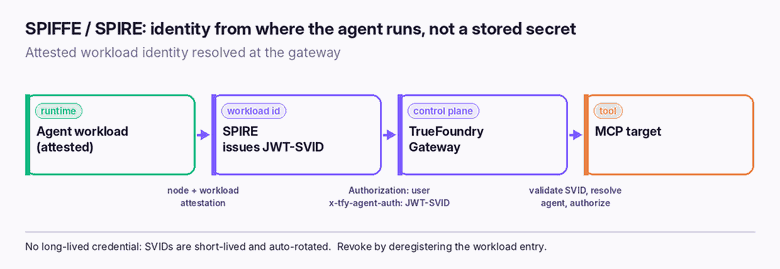
For workload-based authentication, TrueFoundry supports SPIFFE/SPIRE, where the agent’s credential is derived from runtime attestation — so the agent holds no long-lived secret at all.

Attested workload identity with SPIFFE/SPIRE: the agent’s short-lived credential is derived from where it runs, resolved to a governed agent at the gateway.
Authenticate every agent with short-lived, verifiable credentials at one governed gateway.

Try now.

One gateway for all your models, MCP servers, and agents. No credit card needed.

Start free
Table of Contents

One Gateway for Every LLM, Agent and MCP Server

Book a 30-min with our AI expert

Book a Demo

The fastest way to build, govern and scale your AI

Book Demo
Summarize with
ChatGPT logo by OpenAI
Perplexity AI logo
Blurry red snowflake on white background, symmetrical frosty design with soft edges and abstract shape.

Discover More

No items found.
November 14, 2026
|
5 min read

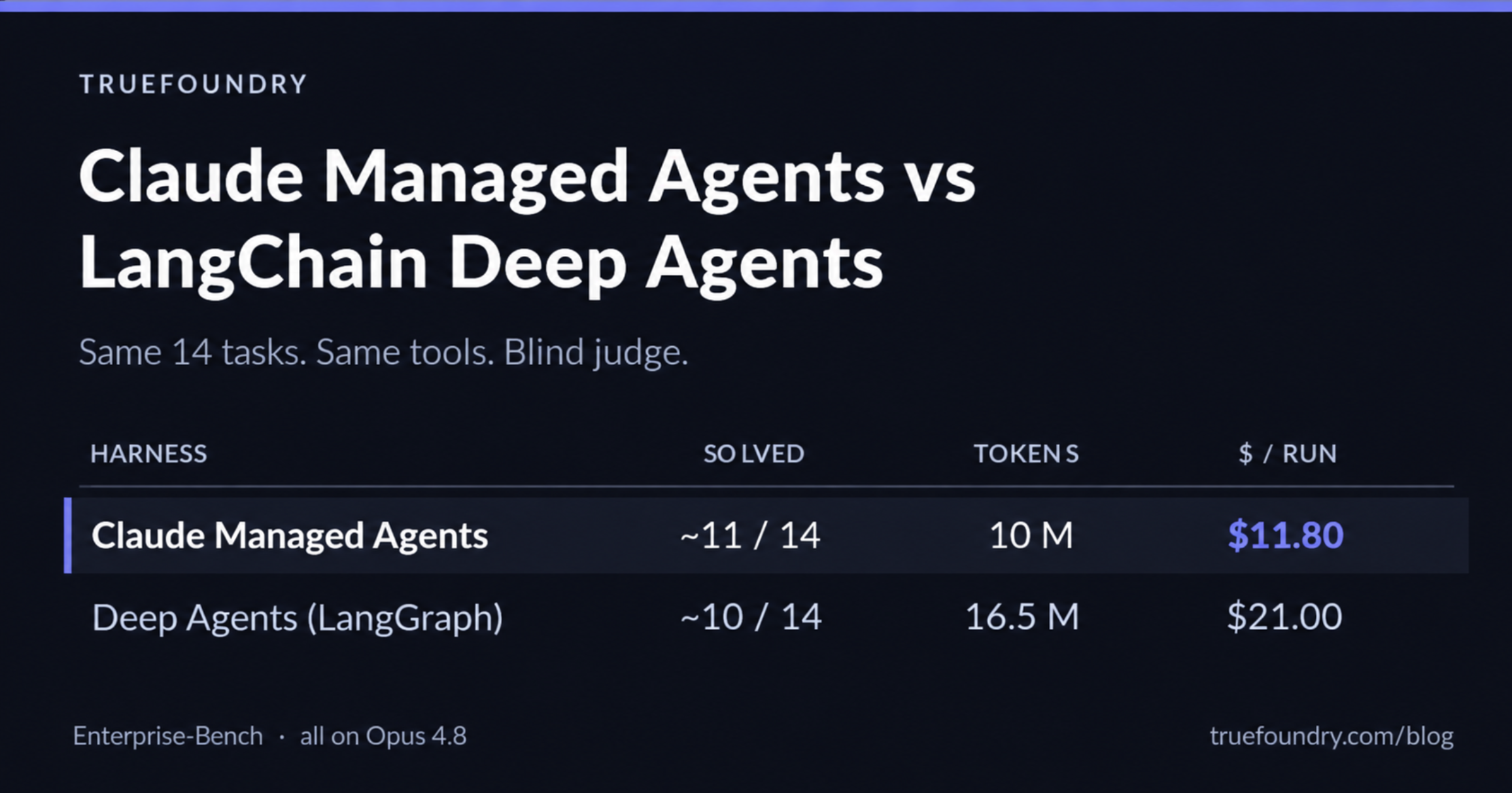
Claude Managed Agents vs LangChain Deep Agents: Which Agent Harness Should You Choose?

TrueForge
November 13, 2026
|
5 min read

Claude Managed Agents vs TrueForge: Which Agent Harness Should Enterprise Teams Run in 2026

TrueForge
 What is an LLM Gateway
November 13, 2026
|
5 min read

What Is an LLM Gateway? How It Works, What to Look For, and When You Need One

Engineering and Product
November 13, 2026
|
5 min read

How to Host Helm Charts on GitHub Pages and Publish Them on Artifact Hub (2026 Guide)

Engineering and Product
No items found.

Recent Blogs

Black left pointing arrow symbol on white background, directional indicator.

Frequently asked questions

What is agent-to-agent authentication and how is it used?

Agent-to-agent authentication verifies the identity of one AI agent before it communicates with or requests services from another agent. It uses mechanisms such as OAuth 2.0, OIDC tokens, mutual TLS (mTLS), and SPIFFE/SPIRE credentials. This ensures that only trusted agents can interact, enabling secure collaboration, controlled access, and accountability across multi-agent systems.

How are AI agents authenticated?

AI agents are authenticated using unique identities and verifiable credentials, such as OAuth 2.0 tokens, OpenID Connect (OIDC), mutual TLS certificates, or SPIFFE/SPIRE workload identities. A gateway or identity provider validates the credential's signature, issuer, audience, and expiration on every request. Short-lived credentials and automatic rotation further reduce the risk of credential theft and unauthorized access.

Who offers the best AI agent authentication?

TrueFoundry offers AI agent authentication through its Agent Gateway and MCP Gateway. It supports TrueFoundry-managed credentials, identity-provider-backed authentication through providers such as Okta and Microsoft Entra, and SPIFFE/SPIRE workload identity. These capabilities help enterprises establish verifiable agent identities, validate credentials on every request, and enforce centralized access governance across AI agents and tools.

Why is agent authentication critical in agentic AI systems?

Agent authentication is critical because autonomous AI agents interact with enterprise tools, data, APIs, and other agents without continuous human supervision. Without verified identities, malicious or unauthorized agents can impersonate trusted agents, access sensitive resources, or perform unintended actions. Strong authentication enables per-agent accountability, access enforcement, individual credential revocation, and secure governance across agentic AI systems.

Why is agent authentication becoming more important now?

Agent authentication is becoming more important as enterprises increasingly deploy autonomous and multi-agent systems that interact with sensitive data, applications, and external tools. Shared API keys and long-lived credentials cannot provide reliable per-agent accountability or granular revocation. Organizations need unique agent identities, short-lived credentials, and centralized authentication to prevent impersonation and secure AI operations at scale.

What is agent authentication?

Agent authentication is verifying an AI agent’s identity before it acts. The agent presents a credential — usually a short-lived, signed token — and a verifier validates its signature, issuer, audience and expiry to confirm the agent is genuine rather than spoofed.

What is the difference between agent authentication and authorization?

Authentication verifies who the agent is; authorization decides what the authenticated agent may do. Authentication happens first and produces a verified identity; authorization then evaluates that identity against least-privilege policy for each specific action.

How do you authenticate an AI agent?

Register the agent as its own identity, issue it a short-lived credential (OAuth/OIDC token, mTLS certificate, or a SPIFFE SVID), and validate that credential on every request at a control point such as a gateway — checking signature, issuer, audience and expiry, and rotating credentials regularly.

Why not just give agents an API key?

A shared, long-lived API key cannot distinguish one agent from another, cannot be revoked for a single agent, and never expires. Per-agent, short-lived credentials provide attribution, individual revocation, and a smaller blast radius if leaked.

What credentials are used for agent authentication?

Commonly OAuth 2.0 client credentials or OIDC tokens, mutual TLS certificates, and SPIFFE/SPIRE SVIDs for attested workload identity. These are typically validated at a gateway that fronts models, tools and MCP servers.

Take a quick product tour
Start Product Tour
Product Tour