November 14, 2026
|
5 min read


Blazingly fast way to build, track and deploy your models!
As multi-agent systems become more complex, the challenge is no longer just making individual agents work reliably. It is designing how they connect, divide responsibilities, delegate tasks, and coordinate at runtime. This is the idea behind graph engineering, a concept explored in an ExplainX.ai article published on July 18, 2026, which frames a multi-agent organization as an engineered graph rather than a collection of loosely connected agents.
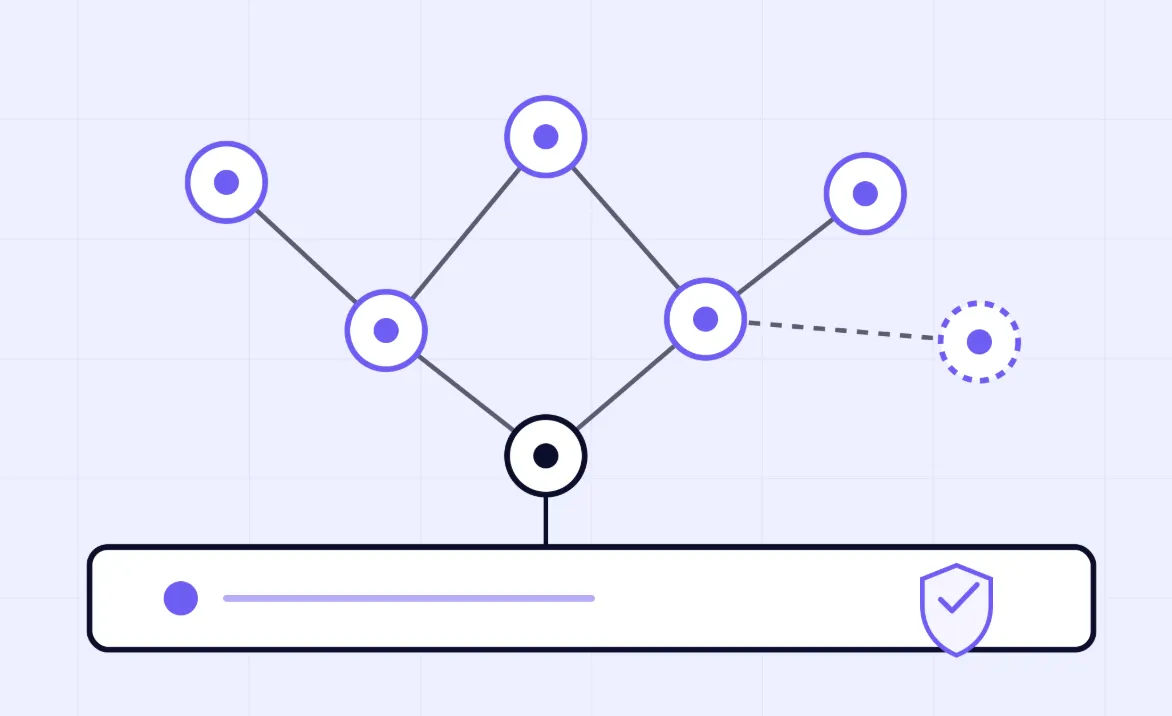
Graph engineering defines the system's topology: which nodes exist (agents, deterministic functions, routers, and human checkpoints), what each is responsible for, which transitions are allowed, and how work moves through the system. Loop engineering, by contrast, focuses on how each agent executes its tasks. Although the term's origins remain unsettled and its name overlaps with the established field of knowledge graphs, graph-based orchestration builds on longstanding ideas in computing and distributed systems.
For enterprises, the distinction has practical implications. The orchestrator defines and manages the workflow graph, while TrueFoundry governs model and MCP-tool operations routed through its gateways and provides a managed runtime for Agent Harness agents. Understanding where these responsibilities begin and end is essential to designing reliable, governable multi-agent systems.
Graph engineering is the design and operation of a multi-agent system as an explicit graph of heterogeneous nodes — agents, deterministic functions, routers, joins, tools, human checkpoints — with communication and delegation as edges, and the topology itself — who exists, what each owns, who may talk to whom, how work routes — treated as a programmable, versionable artifact rather than an emergent accident.
The synthesizing article's ownership example makes it concrete: a security agent that owns auth, permissions, and audit logs; a data agent that owns schema and migrations; an API agent that owns endpoints and contracts; a frontend agent that owns components and state — each a node with a mandate, wired into an organization whose structure is itself the engineered object (explainx.ai).
One disambiguation matters immediately, both for readers and for anyone arriving from a search engine: this is not knowledge-graph engineering — the established discipline of building graph-structured data (entities, relationships, triple stores) for retrieval and reasoning.
Knowledge graphs structure what a system knows; graph engineering in the 2026 sense structures who the system is — its members, mandates, and message paths. The two can and will co-exist in one architecture; they answer different questions.
New terms deserve an understanding of their origins, and graph engineering has a particularly rich history worth tracing. That history helps explain how the practice may evolve. One of its deepest roots is the idea that computation is a graph. Early dataflow architectures explored this concept in hardware, and it resurfaced wherever work needed to be broken down and scheduled.
Compiler dependency graphs and MapReduce's implicit DAG followed the same principle. Later, workflow orchestrators such as Airflow made DAGs central to data engineering, while deep-learning frameworks made computation graphs central to model execution.
A second, more direct root lies in decades of multi-agent systems research. Actor-style computation modeled independent actors exchanging messages, while contract-net protocols allowed agents to bid for and delegate tasks — forming a work graph long before the term existed. The distributed-AI community also developed vocabularies for agent communication and organization that read today like design documents for the systems engineers are building.
A third root comes from organizational design. Org charts, RACI matrices, and business-process notation all map ownership and how work flows. The July 18 article's concept of an "org graph" brings this tradition into software, whether intentionally or not.
Modern convergence happened quickly. Agent frameworks made graphs first-class objects in code: LangGraph signals this in its name, while AutoGen and CrewAI structured multi-agent conversations and teams. Google's A2A protocol (2025) proposed a standardized approach to agent discovery, task management, messaging, artifacts, and coordination — a layer we examined in our detailed guide on multi-agent governance.
By mid-2026, the practitioner progression had moved from prompt to context to loop engineering, with the June discussion around loop engineering providing a template that the July discussion around graph engineering built on.
Our synthesis, with the caution an emerging term deserves, is that graph engineering is not an invention but a naming event: the point at which a practice developed over decades became recognizable and discussable as a single discipline. Naming events matter because they shape how people discuss tooling, hiring, and — in our case — operations.
Graph engineering is useful when an AI workflow needs parallel execution, conditional routing, repeated validation, or coordination between specialized agents. However, not every task needs a graph. The right approach depends on how much control and coordination the workflow requires.
Use graph engineering when:
You may not need graph engineering when a single agent can complete a task through reasoning, tool calls, and self-checks, or when every step follows a fixed sequence. A basic customer support assistant or document summarization pipeline may work perfectly well with a single-agent loop or linear workflow.
The trade-off is complexity. Graphs provide greater control over execution but introduce additional orchestration, state management, and debugging overhead. Start with the simplest approach that meets your requirements, and introduce graph engineering when branching, dependencies, or coordination become difficult to manage.
A single-agent loop relies on one agent to reason through a task, call tools, evaluate results, and decide what to do next. The agent controls its actions within the loop, making this approach simpler to implement and debug when the task has one clear objective. Graph engineering defines the relationships between tasks and the rules for moving between them. It is useful when specialized agents need distinct responsibilities, explicit handoffs, or parallel execution.
For example, a coding agent can handle a small bug fix on its own, while a complex software release may need separate security, API, and testing agents coordinated through a graph.
The key difference is where execution logic lives: a single-agent loop lets the agent decide its next action, while a graph makes important transitions and dependencies explicit. Graphs can also contain agent loops, so the two approaches are not mutually exclusive.
A linear workflow executes steps in a predetermined order, with each stage starting after the previous one finishes. This makes it suitable for predictable tasks such as extracting document text, classifying it, and generating a summary. Its structure is easy to follow, but introducing conditional paths or parallel tasks can require additional branching logic.
Graph engineering represents tasks as connected nodes, allowing execution to branch, run independent steps concurrently, loop back after failures, or wait for approval. For example, a release workflow can run security and testing checks in parallel, send failed checks for remediation, and allow deployment only after the required validations pass.
The main difference is fixed sequencing versus flexible execution paths. Use a linear workflow when the steps and their order are known in advance. Choose a graph when the workflow needs conditional routing, parallel execution, retries, or dependencies that cannot be handled cleanly by a fixed sequence.
Most multi-agent systems use a combination of graph patterns. The right structure depends on how predictable the task is, whether steps can run independently, and where the workflow needs to pause or recover.
A sequential workflow moves work through a defined series of nodes, with each step depending on the previous one. A conditional workflow adds branching: the next node depends on a result, rule, or decision. For example, a code review graph might send a successful build to security review but route a failed build to debugging first.
Fan-out allows a graph to send work to multiple nodes at the same time. A software release workflow could run security analysis, test generation, and dependency checks in parallel, then bring their results together at a review node. Parallel execution can reduce latency, but the graph must define how results are collected and what happens if one branch fails or takes too long.
Not every workflow follows a straight path. Cycles allow a task to return to an earlier node when its output fails validation. For example, a coding agent might generate a patch, send it to a test runner, and return to the coding node if tests fail. The graph should define retry limits, failure routes, and exit conditions to prevent endless loops or repeated work.
Some decisions should not be left to automated agents. A graph can route work to a human checkpoint before a sensitive action, such as deploying code, approving a payment, or changing production infrastructure. The workflow should specify what requires approval, what context the reviewer receives, and whether a rejection sends the task back for revision or stops execution.
The synthesizing article's progression table is the cleanest way to place the term, and it rewards one addition.
Prompt engineering controls one model response; its primitive is instruction text; it suffices for static, one-shot tasks. Context engineering controls what the model sees; its primitives are retrieval, memory, and window budgets.
Loop engineering controls one agent's behavior cycle — the observe-reason-act-verify loop, its stopping conditions, its tool discipline — and it is where our own two-part treatment lives: Part One argued that a loop that works on a laptop and a loop that runs in an enterprise differ not in the loop but in what surrounds it (identity, budgets, guardrails, traces), and Part Two argued that many governed loops constitute a fleet — an operations problem with its own disciplines, not merely a bigger loop.
Graph engineering controls topology across heterogeneous nodes — agentic loops, deterministic operations, routers, joins, tools, and human checkpoints — defining which nodes exist, what each owns, which transitions are permitted, and how work flows between them. The addition worth making explicit: these layers compose rather than supersede.
A graph whose nodes have unengineered loops is an org chart of unreliable employees; a graph whose loops are excellent but whose topology is accidental is our fleet post's warning realized — coordination failure at scale. Anyone searching for whether graph engineering replaces loop engineering should leave with the answer: no; it names the layer above it, and inherits its requirements at a multiplier set by topology and runtime behavior — fan-out, retries, concurrency, tool use, context size, and caching — not by node count alone.
Building a multi-agent graph starts with defining what each component does and how work moves between them. You also need clear rules for shared state, failure handling, and execution tracking. These decisions help keep the workflow predictable as you add agents and more complex tasks.
Start by identifying the work your system needs to perform. Each node should have a clear responsibility, such as planning a task, reviewing code, running tests, calling a tool, or requesting human approval. A node can be an AI agent, a deterministic function, a router, or a human checkpoint. Keep responsibilities narrow enough that you can test each node and understand its output.
Edges define how work moves between nodes. Some transitions are unconditional, while others depend on a result or rule. For example, a code review node might route approved code to testing and send rejected code back to the coding agent. Define these conditions explicitly, including what happens when a node returns an unexpected result. This makes routing easier to test and reduces ambiguity during execution.
Agents often need context produced by earlier steps, but giving every node access to all available data can create unnecessary coupling and security risks. Define which state each node can read or update, how outputs are passed between nodes, and how conflicting updates are handled.
Keep run-level information, such as task status and identifiers, separate from individual agents' working context. This makes the graph easier to debug and helps prevent one node from unintentionally changing another's inputs.
Design failure handling before putting the graph into production. Set retry limits, timeouts, validation rules, and fallback paths for nodes that fail or return unusable results. Not every error should trigger a retry; some failures need to stop the workflow or go to a human reviewer.
You should also trace each run across nodes. Record node inputs and outputs where appropriate, execution status, latency, model and tool calls, and errors. Use consistent graph, run, and node identifiers so you can correlate orchestration traces with model and tool activity recorded by your gateways. This helps you locate bottlenecks, investigate failures, and understand the cost of individual parts of a workflow.
Some enterprise requirements remain relevant regardless of how the definition of graph engineering evolves. Production multi-agent graphs combine agentic and deterministic components. Agentic callers may hold identities, invoke models and tools, and create dynamic work. The resulting operational load depends on topology, fan-out, retries, concurrency, and runtime mutation.
Governance: Each independently governed caller or service agent needs a resolved identity. In-process deterministic nodes may operate under the identity of their containing service, unless the architecture requires separate policy or attribution. This builds on the virtual accounts, RBAC, and per-user delegation covered in our agent identity census. After all, "the graph did it" is not an audit answer.
Gateway-mediated model requests and MCP tool invocations emitted by the graph also need policy controls. Which nodes can access which tools is a matter of registry configuration, including tool-level restrictions and virtual MCP servers that scope each node to its mandate.
The four documented guardrail hooks can also be applied to gateway-mediated model requests and MCP tool invocations emitted by the graph: llm_input, llm_output, and the pre- and post-tool-invoke pair. Output guardrails require non-streamed responses, and system prompts are excluded by default. These hooks can help detect, block, or redact configured classes of risky content before they propagate between participating nodes. They do not eliminate cross-agent prompt-injection risk. See the guardrails documentation and MCP Gateway documentation.
Cost control: A work graph can increase model and tool calls through fan-out, retries, and dynamically spawned subtasks, so cost control must be explicit. Budget rules are created at tenant or team scope and can allocate separate limits per virtual account or metadata value. Rate-limit rules can match or partition requests by supported metadata dimensions.
Propagating graph_id or node_id creates this mapping; the gateway does not infer graph membership. For example:
Authorization: Bearer <node-specific-virtual-account-token>X-TFY-METADATA: { "graph_id": "release-review", "run_id": "run-8f31", "node_id": "security-reviewer"}Illustrative correlation pattern: a distinct virtual-account token plus propagated graph, run, and node identifiers.
See the budget documentation and rate-limit documentation.
Observability: Observability helps distinguish intended roles from the work that actually ran. For gateway-mediated requests carrying stable graph, run, and node identifiers, gateway metrics and request records can support node-associated analysis of cost, latency, models, and tools. Request-level records also provide caller identity and policy outcomes.
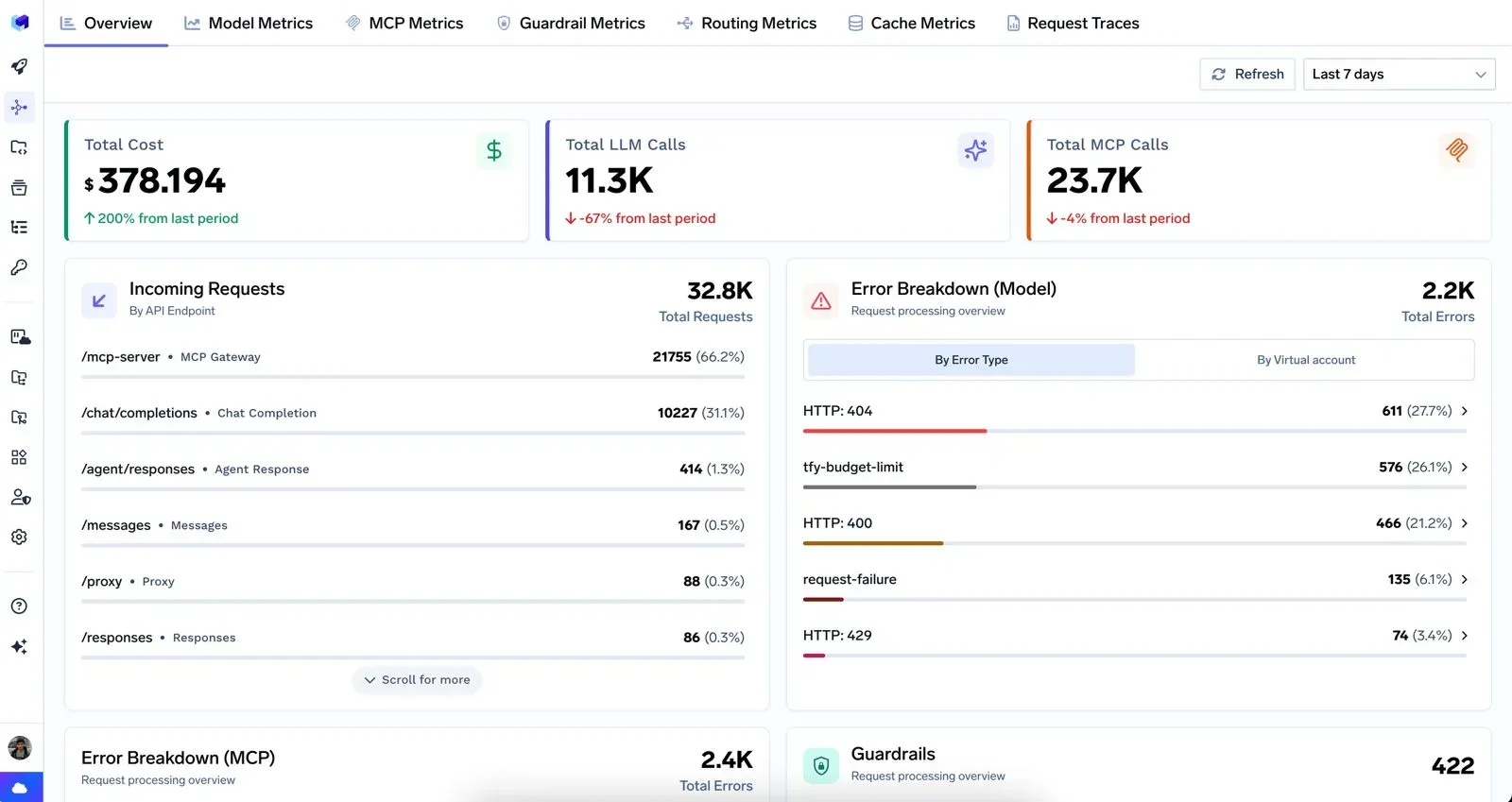
When the orchestrator emits stable graph_id, run_id, and node_id identifiers, these records can be correlated with its execution trace. The orchestrator remains the source of truth for topology; the gateway contributes model, tool, policy, latency, and cost evidence for the operations it observes. See the Metrics Dashboard documentation.
The managed agent runtime: Agentic nodes run loops; other node types — deterministic functions, routers, joins, and human checkpoints — do not. The TrueFoundry Agent Harness is the documented place to run a governed loop, with orchestration, memory, MCP tool access, step-level traces with cost per step, and human approval gates for configured sensitive actions.
Within a graph, these approval gates become something more specific: structural checkpoints — human approval points placed before configured sensitive tool calls, at the edges where consequences concentrate.
Optimization: Node-associated attribution, available for gateway-mediated requests carrying stable identifiers, turns the graph into a tunable system. An expensive node can use a cheaper model through routing; a repeated subtask can benefit from semantic caching; and a flaky model target can use a gateway fallback chain. Retry and recovery behavior for orchestration edges remains the graph runtime's responsibility. These are the same optimization levers covered in our gateway posts, now with a topology to target.
For the team asked this quarter to take a multi-agent graph to production, the requirements compress to seven questions, each spanning both the orchestration layer and the governed execution plane:
Each unanswered item is a plausible incident location.
The following are predictions, not certainties. The terminology will likely evolve: “org graph” and “work graph” may not stick, and competing definitions could emerge within weeks, as they did with loop engineering.
Frameworks will also compete to establish their own interpretation of graph engineering. The more interesting engineering challenges are likely to emerge where the July 18 article's core ideas meet: runtime work-graph changes operating within stable organizational policies. Key questions include who can create a new node, what permissions and context that node inherits, and how side effects are handled when a task is cancelled.
Standards such as A2A and its successors will continue to shape communication between agents. As multi-agent systems move from isolated experiments into shared production environments, enterprise requirements will become more concrete. The questions in this guide's checklist will then move beyond architectural discussion and become procurement criteria.
One principle, however, is likely to hold regardless of which terms survive: paradigms may be born on X and in frameworks, but they grow up in production. Making multi-agent systems work reliably at scale will still require clear ownership, governed execution, observability, cost controls, and well-defined operational boundaries.
Graph engineering is still an emerging discipline, and even the term's origins remain unsettled. TrueFoundry's approach focuses on the enterprise requirements that remain constant as orchestration frameworks evolve: governing model and MCP-tool access, managing agent execution, and maintaining visibility into runtime behavior.
In a multi-agent graph, some nodes call models or MCP tools, while others perform deterministic operations or involve human decisions. TrueFoundry's gateways govern the model requests and MCP tool invocations routed through them, providing policy enforcement, access controls, and operational visibility. These records can be correlated with the orchestrator's own execution data to help enterprises understand what happened across a workflow. The orchestrator remains responsible for defining and managing the graph itself.
For agentic nodes, TrueFoundry Agent Harness provides a managed runtime where agents plan, act, and observe, with support for approvals, sandboxing, and step-level traces. Our loop engineering guide and fleet-scale guide explore how to govern individual agent loops and operate them as a fleet.
Together, these capabilities address two distinct layers of enterprise multi-agent systems: the runtime where individual agents execute and the gateway layer that governs their model and tool interactions. Graph engineering connects these layers through an orchestration structure defined by the enterprise.
Book a demo to see how TrueFoundry works.
TrueFoundry AI Gateway delivers ~3–4 ms latency, handles 350+ RPS on 1 vCPU, scales horizontally with ease, and is production-ready, while LiteLLM suffers from high latency, struggles beyond moderate RPS, lacks built-in scaling, and is best for light or prototype workloads.



No. Knowledge graph engineering structures data — entities and relationships for retrieval and reasoning. Graph engineering in the 2026 multi-agent sense structures the system: heterogeneous nodes, permitted transitions, responsibilities, and the runtime work graph. One architecture can use both.
Production graph engineering spans the orchestrator, application instrumentation, and governed execution plane. The orchestrator records topology and runtime graph state; participating callers propagate graph, run, and node identifiers; and TrueFoundry can apply identity, access policy, budgets, rate limits, guardrails, approvals, records, and metrics to gateway-mediated model and MCP operations.



The latest news, articles, and resources sent to your inbox