


September 21, 2026
|
5 min read


Published: September 21, 2026
Blazingly fast way to build, track and deploy your models!
Building an agent involves more than connecting an LLM to a few tools. You also need to decide how the agent manages state, handles context, calls tools, executes tasks, and determines what to do next.
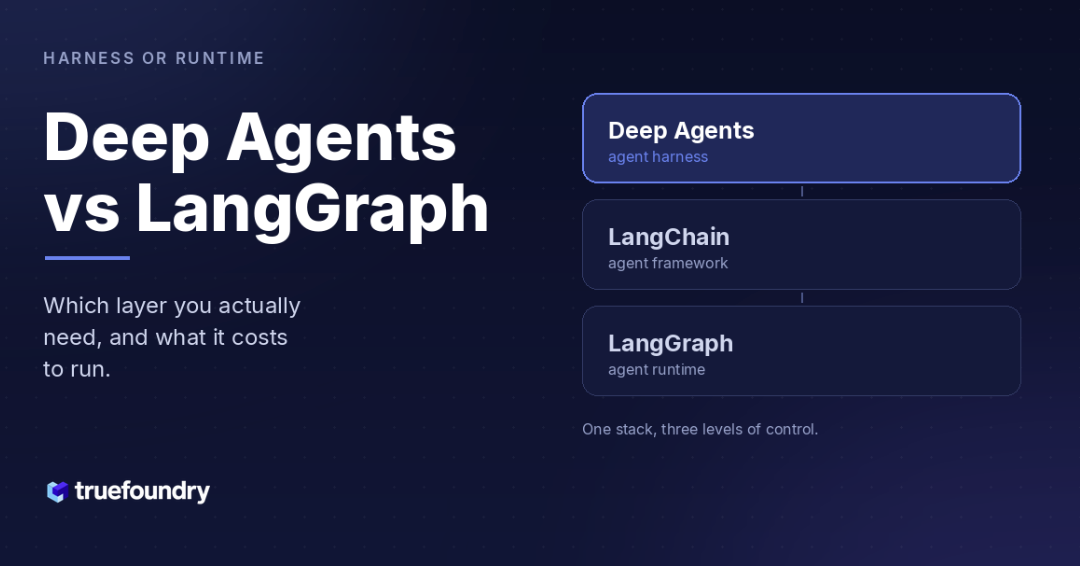
LangGraph and Deep Agents solve these problems at different levels of abstraction. LangGraph gives developers the primitives to define and control an agent's execution flow, while Deep Agents provides a higher-level, pre-built agent harness on top of LangGraph.
Both solve the same underlying problem. A model reasons but cannot act. It will not open a file, call an API, run the code it just wrote, or remember what it decided four turns ago. Something has to sit around the model and close that gap, then keep closing it for as long as the task takes. LangGraph gives you the parts to build that thing. Deep Agents hands it to you assembled.
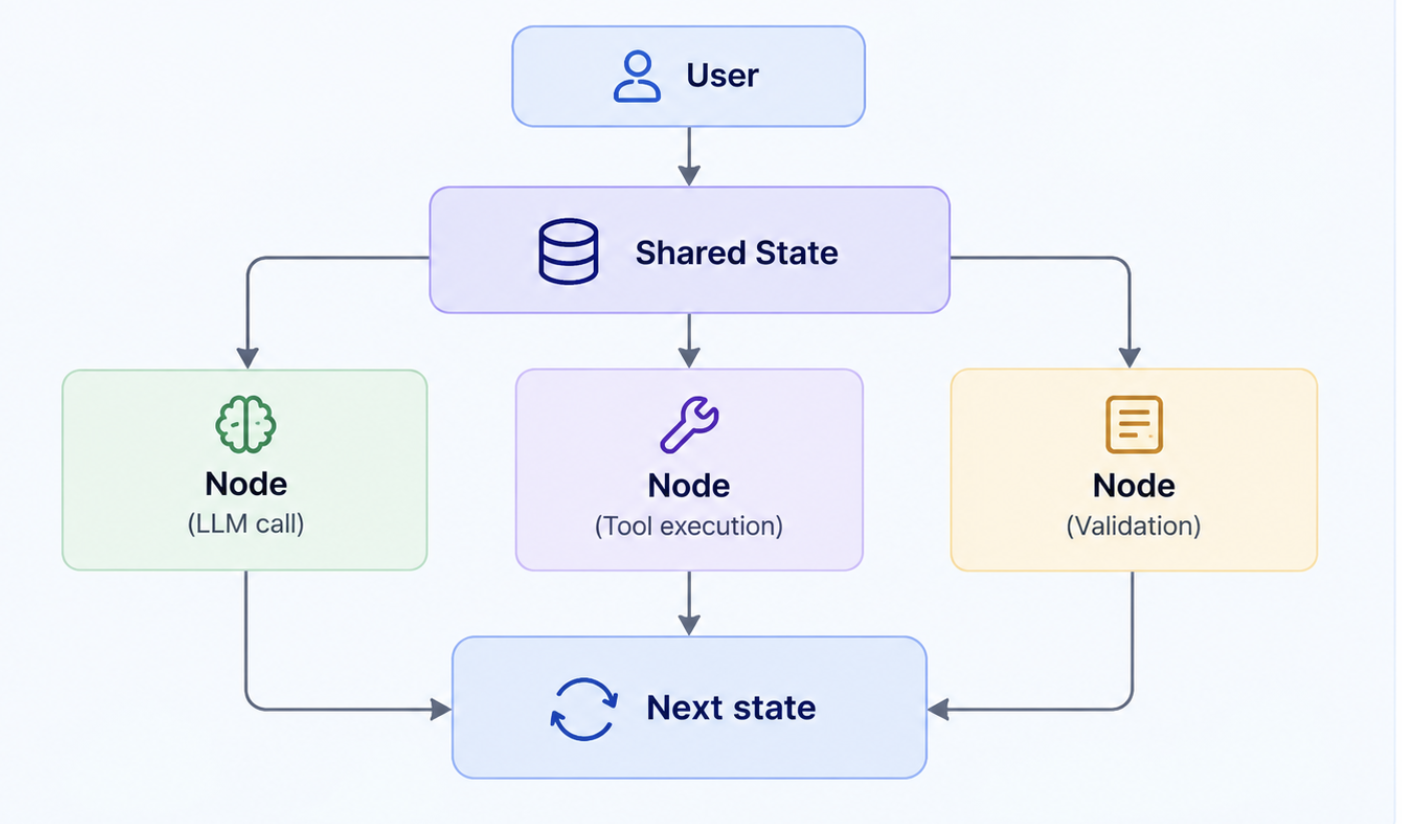
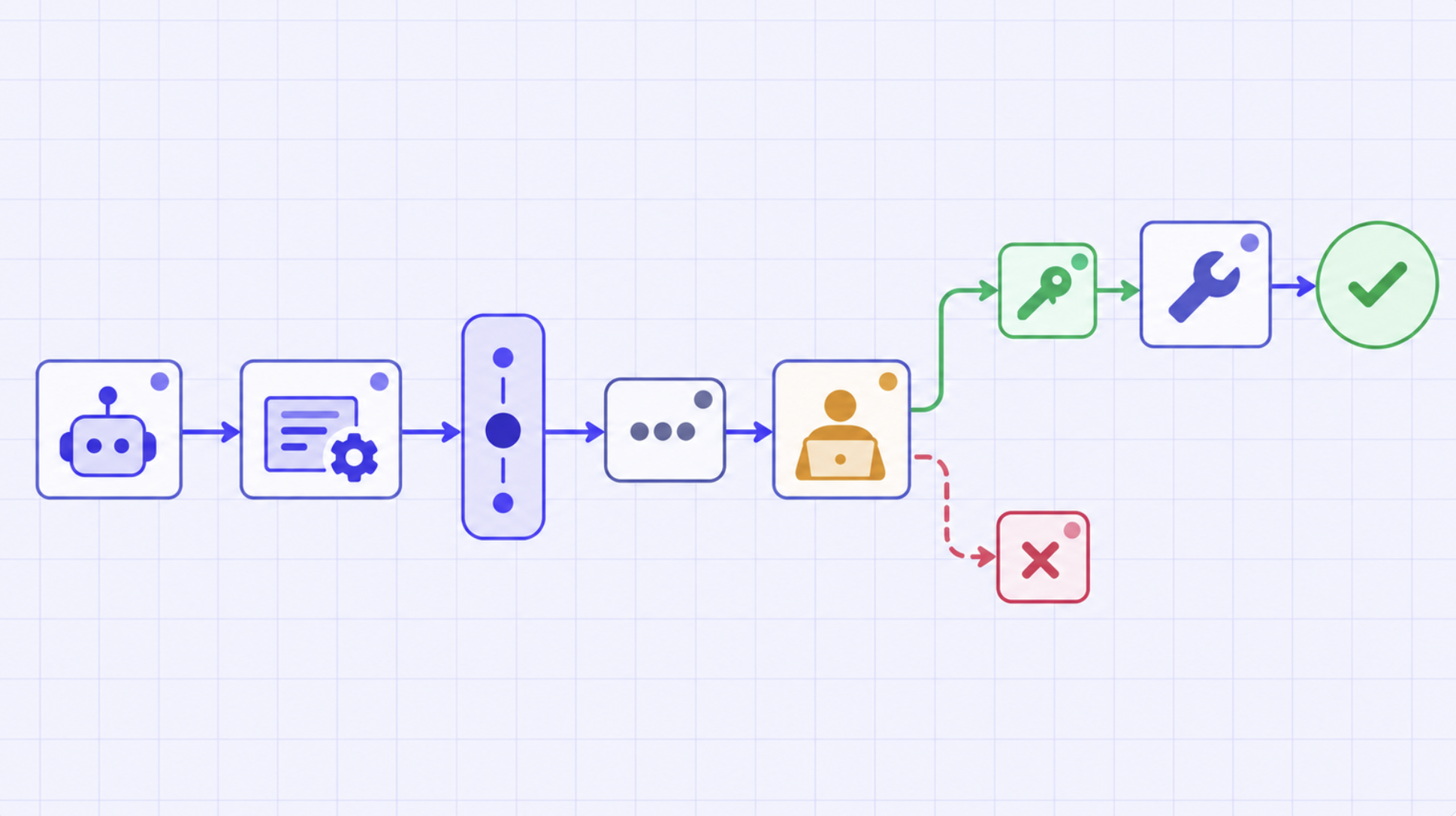
LangGraph is an agent runtime. You model the workflow as a directed graph: nodes are discrete operations, edges define what runs next, and a typed state schema threads through every step. Execution walks your structure until a node returns END.
A LangGraph build usually looks like this:
The checkpointers and interrupts are the genuine differentiators here, and they are why LangGraph ended up underneath almost everything else in the LangChain stack. Both LangChain's create_agent and Deep Agents run on it.
LangChain's own example is a rental application pipeline: extract income and credit history from documents, score against the landlord's criteria, then auto-approve, reject, or escalate borderline cases. Only the first step touches an LLM. The rest is fixed code, and it should stay fixed code.
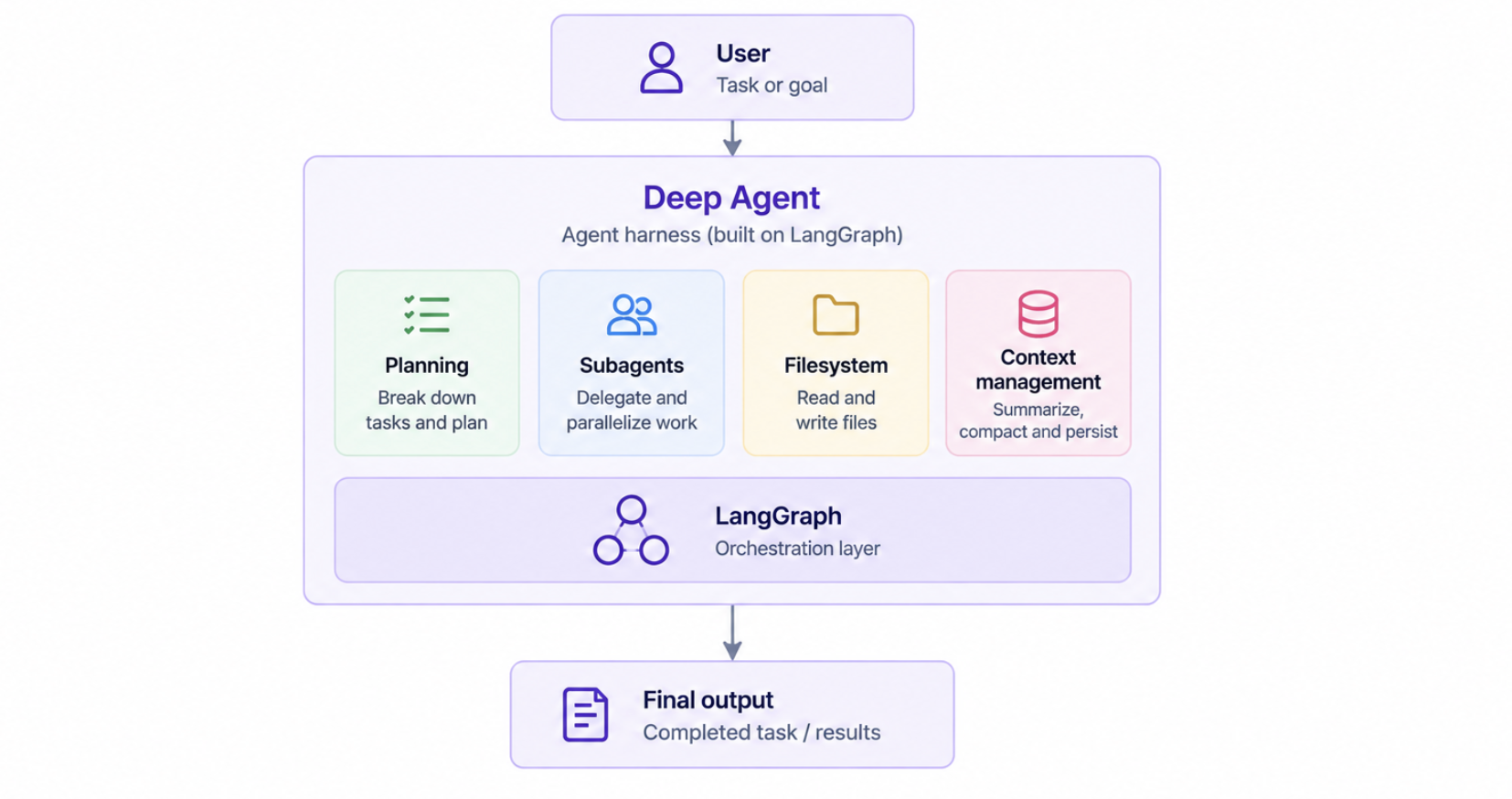
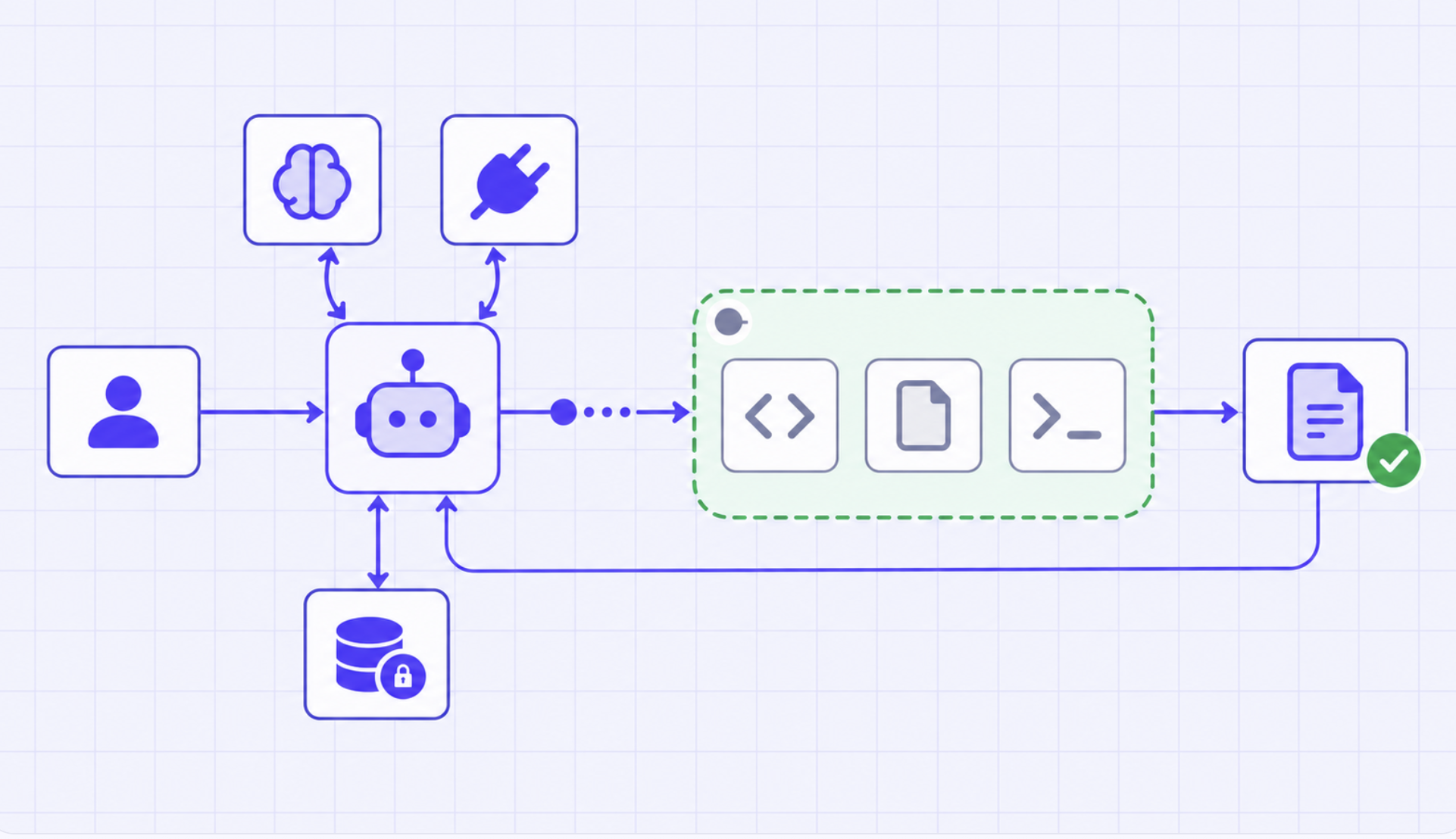
Deep Agents is an agent harness. Same core loop as LangChain's create_agent, but opinionated, with context engineering practices bundled in by default. LangChain describes it as the core agent plus a set of middleware, and underneath, it's still a LangGraph graph.
What ships with it:
You get an agent from create_deep_agent with a model, a set of tools and a system prompt. No graph to author.
The distinction from LangGraph is about who writes the loop. With LangGraph you declare the nodes and conditions, and control flow is yours. With Deep Agents you supply tools and instructions and press go, and the model decides what happens next inside a loop somebody else wrote. If you want the longer version of that line, we wrote it up separately in agent harness vs agent framework.
Both aim at the same outcome, and they sit at different heights in the same stack, which is why "which is better" doesn't resolve. One asks you to design the agent's behaviour. The other decides most of it for you and charges you in tokens for the parts it decided generously.
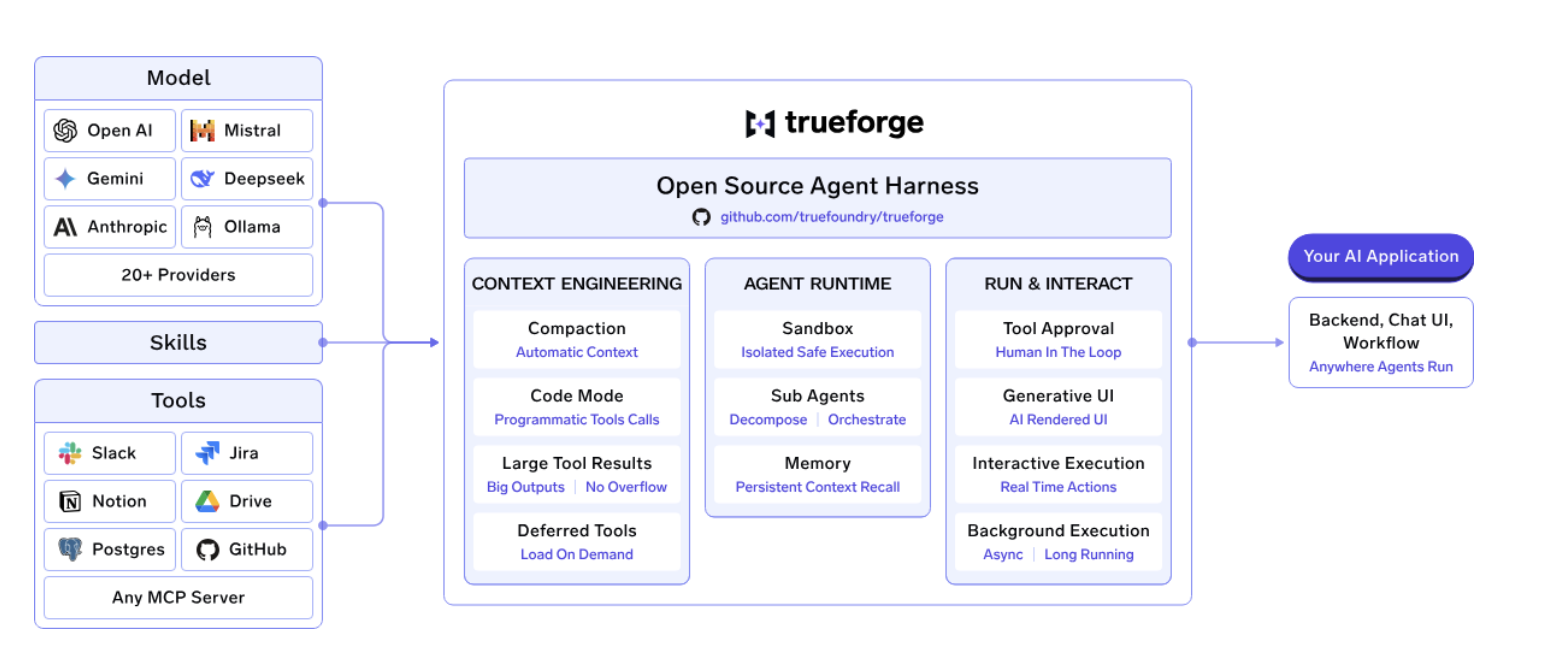
LangChain Deep Agents solves much of the hard work inside an individual agent, including planning, subagents, filesystem tools, skills, memory, and long-running execution. But once you're running agents across multiple teams, the problem shifts from building the agent to operating the fleet.
TrueForge is TrueFoundry's open-source, vendor-neutral agent harness for that runtime layer. It runs the agent loop around the model, including planning, tool calls, context management, approvals, and session state, while letting you bring your own models, MCP servers, and sandbox providers.
You can run it locally with npx @truefoundry/trueforge, or deploy the same harness for a team using Docker Compose or Helm. See the TrueForge documentation.
TrueForge also provides several mechanisms for controlling the amount of context and tool data that reaches the model.
Deferred tool loading means MCP tool schemas load on demand instead of filling the window upfront. Code Mode lets the agent chain several tool calls inside one sandbox script, so only the printed summary enters context rather than every intermediate result. Oversized tool responses get offloaded to a sandbox file and replaced with a path and a preview. Compaction fires at 80% of the model's context length and swaps old history for a structured summary, which is the direct answer to replay. Subagents run with their own clean context and hand back only the result.
The sandbox model is the other lever. Most harnesses wrap the entire session in a container. TrueForge treats the sandbox as a tool and spins one up only when the agent actually needs to execute code, so one server runs many agents at once and turns that never touch code stay cheap.
TrueForge is also structured as a runtime rather than only a library interface.
The core server runs the agent loop and provides streaming, approval gates, subagent delegation, compaction, and persistent sessions. An HTTP API and TypeScript SDK (@truefoundry/trueforge-sdk) expose the same capabilities programmatically. A separate chat UI and UI SDK (@truefoundry/trueforge-ui) can be used directly, themed, or embedded into another product.
This gives teams a deployment surface beyond the Python agent definition itself: the same runtime can power an application, API, or embedded agent experience.
Models, MCP servers and sandbox providers are all bring-your-own. When a cheaper model ships you point at it instead of rewriting the agent, which is how the same benchmark run on GLM-5.2 solved the same ~11 of 14 tasks for $2.90 per run.
The difference between an agent framework and an agent runtime becomes clearer when you compare them on the same workloads. TrueFoundry benchmarked TrueForge and Deep Agents on DevRev's Enterprise-Bench, which consists of 14 cross-system enterprise tasks. Each task requires the agent to plan, call MCP tools across a CRM, project tracker, and document store, combine the results, and return an answer that meets the evaluation rubric. Both harnesses ran the same tasks with the same MCP servers, and answers were scored by a blind LLM judge.
With Opus 4.8 held constant, the two harnesses produced similar task accuracy, but their execution costs were different:
The benchmark shows a relatively small difference in task accuracy, but a much larger difference in execution cost. TrueForge used less than a quarter of the tokens used by Deep Agents and was roughly 2.5x cheaper per run on the same model.
The difference comes largely from how the two runtimes handle orchestration and context. Deep Agents provides capabilities such as planning, a virtual filesystem, and subagents, but these can also add more orchestration and context to each turn. TrueForge takes a leaner approach, using targeted tool calls and context compaction to avoid repeatedly sending large histories and tool responses back to the model. This matters because the cost of an agent is not determined by the model price alone. Two agent systems running the same model can have very different token consumption depending on how they implement planning, tool use, context management, and subagents.
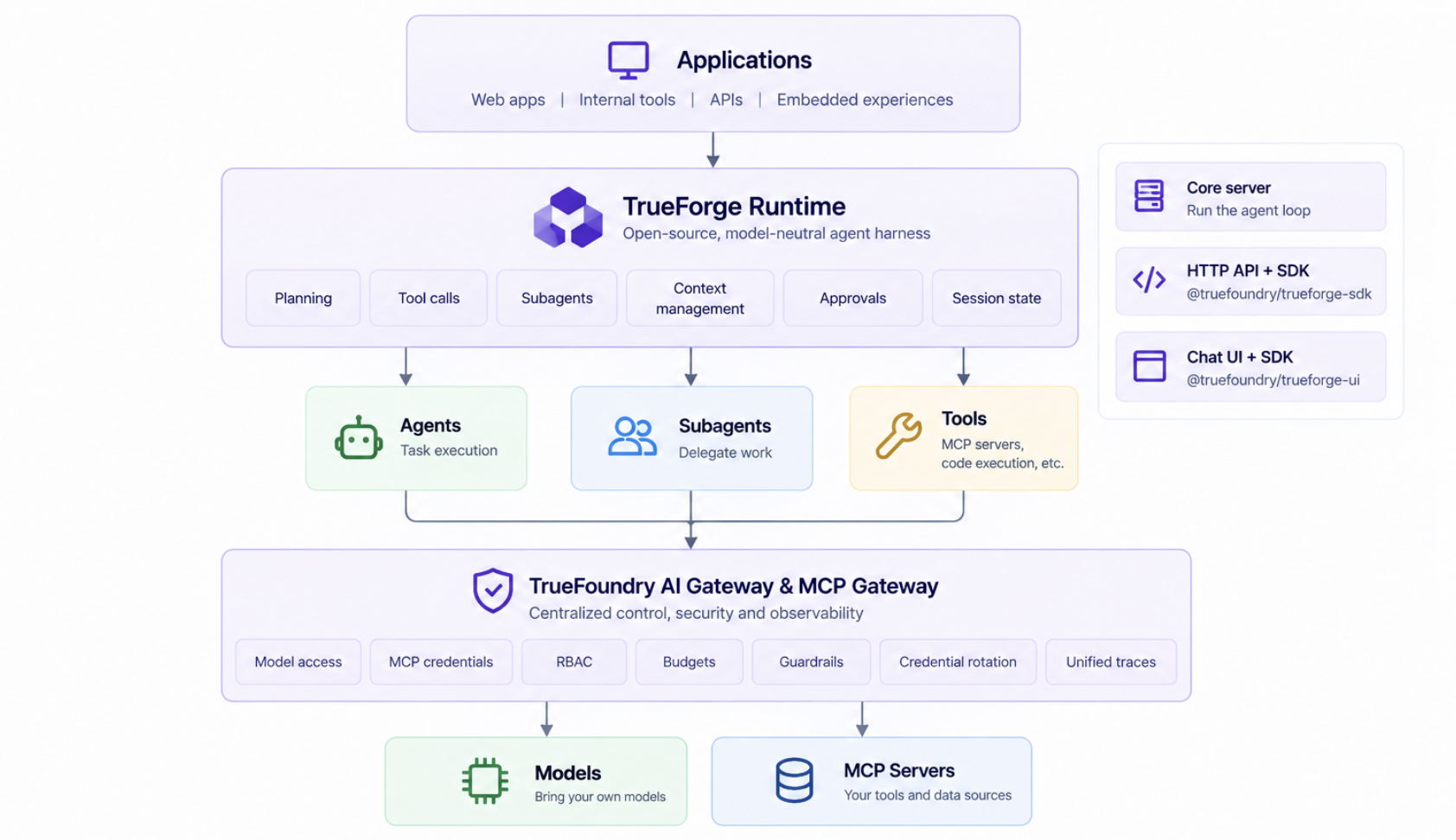
TrueForge can also connect to TrueFoundry's AI Gateway and MCP Gateway to provide the controls that become important once agents are no longer isolated projects, including centralized model access, MCP credentials, RBAC, budgets, guardrails, credential rotation, and unified traces. This moves those concerns out of individual agent definitions and into a shared platform layer.
For teams evaluating Deep Agents for production, the benchmark is a useful reminder that the framework is only one part of the stack. The runtime architecture around the agent can have a significant impact on token usage, latency, and cost. TrueForge is designed to provide that runtime layer while keeping the model and infrastructure choices open.
Reach for LangGraph when the graph's shape is the value. Compliance gates at specific nodes, conditional loops back to earlier stages, a pipeline where only one step should ever touch a model. If you're already on LangGraph and the flow is genuinely graph-shaped, stay.
Reach for a harness when you find yourself hand-building a loop that already exists somewhere. Then the question is only which harness, and that's a context-management question, so read the docs for compaction, offloading and deferred loading before you commit. If nothing mentions them, you're looking at a framework wearing a harness label.
Reach for deepagents specifically if you want LangChain's ecosystem and abstractions and the token profile is acceptable for your workload. Short runs won't feel the difference.
Reach for TrueForge if long runs are your normal case, if you need an HTTP API or embedded UI rather than a library, if you want MIT licensing and no ecosystem commitment, or if the per-run cost has to survive finance asking about it. Our LangGraph alternatives breakdown covers the framework-layer options if that turns out to be the layer you actually need.
And often the answer is both. A framework handles orchestration between agents, or the deterministic workflow a harness-driven agent sits inside. A harness runs the agents themselves. The two failure modes to avoid are using a framework to rebuild a loop you could have inherited, and forcing a harness through a rigid compliance sequence by describing it in a prompt and hoping.
Q: What is the difference between deep agents and LangGraph?
A: LangGraph is an agent runtime and Deep Agents is an agent harness built on top of it. With LangGraph you declare nodes, edges and state and write the control flow yourself. With Deep Agents the loop is already written, along with a filesystem, subagents, skills and memory, so you supply tools and instructions instead. Deep Agents compiles down to a LangGraph graph underneath.
Q: Is Deep Agents a replacement for LangGraph?
A: No, and it can't be, because it runs on LangGraph. A harness gives you a fixed loop that a model drives. If your workflow needs an arbitrary topology, validation gates at named nodes, or conditional loops back to earlier stages, no harness will express that and LangGraph remains the right tool. Plenty of production systems run both at different layers.
Q: Which is cheaper to run, deepagents or another harness?
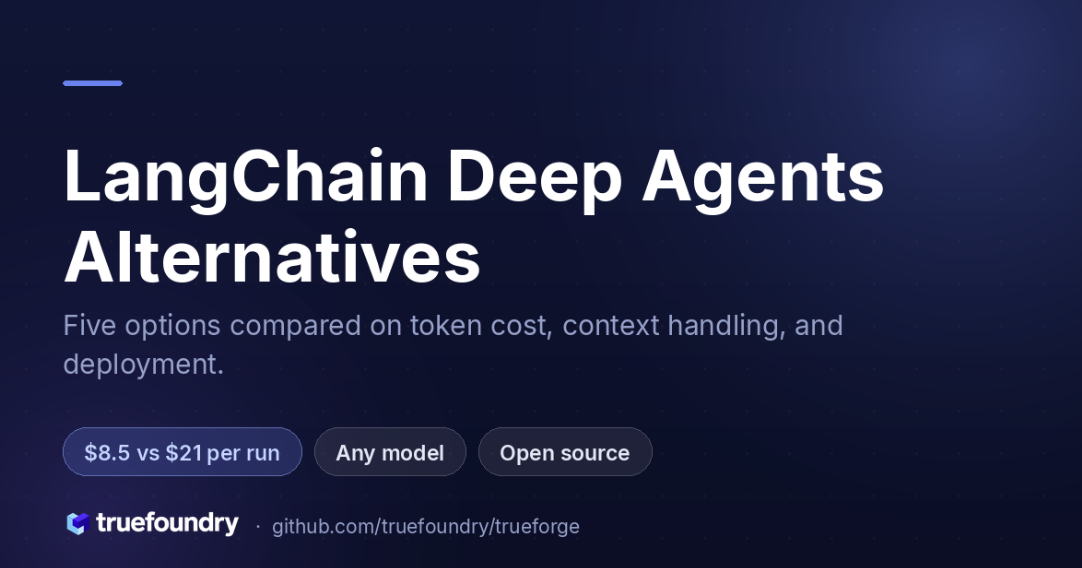
A: On our Enterprise-Bench run, deepagents on Opus 4.8 used 16.5M tokens and $21 per run, against 3.8M tokens and $8.50 for TrueForge on the same model and the same 14 tasks, with accuracy within one task. The gap comes from replaying accumulated context rather than compacting it, plus the scaffolding carried on every turn.
Q: Can I run either of these in my own VPC or on-prem?
A: Yes. Both are self-hostable open source. TrueForge runs from a single npx command locally, or via Docker Compose and Helm for team deployments with Postgres, Redis, replicas and OIDC login. TrueFoundry's managed platform also runs self-hosted, on-prem, air-gapped or hybrid, so no data leaves your domain.
Q: How do I govern models and MCP servers across a lot of agents?
A: Through a gateway layer, once self-managed keys stop scaling. TrueFoundry's AI Gateway puts 1,000+ LLMs behind one OpenAI-compatible API at roughly 3 to 4 ms of added latency and 350+ RPS on a single vCPU, with RBAC, budgets, guardrails and credential rotation, plus OpenTelemetry traces into Grafana, Datadog or Prometheus. Agents built on LangGraph, deepagents or anything else get governed the same way.
Deep agents vs LangGraph comes down to which layer your problem lives at, and you can settle that with one question: does the agent's path have a shape you want to author, or is it discovered as the run goes?
If it has a shape, LangGraph. If it doesn't, you want a harness, and then the differentiator is what that harness does to your context window on turn forty. That's worth measuring before you build on it.
npx @truefoundry/trueforge gets you a running agent in about a minute, or see how TrueForge handles context on long runs.
TrueFoundry AI Gateway delivers ~3–4 ms latency, handles 350+ RPS on 1 vCPU, scales horizontally with ease, and is production-ready, while LiteLLM suffers from high latency, struggles beyond moderate RPS, lacks built-in scaling, and is best for light or prototype workloads.






The latest news, articles, and resources sent to your inbox
.png)
.png)
.png)
.png)
.png)
.png)
.png)
.png)
.png)


