November 14, 2026
|
5 min read


Blazingly fast way to build, track and deploy your models!
Enterprises are moving AI agents into production, and the security reality looks very different from a prototype. Agents don't just answer questions. They call models, use tools, and act on data across many teams and frameworks. Traditional gateway controls answer only part of the security question: authentication, rate limits, and access policies decide whether an agent may act, but not whether an authorized agent has been manipulated. The harder question is this: how do you bring AI gateway security to every model call without rebuilding protection inside every agent?
At TrueFoundry, our approach is to keep the execution layer uniform and let teams plug in the security system they choose. That's why we're announcing an integration between the TrueFoundry AI Gateway and Straiker, bringing agentic AI security into the infrastructure enterprises use to build, deploy, and scale AI applications and AI agents. Platform teams run the gateway, security teams own the policies, and application teams stop rebuilding security in every agent.
The TrueFoundry AI Gateway establishes a single, governed entry point for all model and agent requests. Applications and agents no longer talk directly to model providers. They talk to the gateway, which gives teams access to 2,500+ LLMs through one OpenAI-compatible API and applies routing, rate limits, budgets, and request tracing centrally. With under 3 ms of internal latency, even at enterprise scale, it can sit directly in the production path of every request. That makes the gateway the one consistent place to enforce AI guardrails: built in, from external security providers, or custom.
For security leaders, this is the point where AI protection stops being a per-application project and starts behaving like infrastructure.
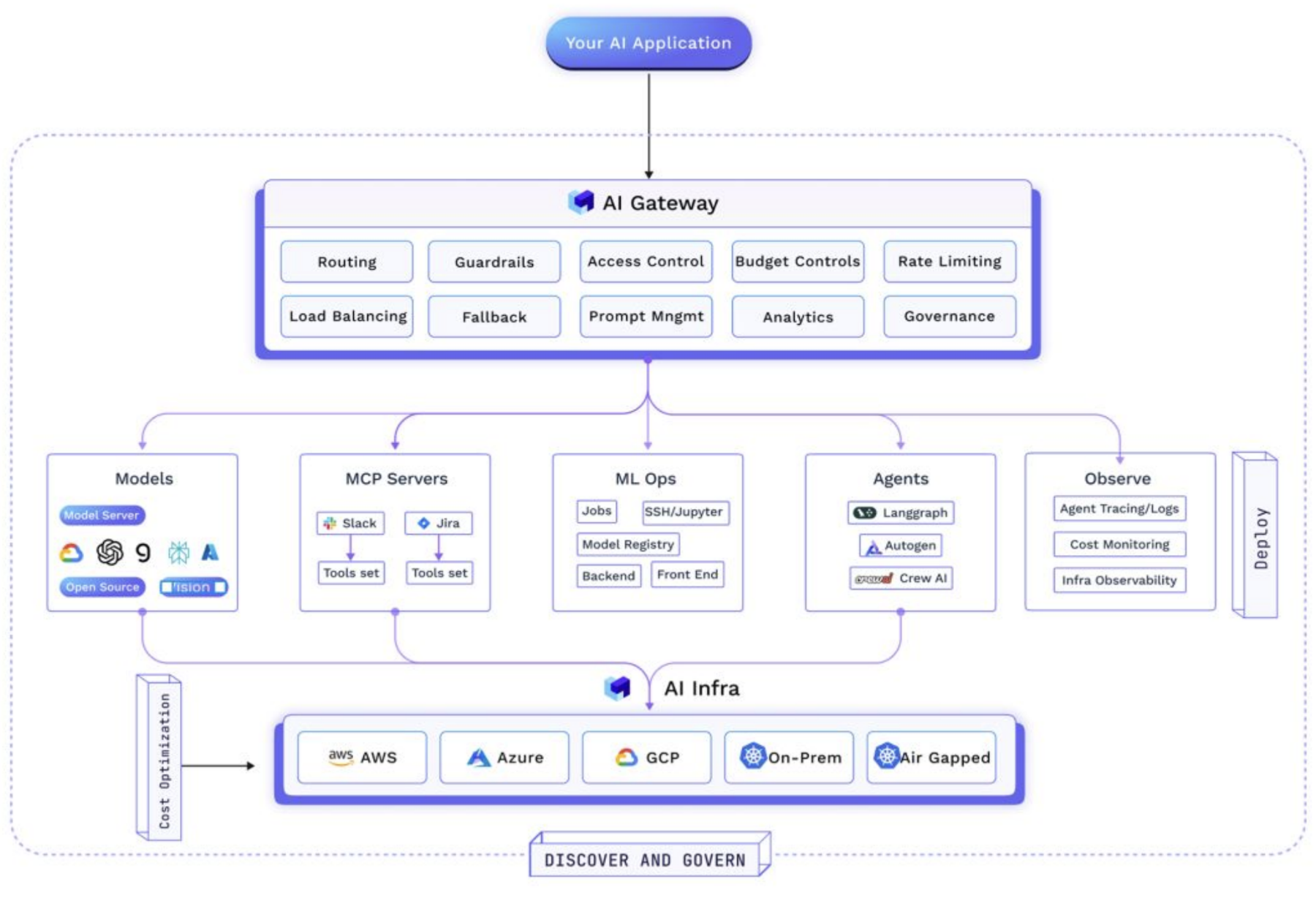
Straiker adds agent-specific security to that control point. Agent attacks rarely fit inside one prompt and response, so Straiker inspects full agentic traces across turns and sessions. This gives its detection layer the context to evaluate what an agent is doing, which resources it is using, and how its behavior changes over time.
Discover AI maps the agentic ecosystem across an organization. For organizations standardizing on TrueFoundry, it adds a security view of what has been deployed and what each agent can reach. Ascend AI tests agents through automated, multi-turn adversarial campaigns, offering remediation plans and benchmarking against today's most popular compliance frameworks. Defend AI inspects live agent activity and applies policy to prompts, responses, tool calls, and multi-step workflows. It maps an enterprise's agentic blast radius across identities, surfaces, agents, models, and tools, and monitors and blocks malicious and suspicious activity. Straiker's published benchmark reports a 98.1% true-positive rate and a 0.7% false-positive rate across its evaluated threat categories. Straiker is designed for low-latency runtime enforcement, with detection generally completing in less than 300 milliseconds.
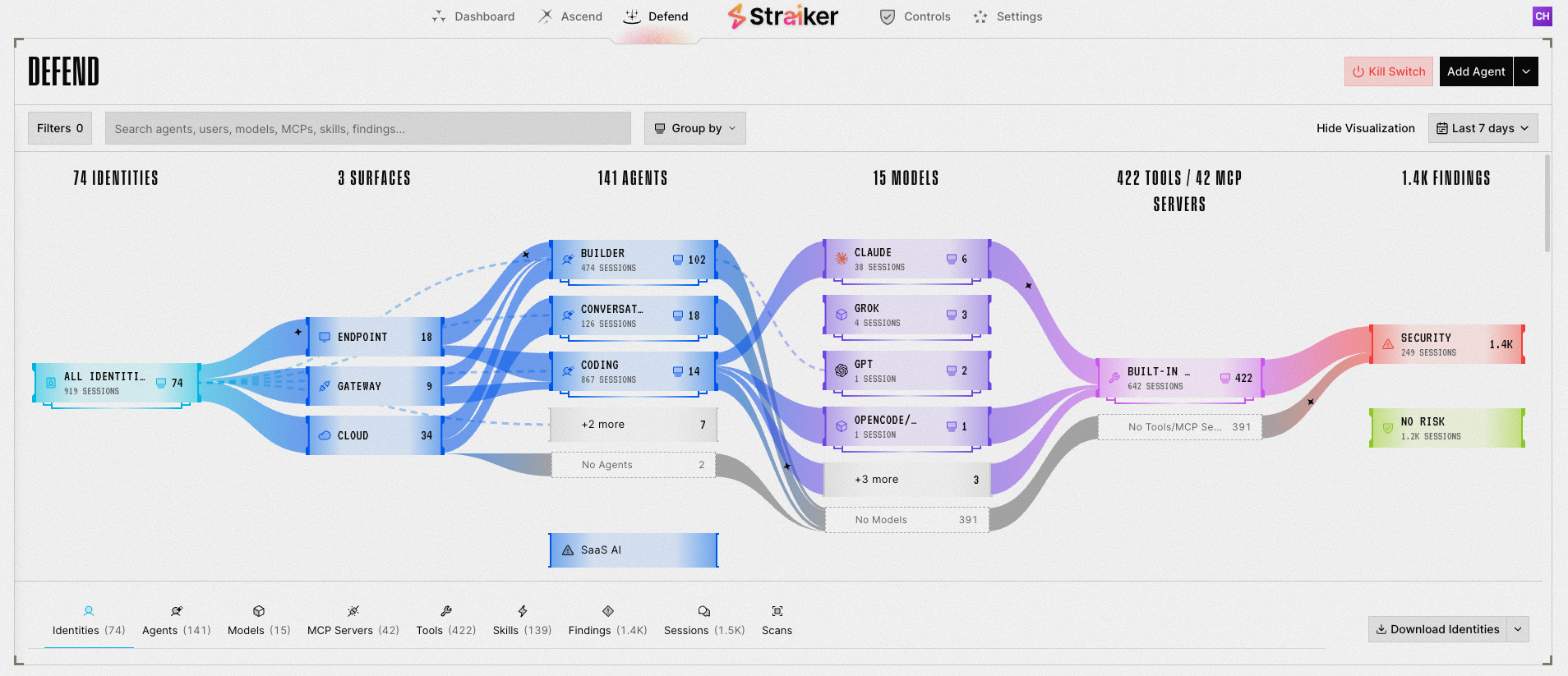
Blocking one request may not stop a compromised agent. Straiker's Agentic Kill Switch provides an escalation path from transaction-level blocking to agent-level containment: depending on the deployment, teams can revoke tool access, suspend sessions, freeze memory, or take an individual agent or agent fleet offline.
Both companies already support shared enterprise customers, including Automation Anywhere and Comcast.
An AI gateway is a natural enforcement point for production AI security, yet most teams still approach AI agent security one application at a time. They typically end up choosing between two unsatisfactory options:
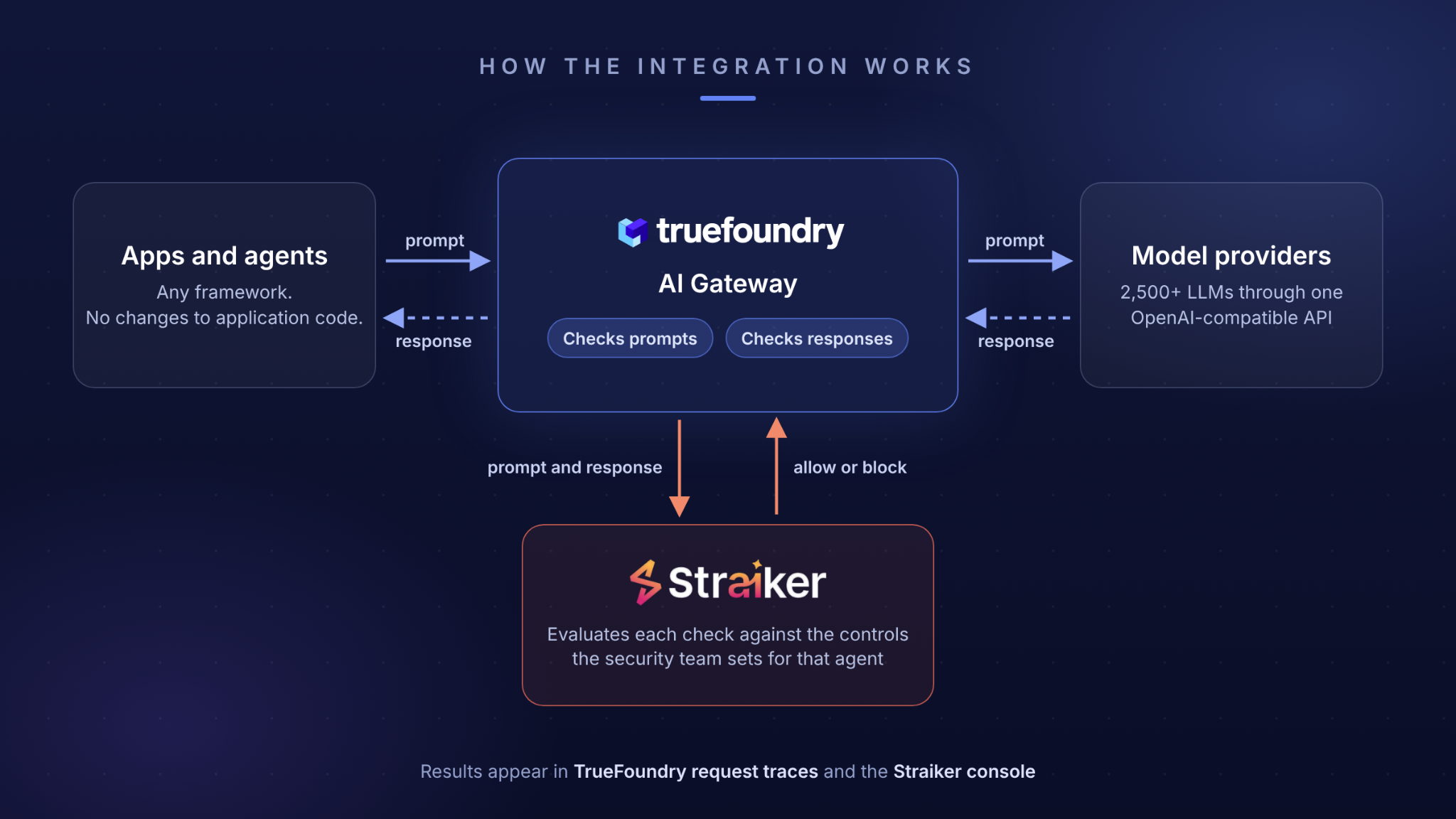
On the TrueFoundry side, Straiker plugs into the AI Gateway as a guardrail that checks prompts on the way in and model responses on the way out. There is no adapter or wrapper service to build or run. Teams can turn it on for specific models or across traffic through a gateway policy, with no changes to application code.
On the Straiker side, security teams set the controls for each agent in the Straiker console. Straiker evaluates prompts and responses against those controls and returns an allow or block verdict, which the gateway enforces, giving applications runtime AI protection where their traffic already flows.
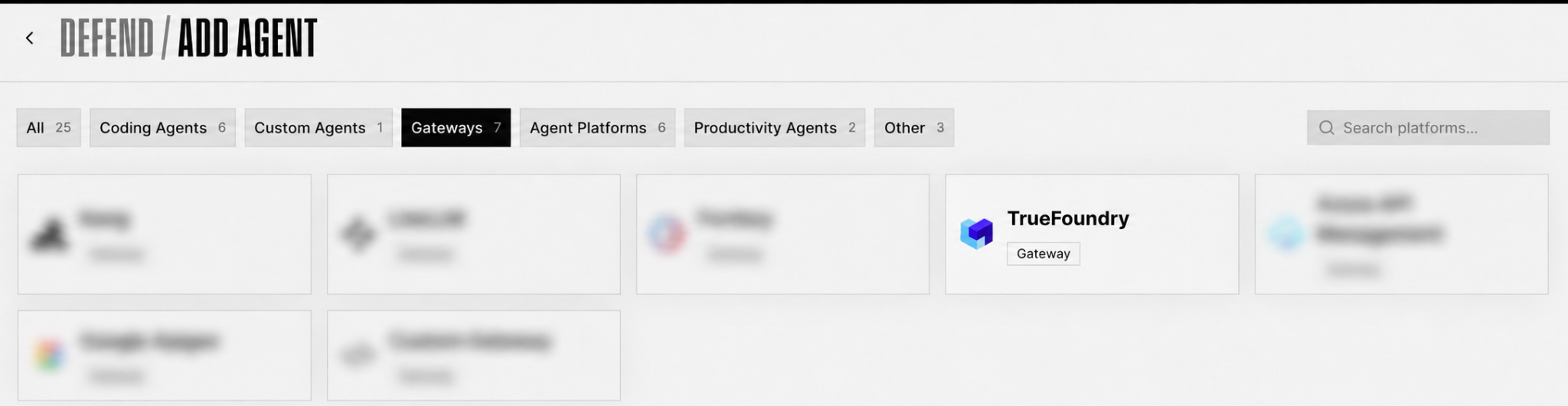
In Straiker Defend, add an agent and select TrueFoundry from the available gateway integrations. Security teams set that agent's controls in the Straiker console, including which detections to block, and review every finding there. Straiker's TrueFoundry integration guide covers this side of the setup.
In the TrueFoundry AI Gateway, add Straiker as a guardrail on the models or traffic you want to protect. Start in Audit mode to see what Straiker flags without blocking anything, then switch to Enforce once the results look right. Each check also appears in TrueFoundry's request traces, so platform and security teams review the same activity. The TrueFoundry Straiker guide walks through each step.
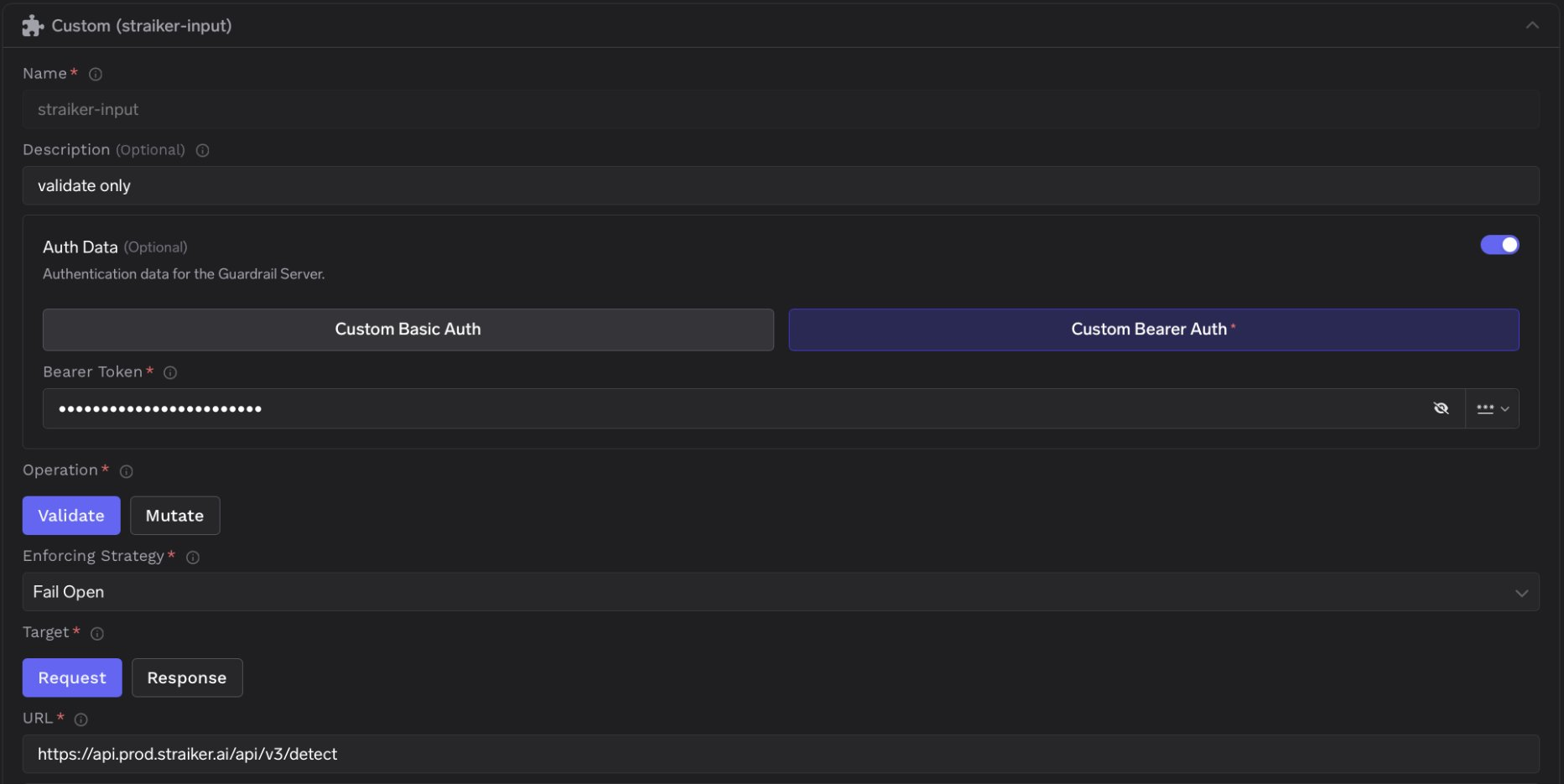
For AI and security leaders, the TrueFoundry and Straiker integration makes AI gateway security part of the same layer that already routes and governs production AI. Platform teams keep one governed gateway, security teams own the policies, and application teams ship agents without rebuilding protection in each one. The partnership is intentionally composable: TrueFoundry routes and enforces, Straiker evaluates and decides. Teams can build, deploy, and govern with TrueFoundry, then discover, test, defend, and contain with Straiker.
See Straiker in action or book a TrueFoundry AI Gateway demo.
AI gateway security means enforcing security controls at the AI gateway, the shared layer every model and agent request passes through, so prompts and responses are checked in one place instead of in every application. With TrueFoundry and Straiker, that layer enforces Straiker's agent-specific verdicts.
No. The TrueFoundry AI Gateway connects to Straiker directly, so there is no adapter or wrapper service to build or run.
Any LLM the TrueFoundry AI Gateway routes to, from OpenAI, Anthropic, and Google models to self-hosted ones. Guardrails work the same way for every model behind the gateway, so a single Straiker guardrail can cover all of them.
Yes. TrueFoundry runs in your own VPC, on-premises, air-gapped, or across hybrid and multi-cloud setups.
Yes. TrueFoundry is built to meet SOC 2, HIPAA, and GDPR standards, with SSO, role-based access control, and immutable audit logging built in.
TrueFoundry AI Gateway delivers ~3–4 ms latency, handles 350+ RPS on 1 vCPU, scales horizontally with ease, and is production-ready, while LiteLLM suffers from high latency, struggles beyond moderate RPS, lacks built-in scaling, and is best for light or prototype workloads.






The latest news, articles, and resources sent to your inbox