Blank white background with no objects or features visible.

Hello, EMEA! TrueFoundry is growing our footprint across Europe, the Middle East, and Africa. Read more. →

AI Agent Lifecycle Management: Identity-First Security

By Ashish Dubey

Updated: November 9, 2026

Published: November 3, 2026

AI agent lifecycle management is the practice of governing an AI agent’s identity and access across its entire life — from provisioning a unique identity with least-privilege scopes, through authenticated and authorized operation, to clean deprovisioning that revokes credentials and retires the identity — so no agent is ever over-privileged, unattributed, or left running after it should be gone.

In one line: treat each agent like a managed employee — onboard it with an identity, govern it while it works, and offboard it cleanly. Identity is the thread through every stage.

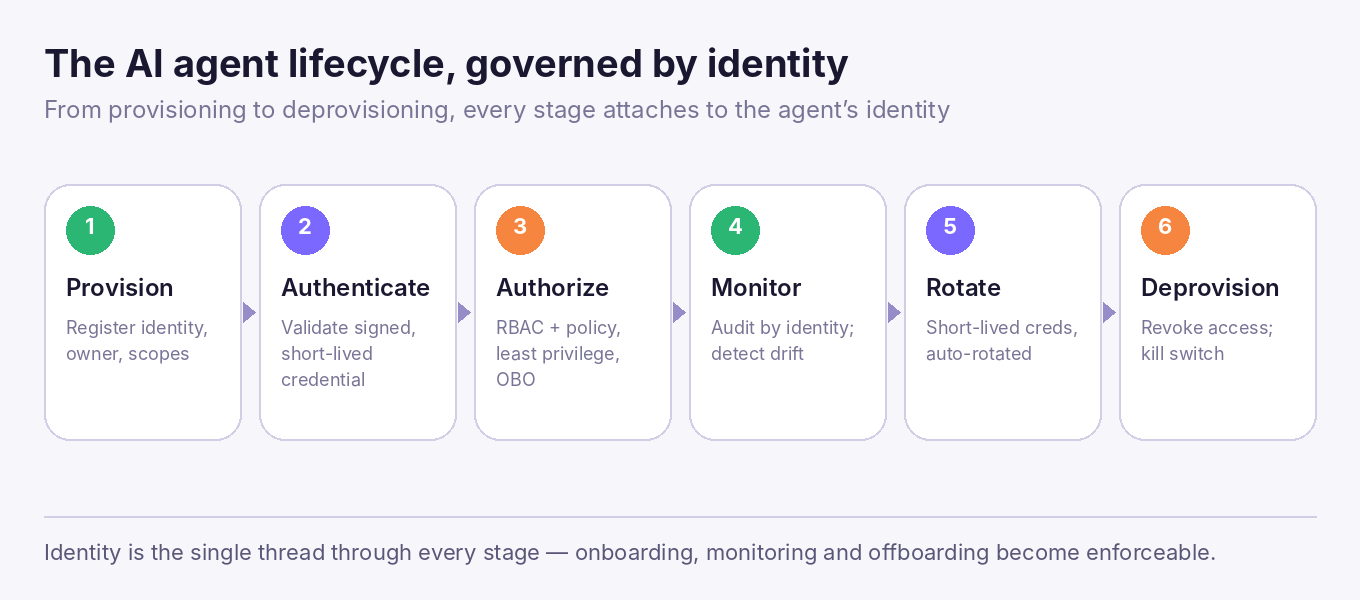
The six stages of the AI agent lifecycle, each anchored on the agent’s identity.

Why does agent lifecycle management matter?

Agents are created and retired far faster than human accounts, and without lifecycle discipline the mess compounds:

  • Orphaned agents. An agent that is no longer used but still holds valid credentials is a standing, unattended attack surface.
  • Privilege creep. Agents accumulate scopes over time and rarely give them back, drifting far from least privilege.
  • No attribution. If agents are spun up on shared keys with no registered identity, you cannot tell which agent did what — during an incident or an audit.
  • No offboarding. Without a deprovisioning step, retiring an agent cleanly (revoke, rotate, remove access) simply never happens.

Making identity the organizing principle fixes this: if every agent has a registered identity, every lifecycle stage has something concrete to attach to. It’s the operational backbone of AI agent governance.

Govern the full agent lifecycle — from provisioning to kill switch — in one place.

The AI agent lifecycle, stage by stage

StageWhat happensIdentity-first control
1. Provisioning / onboardingAgent is created and registeredIssue a unique identity, assign an owner and least-privilege scopes
2. AuthenticationAgent proves who it is on each requestValidate short-lived, signed credentials at a control point
3. AuthorizationAgent acts within policyEnforce least-privilege and on-behalf-of delegation per action
4. Monitoring & driftAgent runs in productionAudit every action against the agent’s identity; flag anomalies and scope drift
5. RotationCredentials refreshKeep credentials short-lived and rotate automatically
6. Deprovisioning / offboardingAgent is retiredRevoke credentials, remove access, retire the identity — no orphans

Why “identity-first”?

You can try to manage agents by network rules, keys or app config — but those are proxies. Identity is the only thread that runs cleanly through every stage: you provision an identity, authenticate an identity, authorize an identity, audit by identity, and deprovision an identity. Anchor the lifecycle on the agent’s identity and onboarding, monitoring and offboarding all become concrete, enforceable steps instead of best-effort intentions. This is the same per-agent identity principle behind non-human identity for every agent.

The role of an agent registry

Lifecycle management needs a single source of truth: a registry of every agent, its owner, purpose, scopes, credentials and status. The registry is what makes it possible to answer “which agents exist, who owns them, and what can they do?” — and to drive provisioning and deprovisioning from one place. We cover this in depth in what is an AI agent registry.

Stop orphaned, over-privileged agents before they accumulate.

Common lifecycle failures (and the fix)

  • Orphaned agents → deprovision on a schedule and on owner/offboarding events; the registry flags agents with no recent activity or no owner.
  • Privilege creep → review scopes periodically; least-privilege at provisioning plus per-action authorization limits accumulation.
  • Unattributed actions → no agent runs without a registered identity; every action is logged against it.
  • Stale credentials → short lifespans and automatic rotation mean a leaked credential is useful only briefly.

These risks map directly to the broader agentic AI security risks.

How TrueFoundry supports the agent lifecycle

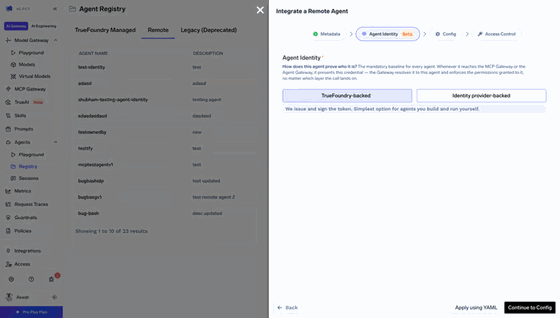
TrueFoundry anchors the whole lifecycle on agent identity through its agent registry — the single inventory of every agent, its owner and its authority.

The TrueFoundry agent registry: every agent registered with an identity, owner and defined authority — the source of truth for provisioning and deprovisioning.

At provisioning, each agent is registered with its owner, business purpose, defined authority (the tools, data domains and actions it may use, and the principals it may act for) and a review cadence. In operation, it is authenticated and authorized at the gateway on every request. For ongoing governance, TrueFoundry adds four lifecycle controls drawn straight from how it models agent governance:

  • Certification — periodic, owner-signed review that grants still match the agent’s purpose.
  • Runtime drift detection — behaviour is compared against defined authority, and the gateway can constrain, suspend or notify the owner when an agent drifts.
  • Decision evidence — every action is logged against the agent’s identity (user, agent, delegation chain, tool, policy decision, scopes, status) for attribution and audit.
  • Kill switch — a single agent’s identity can be revoked instantly, with no effect on any other agent.

Credentials are kept short-lived and rotated, with per-hop scoped tokens so a leaked credential is useful only briefly. At deprovisioning, revoking the identity cleanly removes the agent’s access everywhere — no orphans. All of this deploys as SaaS, in your VPC, on-prem or air-gapped.

Onboard, govern and offboard every agent by identity — from one control plane.

Try now.

One gateway for all your models, MCP servers, and agents. No credit card needed.

Start free
Table of Contents

One Gateway for Every LLM, Agent and MCP Server

Book a 30-min with our AI expert

Book a Demo

The fastest way to build, govern and scale your AI

Book Demo
Summarize with
ChatGPT logo by OpenAI
Perplexity AI logo
Blurry red snowflake on white background, symmetrical frosty design with soft edges and abstract shape.

Discover More

No items found.
November 14, 2026
|
5 min read

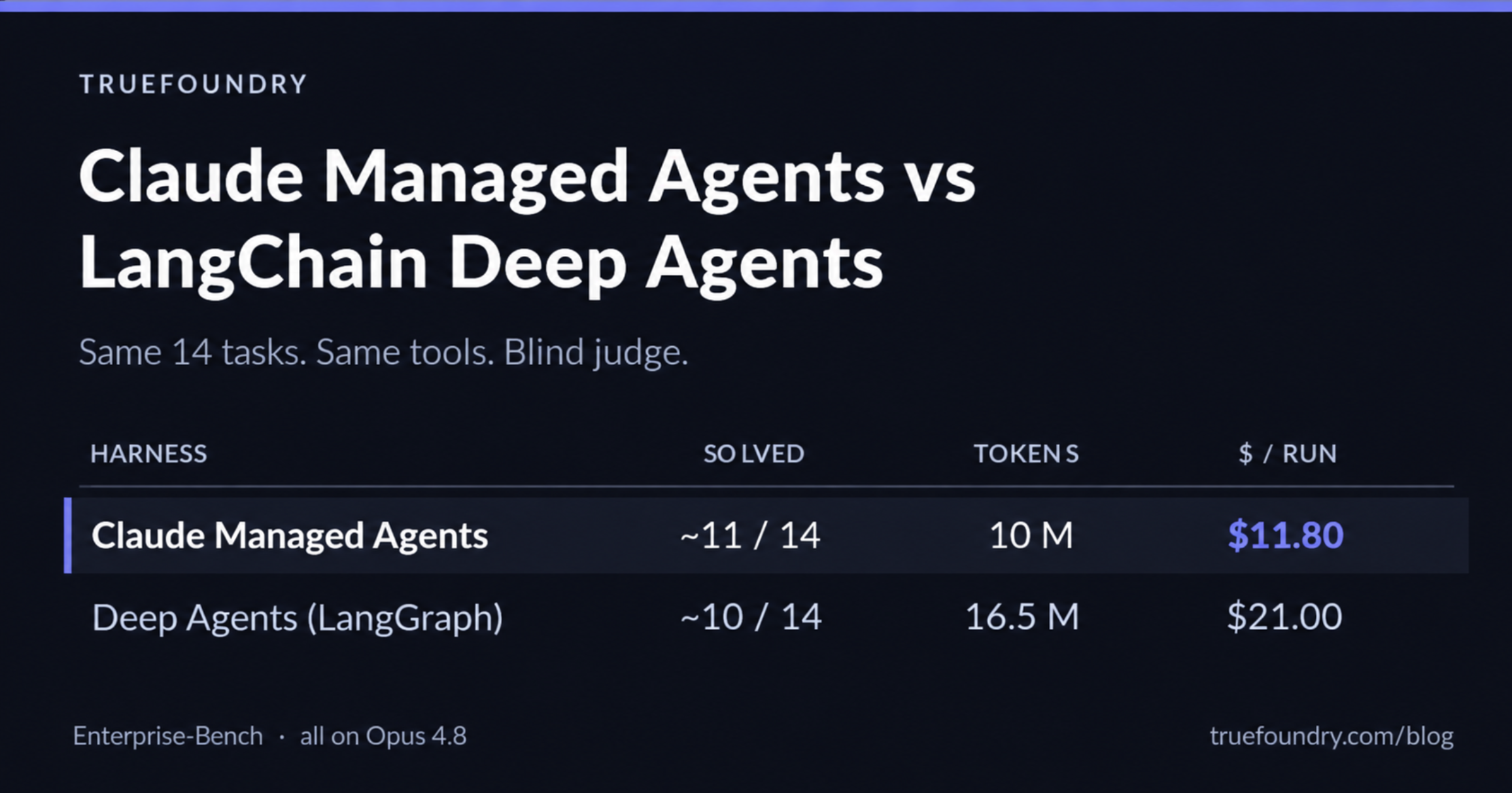
Claude Managed Agents vs LangChain Deep Agents: Which Agent Harness Should You Choose?

TrueForge
November 13, 2026
|
5 min read

Claude Managed Agents vs TrueForge: Which Agent Harness Should Enterprise Teams Run in 2026

TrueForge
 What is an LLM Gateway
November 13, 2026
|
5 min read

What Is an LLM Gateway? How It Works, What to Look For, and When You Need One

Engineering and Product
November 13, 2026
|
5 min read

How to Host Helm Charts on GitHub Pages and Publish Them on Artifact Hub (2026 Guide)

Engineering and Product
No items found.

Recent Blogs

Black left pointing arrow symbol on white background, directional indicator.

Frequently asked questions

What is the difference between ALM and SDLC?

Application Lifecycle Management (ALM) manages an application's entire lifecycle, including planning, development, testing, deployment, maintenance, and retirement. Software Development Lifecycle (SDLC) focuses specifically on the processes involved in building and maintaining software. While SDLC is a component of ALM, ALM covers broader activities such as collaboration, governance, and lifecycle oversight.

What are the 5 stages of Agent Lifecycle Management?

The five key stages of AI Agent Lifecycle Management are provisioning, authentication, authorization, monitoring, and deprovisioning. These stages ensure every AI agent has a unique identity, receives appropriate access, operates within defined permissions, and is monitored throughout its lifecycle. Credential rotation and access reviews further strengthen security and governance.

How do you manage the AI agent lifecycle?

Managing the AI agent lifecycle requires maintaining a centralized agent registry, assigning unique identities, enforcing least-privilege access, and authenticating every request. Organizations should continuously monitor agent activities, detect permission drift, rotate credentials, and revoke access when agents are retired. This identity-first approach improves security, accountability, and governance across production AI environments.

Why is identity important in AI agent lifecycle management?

Identity is important because it establishes accountability and control over every AI agent throughout its lifecycle. A unique identity enables organizations to authenticate agents, enforce permissions, track actions, and audit activities. It also helps prevent orphaned agents, privilege creep, and unattributed operations while ensuring credentials and access can be securely revoked when an agent is retired.

What is the difference between AI agent lifecycle management and traditional identity lifecycle management?

Traditional identity lifecycle management primarily focuses on managing human accounts, including onboarding, access permissions, and offboarding. AI agent lifecycle management extends these principles to autonomous, non-human identities that interact with tools, data, and systems. It additionally requires runtime monitoring, automated credential rotation, behavioral drift detection, and per-action authorization to secure autonomous operations.

What is AI agent lifecycle management?

It is the practice of governing an AI agent’s identity and access across its whole life — provisioning a unique identity with least-privilege scopes, authenticating and authorizing it in operation, monitoring and rotating credentials, and deprovisioning it cleanly when retired — so agents never become orphaned or over-privileged.

Why is identity-first security important for agents?

Identity is the single thread that runs through every lifecycle stage. Anchoring provisioning, authorization, audit and deprovisioning on each agent’s identity turns lifecycle management into concrete, enforceable steps and prevents orphaned, unattributed or over-privileged agents.

What is an orphaned agent?

An orphaned agent is one that is no longer used or owned but still holds valid credentials and access. It is a standing, unattended attack surface. Lifecycle management prevents orphans by deprovisioning agents on schedule and on owner-offboarding events, driven from an agent registry.

How often should agent credentials be rotated?

Keep agent credentials short-lived and rotate them automatically rather than on a fixed long interval. Short lifespans mean a leaked credential is useful only briefly, which is far safer than long-lived keys that must be manually rotated.

How does an agent registry help with lifecycle management?

An agent registry is the single source of truth for every agent — its owner, purpose, scopes, credentials and status. It lets you answer which agents exist and what they can do, and it drives provisioning and deprovisioning from one place, which is what makes clean onboarding and offboarding possible.

Take a quick product tour
Start Product Tour
Product Tour