November 14, 2026
|
5 min read


Blazingly fast way to build, track and deploy your models!
Give an autonomous agent access to your tools and you immediately face a question your IAM was never designed for: when the agent reads a Zendesk ticket or queries a database, who did that? There are three usual answers, and all three are wrong.
In each case the audit trail is incomplete, authorization is coarse, and policy cannot tell a human action from an autonomous one. Agent identity fixes this by making the agent a first-class principal — one that can act as itself or on behalf of a user. For the broader picture, see what AI agent identity is and AI agent governance.
On-behalf-of delegation is a token that carries two subjects. Built on the RFC 8693 token-exchange pattern, the resulting token sets sub to the user and act to the agent — “this user, as acted for by this agent.” The permissions on that token (scp) are the intersection of what the user may do and what the agent is allowed to do, so an agent can never widen a user’s reach.
For a chain of agents, the act claims nest: a data agent acting for a research agent acting for a user. Every hop is recorded, so the full delegation path is visible in the audit log rather than flattened into one actor.
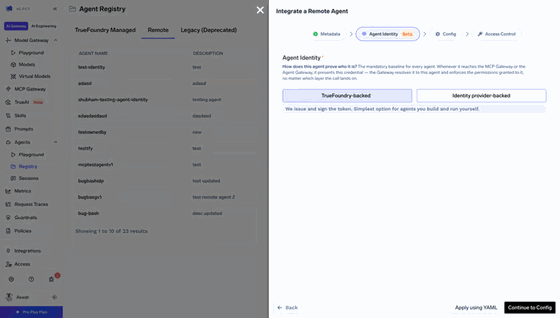
In TrueFoundry, an agent’s identity is created when you register it — each registered agent has exactly one identity, and it can be TrueFoundry-backed (the Gateway issues and signs the token) or identity-provider-backed by Okta or Microsoft Entra. The identity means the same thing either way; only the issuer differs.
Every request to the Gateway then carries two bearer tokens:
Authorization: Bearer <USER_TOKEN>
x-tfy-agent-authorization: Bearer <AGENT_TOKEN>
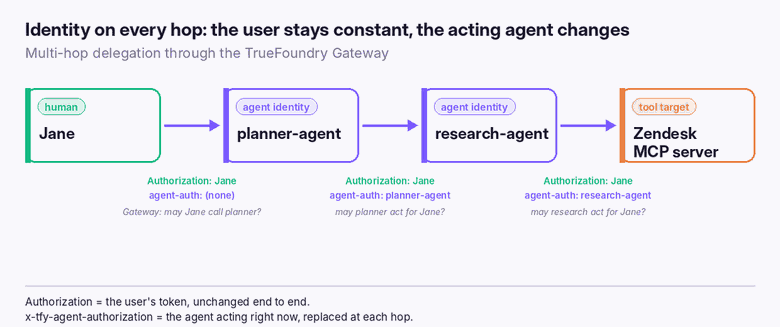
The Authorization header is the user’s SSO token and passes through unchanged from end to end. The x-tfy-agent-authorization header is the agent acting right now, and each agent replaces it with its own identity before calling the next hop. If the agent header is absent, the request is just an ordinary user call, authorized on the user’s permissions alone. The same header pair works across all three surfaces — the LLM Gateway (/api/llm/chat/completions), the MCP Gateway (/mcp/<server>/server) and the Agent Gateway (/agent/<agent-name>).
Delegation is not open-ended. It is bounded by the collaborators on the agent’s Access Control step, which carry two roles:
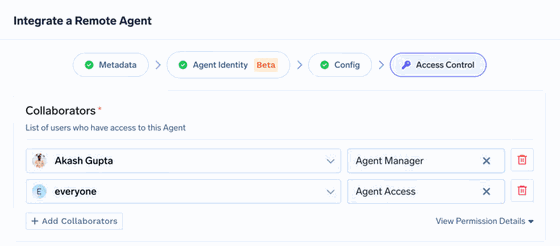
Collaborators can be a user, a team, or a virtual account — so non-human workloads can delegate too. This is the rung that stops an agent from quietly acting for anyone in the org: delegation only works for identities that explicitly granted it.
Being allowed to act for a user is one permission. Being allowed to reach a given tool is another — and both must hold. On an MCP server’s collaborators list, agents appear alongside users and teams, with their own roles: MCP Server User (call tools) and MCP Server Manager (administer).
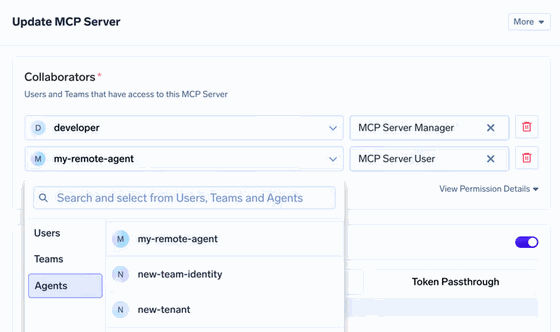
In a YAML manifest the same grants use subject prefixes, so intent is explicit:
collaborators:
  - subject: user:jane@acme.com
    role_id: mcp-server-user
  - subject: agent:research-agent
    role_id: mcp-server-user
Separating the two grants is what makes least-privilege real: an agent your user can act through still cannot touch a tool it was never added to. It mirrors the authorization model we cover in what MCP authorization is and fine-grained authorization.
The clearest way to see the model is to follow one request. Jane asks a planner agent, which delegates to a research agent, which calls a Zendesk MCP server. The user token never changes; the agent token does, and the Gateway checks each hop on its own grants.
Each agent is authorized only on its own grants — it never inherits its caller’s reach. The outbound side is unchanged: the MCP server’s existing auth (OAuth2, a shared API key, or token passthrough) keeps working without reconfiguration. All the Gateway adds is resolving the (user, agent) pair and authorizing it.
x-tfy-agent-authorization token can be impersonated. Keep it out of source control and out of anything the model can read.act claims are lost and your audit log cannot reconstruct who did what. Preserve the delegation chain hop by hop.A support-automation team runs a planner agent that fans out to specialist agents, one of which reads tickets from Zendesk. They want three things: the human requester on every action, the specific agent that acted, and no agent able to reach a tool it was not explicitly granted.
Authorization and the agent token in x-tfy-agent-authorization; let each agent swap in its own.The honest limit: this governs who may act for whom and reach what. It does not replace the MCP server’s own outbound credentials — those stay where they are, which is exactly why adoption does not require re-plumbing your tools.
403, naming the refused principal and reason — a user missing an Agent Access grant is rejected for delegated calls even when they could reach the target directly.Under the two-header model, the question of who performs the token exchange has three answers, set by the agent’s identity type. They trade convenience against where the trust and the secrets live.
In managed credentials, the agent’s OAuth client is registered in the IdP and TrueFoundry stores its credentials as secrets, then performs the exchange with the user’s token as the subject token and caches and refreshes the result. In federated token, the agent does the exchange outside TrueFoundry and sends the finished OBO token, which the gateway validates with jwks_uri, issuer, audience, and an agent_claim (default act.sub) before matching it to the registry — a failed match returns 403. In virtual account, the caller sends two tokens, Authorization: Bearer <virtual-account-token> and X-TFY-User-Token: <user-sso-token>, and the user context is carried by TrueFoundry’s own outbound auth rather than an IdP-issued OBO token; servers that specifically require standard RFC 8693 tokens should use one of the other two modes.
Resolving the (user, agent) identity is step one, not the whole story. Once the pair is known, the request runs a short evaluation before anything reaches the tool, and every layer can only narrow access:
agent:<agent-name>).This is why delegation is safe by construction: the OBO token’s own scope is already the intersection of user and agent permissions, and then four independent grants each have to agree before the call goes through. Tightening any one — removing the user’s collaborator role, dropping the agent, trimming the tool list, or adding a Cedar forbid — tightens the delegated call. The full audit line records the user, the agent, the identity mode, the delegation chain, the server and tool, the RBAC and Cedar decisions, the scopes used, and the status.
An agent that borrows a user’s token or hides behind a service account is a gap waiting to be found — by an auditor, or by an attacker. Agent identity closes it by making the agent a principal in its own right, and on-behalf-of delegation lets that principal act for a specific user while carrying both identities forward, hop after hop.
The mechanics are deliberately small: two headers, two kinds of grant, and an authorization check at the gateway. The user token stays constant, the acting agent changes, and every tool call answers both questions at once — which user, and which agent. That is what makes an autonomous system auditable instead of merely functional.
TrueFoundry AI Gateway delivers ~3–4 ms latency, handles 350+ RPS on 1 vCPU, scales horizontally with ease, and is production-ready, while LiteLLM suffers from high latency, struggles beyond moderate RPS, lacks built-in scaling, and is best for light or prototype workloads.






The latest news, articles, and resources sent to your inbox