> ## Documentation Index
> Fetch the complete documentation index at: https://www.truefoundry.com/llms.txt
> Use this file to discover all available pages before exploring further.
# AWS Claude Platform
> Configure and use Claude Platform on AWS models through TrueFoundry's AI Gateway with SigV4 or API key authentication
**AWS Claude Platform** (Anthropic's **Claude Platform on AWS**) gives you the full Anthropic platform — the Messages API, Files API, prompt caching, extended thinking, and beta features — accessed through your AWS account. Unlike [Amazon Bedrock](/docs/ai-gateway/aws-bedrock), where AWS operates the inference stack, **Anthropic operates Claude Platform on AWS**. AWS provides the authentication layer (SigV4 or API key), IAM-based access control, and billing through AWS Marketplace.
**AWS Claude Platform vs AWS Bedrock** — both let you call Claude through AWS, but they are different integrations:
* **AWS Claude Platform** (this page): Anthropic-operated, uses the Claude API surface (`/v1/messages`), model IDs like `claude-sonnet-4-6`, base URL `aws-external-anthropic.{region}.api.aws`, and requires a **workspace ID**.
* **[AWS Bedrock](/docs/ai-gateway/aws-bedrock)**: AWS-operated, uses Bedrock Converse / InvokeModel, model IDs like `anthropic.claude-sonnet-4-5-20250929-v1:0`.
If you need AWS to be the sole data processor (FedRAMP, HIPAA-ready), use [AWS Bedrock](/docs/ai-gateway/aws-bedrock) instead.
### Prerequisites
Before adding the provider account, complete this **one-time AWS setup**. See Anthropic's [Claude Platform on AWS](https://platform.claude.com/docs/en/build-with-claude/claude-platform-on-aws#set-up-your-account) docs for the full flow.
In the [AWS Console](https://console.aws.amazon.com/), open the **Claude Platform on AWS** service page and choose **Sign up**. This provisions an Anthropic organization tied to your AWS account and sets up the AWS Marketplace subscription.
The Claude Platform on AWS gateway calls `sts:GetWebIdentityToken` server-side to mint a token it forwards to Anthropic. This STS capability is **disabled by default** on every AWS account. Enable it once per account:
```bash theme={"dark"}
aws iam enable-outbound-web-identity-federation
```
If the response says it is `already enabled`, you're good to go.
Without this step, **every request fails** with `"Outbound web identity federation is disabled for your account"`. This is the single most common setup error.
From the AWS Console **Workspaces** page, create a workspace. Workspaces are **bound to a single AWS region** — the region you pick here must match the region you configure on the provider account.
Copy the workspace ID; it has the format `wrkspc_` (for example, `wrkspc_01AbCdEf23GhIj`). You'll need it when adding the account.
### Adding Models
This section explains the steps to add AWS Claude Platform models and configure the required access controls.
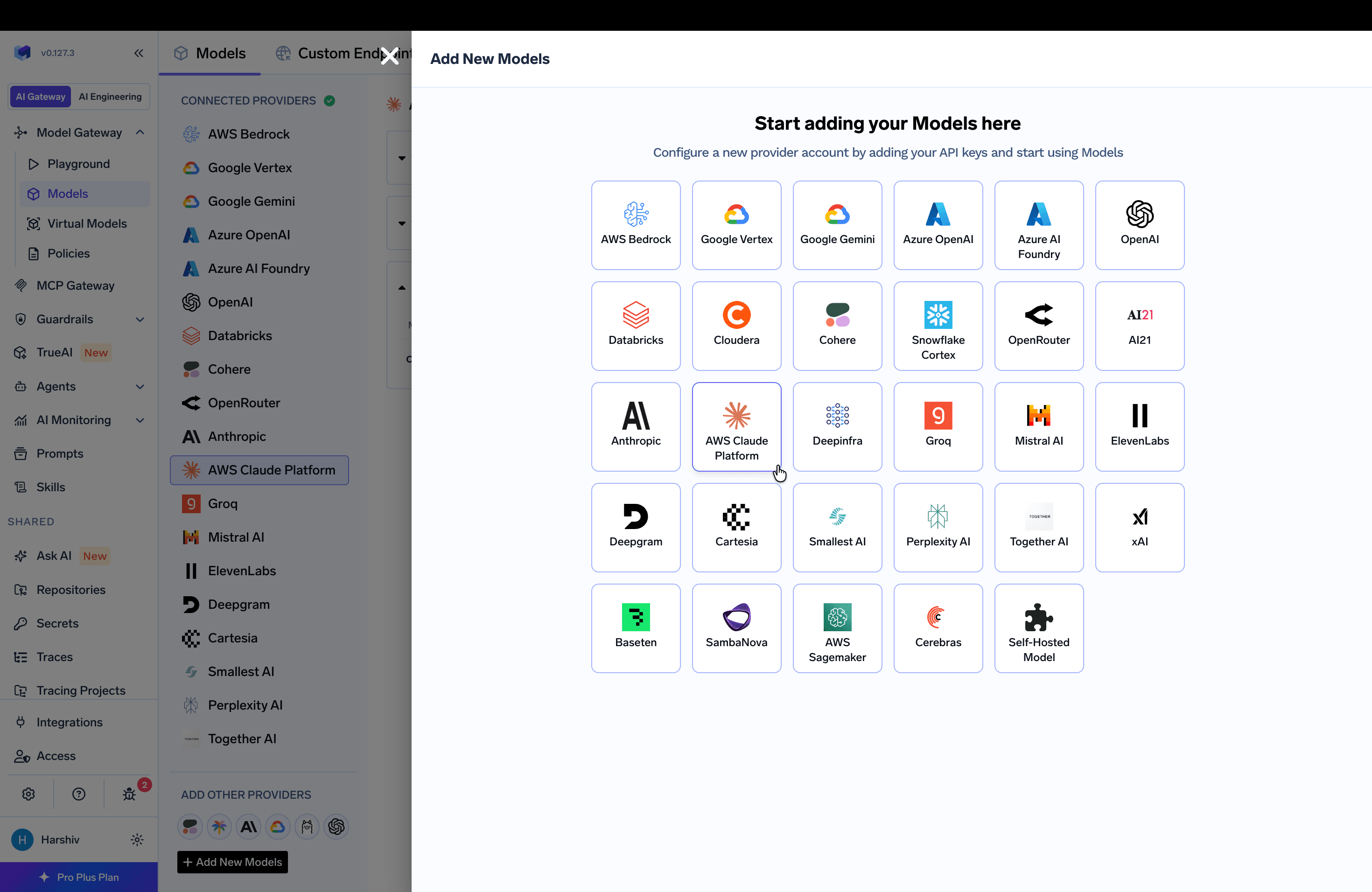
From the TrueFoundry dashboard, navigate to `AI Gateway` > `Models` and select `AWS Claude Platform`.
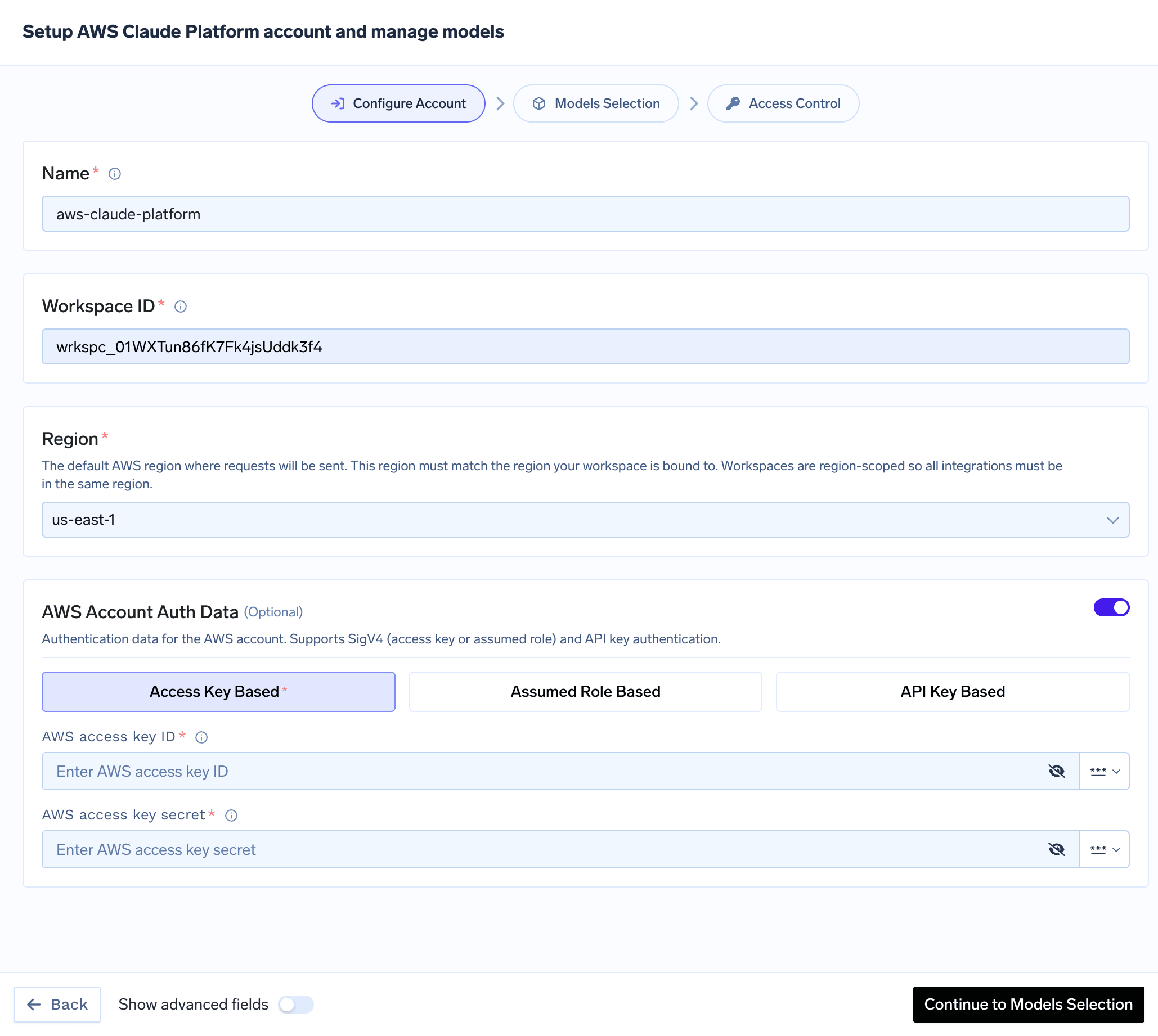
 Give a unique name for the account which will be used to refer to it later in the models. The models in the account are referred to as `@providername/@modelname`. Add collaborators to your account — you can decide which users/teams have access to the models (**User Role**) and who can add/edit/remove models (**Manager Role**). Read more about access control [here](/docs/ai-gateway/gateway-access-control).
Provide the following so the gateway can reach your workspace:
* **Workspace ID** — the `wrkspc_...` ID from the [prerequisites](#prerequisites). It is sent on every request as the `anthropic-workspace-id` header.
* **Region** — the default AWS region for requests. **This must match the region your workspace is bound to**, since workspaces are region-scoped.
* **Authentication** — how the gateway authenticates to Claude Platform on AWS. Three methods are supported: **AWS Access Key / Secret**, **Assumed Role** (both use SigV4), and **API Key**.
Give a unique name for the account which will be used to refer to it later in the models. The models in the account are referred to as `@providername/@modelname`. Add collaborators to your account — you can decide which users/teams have access to the models (**User Role**) and who can add/edit/remove models (**Manager Role**). Read more about access control [here](/docs/ai-gateway/gateway-access-control).
Provide the following so the gateway can reach your workspace:
* **Workspace ID** — the `wrkspc_...` ID from the [prerequisites](#prerequisites). It is sent on every request as the `anthropic-workspace-id` header.
* **Region** — the default AWS region for requests. **This must match the region your workspace is bound to**, since workspaces are region-scoped.
* **Authentication** — how the gateway authenticates to Claude Platform on AWS. Three methods are supported: **AWS Access Key / Secret**, **Assumed Role** (both use SigV4), and **API Key**.
 Claude Platform on AWS authorizes every request through AWS IAM. The SigV4 service name and IAM action namespace is `aws-external-anthropic` (actions look like `aws-external-anthropic:CreateInference`). You attach a policy to the IAM principal (user or role) the gateway uses.
You can choose one of two approaches for the IAM policy.
#### Option A — Quickstart (full access)
The fastest path is to attach the AWS-managed **`AnthropicFullAccess`** policy to your principal. It grants every Claude Platform on AWS action across all workspaces and covers **both** SigV4 and API key authentication, so you don't have to reason about individual actions.
AWS ships five managed policies for common access patterns:
| Managed policy | Use it for |
| -------------------------------------- | -------------------------------------------------------------------------------------------------------------------------------- |
| **`AnthropicFullAccess`** | Everything (recommended quickstart). Covers all auth modes, inference, files, and batches. |
| `AnthropicReadOnlyAccess` | Read-only visibility (no inference). |
| `AnthropicInferenceAccess` | Narrowest policy sufficient for inference. **Does not** grant file create/delete, so it will not cover the Files API on its own. |
| `AnthropicLimitedAccess` | A constrained subset for limited workloads. |
| `AnthropicSelfHostedEnvironmentAccess` | Self-hosted Managed Agents sandboxes. |
See [IAM actions for Claude Platform on AWS → Managed policies](https://platform.claude.com/docs/en/api/claude-platform-on-aws-iam-actions#managed-policies) for the exact actions each one grants.
#### Option B — Least-privilege (production hardening)
For production, attach a scoped policy granting only the actions the gateway uses, restricted to your workspace ARN. The workspace ARN follows this format:
```text theme={"dark"}
arn:aws:aws-external-anthropic:{region}:{account-id}:workspace/{workspace-id}
```
The per-operation actions below authorize the actual API routes the gateway calls and are needed for **both** SigV4 and API key authentication:
| Operation | IAM action | Resource |
| ---------------------------------------------- | -------------------------------------------------- | -------------------- |
| Chat / Messages | `CreateInference` | workspace ARN |
| Count tokens | `CountTokens` | workspace ARN |
| List / get models | `ListModels`, `GetModel` | workspace ARN |
| Files (upload / list / get / content / delete) | `CreateFile`, `ListFiles`, `GetFile`, `DeleteFile` | workspace ARN |
| Get workspace | `GetWorkspace` | workspace ARN |
| List workspaces | `ListWorkspaces` | `*` (account-scoped) |
`GetFile` covers both file metadata and file `/content`. Account-scoped actions like `ListWorkspaces` must use `"Resource": "*"`; specifying a workspace ARN on them has no effect.
```json IAM policy (least-privilege) lines theme={"dark"}
{
"Version": "2012-10-17",
"Statement": [
{
"Sid": "WorkspaceScopedActions",
"Effect": "Allow",
"Action": [
"aws-external-anthropic:CreateInference",
"aws-external-anthropic:CountTokens",
"aws-external-anthropic:ListModels",
"aws-external-anthropic:GetModel",
"aws-external-anthropic:GetWorkspace",
"aws-external-anthropic:CreateFile",
"aws-external-anthropic:ListFiles",
"aws-external-anthropic:GetFile",
"aws-external-anthropic:DeleteFile"
],
"Resource": "arn:aws:aws-external-anthropic:us-west-2::workspace/"
},
{
"Sid": "AccountScopedActions",
"Effect": "Allow",
"Action": "aws-external-anthropic:ListWorkspaces",
"Resource": "*"
}
]
}
```
**If you authenticate with an API key**, also add `aws-external-anthropic:CallWithBearerToken` to the `"Resource": "*"` (account-scoped) statement:
```json lines theme={"dark"}
{
"Sid": "AccountScopedActions",
"Effect": "Allow",
"Action": [
"aws-external-anthropic:ListWorkspaces",
"aws-external-anthropic:CallWithBearerToken"
],
"Resource": "*"
}
```
`CallWithBearerToken` is a route-less, authentication-layer action that does **not** bind to a workspace ARN. SigV4 principals (access key / assumed role) do **not** need it.
Want to also run batch jobs directly on AWS? Add the batch actions (`CreateBatchInference`, `ListBatchInferences`, `GetBatchInference`, `CancelBatchInference`, `DeleteBatchInference`) on the workspace ARN. `GetBatchInference` covers both batch metadata and results.
***
Once you have a policy, attach it to a principal and configure credentials in TrueFoundry using one of the methods below.
**Using AWS Access Key and Secret (SigV4)**
1. Create an IAM user (or choose an existing one) following [these steps](https://docs.aws.amazon.com/IAM/latest/UserGuide/id_users_create.html).
2. Attach the IAM policy (Option A or B) to this user.
3. Create an access key for this user [as per this doc](https://docs.aws.amazon.com/IAM/latest/UserGuide/access-keys-admin-managed.html#admin-create-access-key).
4. Use this access key and secret while adding the provider account.
**Using Assumed Role (SigV4)**
The gateway role assumes your role, which in turn accesses Claude Platform on AWS.
1. Create an IAM role in your AWS account and attach the IAM policy (Option A or B) to it.
2. Configure the trust policy so the gateway role can assume it. Use the appropriate role ARN based on your deployment:
**For SAAS deployments:**
* Gateway role ARN: `arn:aws:iam::416964291864:role/tfy-ctl-production-ai-gateway-deps`
**For on-prem deployments:**
* Your gateway role ARN will look like: `arn:aws:iam:::role/-truefoundry-deps`
```json Trust policy lines theme={"dark"}
{
"Version": "2012-10-17",
"Statement": [
{
"Sid": "Statement1",
"Effect": "Allow",
"Principal": {
// for SAAS deployments:
"AWS": "arn:aws:iam::416964291864:role/tfy-ctl-production-ai-gateway-deps"
// or for on-prem deployments:
// "AWS": "arn:aws:iam:::role/-truefoundry-deps"
},
"Action": "sts:AssumeRole",
// (Optional) For additional security use external ID.
"Condition": {
"StringEquals": {
"sts:ExternalId": "your-external-id"
}
}
}
]
}
```
You can optionally configure an **external ID** in the trust policy for additional security. If you use one, provide the same external ID when creating the integration in TrueFoundry.
**Using API Key**
API keys are the simplest path and are ideal for exploration and development.
1. In the **AWS Console**, go to **Claude Platform on AWS → API keys**.
2. Choose **Generate a key** and copy the key value.
3. Grant the `aws-external-anthropic:CallWithBearerToken` IAM action to the principal the key is generated under (see the warning under Option B).
4. Use this API key while adding the provider account.
API keys for Claude Platform on AWS are managed in the **AWS Console**, not the Claude Console. Keys created in the standard Claude Console (for first-party API access) do **not** work with this endpoint.
Select the models from the list that you want to add. You can use `Select All` to select all the models.
If the model you are looking for is not present in the options, you can add it using `+ Add Model` at the end of the list and entering the model ID.
Model IDs are identical to the first-party Claude API — there are no Bedrock-style ARNs or `anthropic.` prefixes. Commonly available models:
| Model | Model ID |
| ----------------- | ------------------- |
| Claude Opus 4.8 | `claude-opus-4-8` |
| Claude Opus 4.6 | `claude-opus-4-6` |
| Claude Sonnet 4.6 | `claude-sonnet-4-6` |
| Claude Opus 4.5 | `claude-opus-4-5` |
| Claude Sonnet 4.5 | `claude-sonnet-4-5` |
| Claude Haiku 4.5 | `claude-haiku-4-5` |
| Claude Fable 5 | `claude-fable-5` |
For the authoritative, up-to-date list of model IDs, see Anthropic's [Available models on Claude Platform on AWS](https://platform.claude.com/docs/en/build-with-claude/claude-platform-on-aws#available-models).
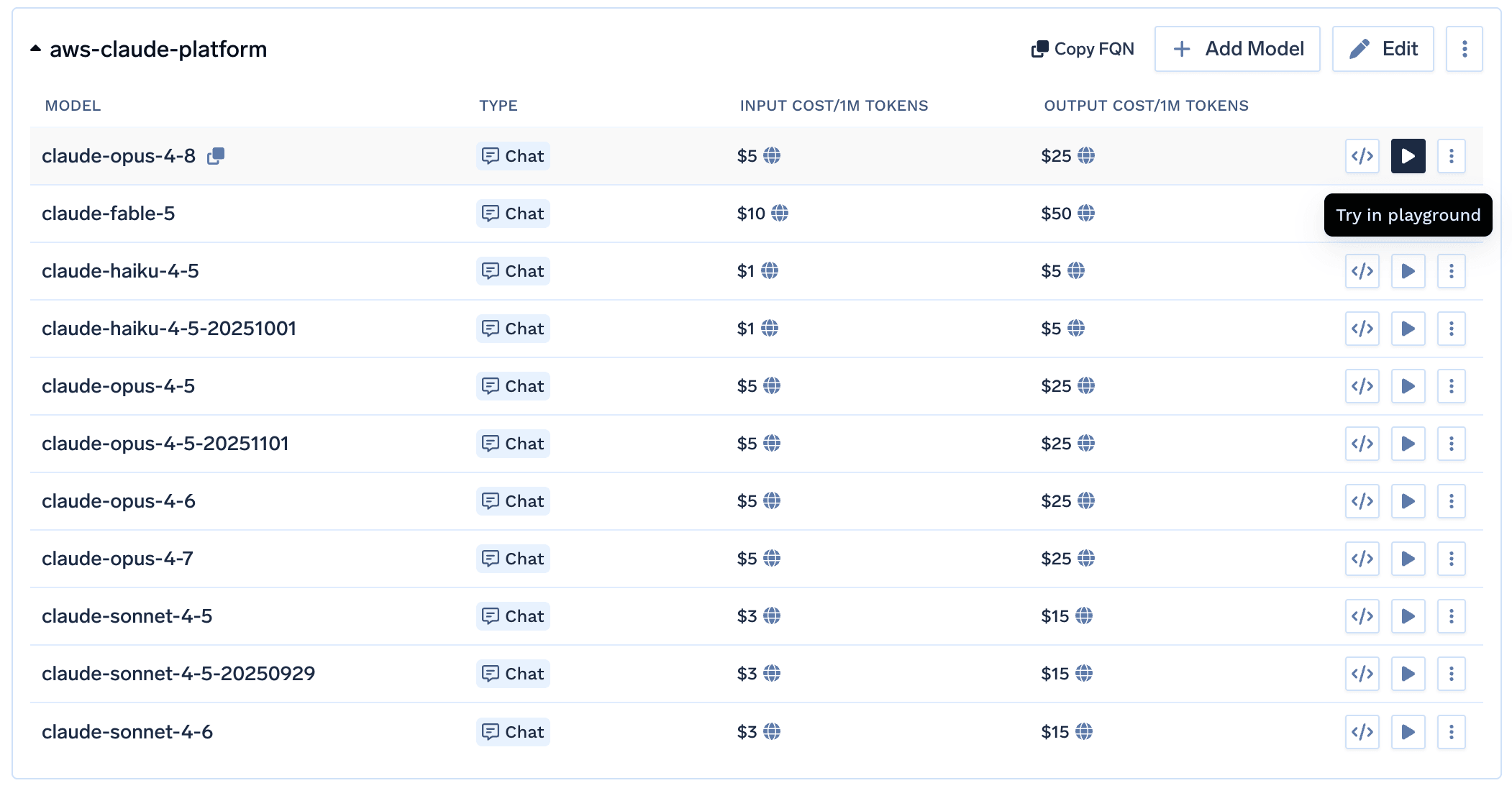
### Inference
After adding the models, you can perform inference using an OpenAI-compatible or Anthropic-compatible API via the Playground or by integrating with your own application.
Claude Platform on AWS authorizes every request through AWS IAM. The SigV4 service name and IAM action namespace is `aws-external-anthropic` (actions look like `aws-external-anthropic:CreateInference`). You attach a policy to the IAM principal (user or role) the gateway uses.
You can choose one of two approaches for the IAM policy.
#### Option A — Quickstart (full access)
The fastest path is to attach the AWS-managed **`AnthropicFullAccess`** policy to your principal. It grants every Claude Platform on AWS action across all workspaces and covers **both** SigV4 and API key authentication, so you don't have to reason about individual actions.
AWS ships five managed policies for common access patterns:
| Managed policy | Use it for |
| -------------------------------------- | -------------------------------------------------------------------------------------------------------------------------------- |
| **`AnthropicFullAccess`** | Everything (recommended quickstart). Covers all auth modes, inference, files, and batches. |
| `AnthropicReadOnlyAccess` | Read-only visibility (no inference). |
| `AnthropicInferenceAccess` | Narrowest policy sufficient for inference. **Does not** grant file create/delete, so it will not cover the Files API on its own. |
| `AnthropicLimitedAccess` | A constrained subset for limited workloads. |
| `AnthropicSelfHostedEnvironmentAccess` | Self-hosted Managed Agents sandboxes. |
See [IAM actions for Claude Platform on AWS → Managed policies](https://platform.claude.com/docs/en/api/claude-platform-on-aws-iam-actions#managed-policies) for the exact actions each one grants.
#### Option B — Least-privilege (production hardening)
For production, attach a scoped policy granting only the actions the gateway uses, restricted to your workspace ARN. The workspace ARN follows this format:
```text theme={"dark"}
arn:aws:aws-external-anthropic:{region}:{account-id}:workspace/{workspace-id}
```
The per-operation actions below authorize the actual API routes the gateway calls and are needed for **both** SigV4 and API key authentication:
| Operation | IAM action | Resource |
| ---------------------------------------------- | -------------------------------------------------- | -------------------- |
| Chat / Messages | `CreateInference` | workspace ARN |
| Count tokens | `CountTokens` | workspace ARN |
| List / get models | `ListModels`, `GetModel` | workspace ARN |
| Files (upload / list / get / content / delete) | `CreateFile`, `ListFiles`, `GetFile`, `DeleteFile` | workspace ARN |
| Get workspace | `GetWorkspace` | workspace ARN |
| List workspaces | `ListWorkspaces` | `*` (account-scoped) |
`GetFile` covers both file metadata and file `/content`. Account-scoped actions like `ListWorkspaces` must use `"Resource": "*"`; specifying a workspace ARN on them has no effect.
```json IAM policy (least-privilege) lines theme={"dark"}
{
"Version": "2012-10-17",
"Statement": [
{
"Sid": "WorkspaceScopedActions",
"Effect": "Allow",
"Action": [
"aws-external-anthropic:CreateInference",
"aws-external-anthropic:CountTokens",
"aws-external-anthropic:ListModels",
"aws-external-anthropic:GetModel",
"aws-external-anthropic:GetWorkspace",
"aws-external-anthropic:CreateFile",
"aws-external-anthropic:ListFiles",
"aws-external-anthropic:GetFile",
"aws-external-anthropic:DeleteFile"
],
"Resource": "arn:aws:aws-external-anthropic:us-west-2::workspace/"
},
{
"Sid": "AccountScopedActions",
"Effect": "Allow",
"Action": "aws-external-anthropic:ListWorkspaces",
"Resource": "*"
}
]
}
```
**If you authenticate with an API key**, also add `aws-external-anthropic:CallWithBearerToken` to the `"Resource": "*"` (account-scoped) statement:
```json lines theme={"dark"}
{
"Sid": "AccountScopedActions",
"Effect": "Allow",
"Action": [
"aws-external-anthropic:ListWorkspaces",
"aws-external-anthropic:CallWithBearerToken"
],
"Resource": "*"
}
```
`CallWithBearerToken` is a route-less, authentication-layer action that does **not** bind to a workspace ARN. SigV4 principals (access key / assumed role) do **not** need it.
Want to also run batch jobs directly on AWS? Add the batch actions (`CreateBatchInference`, `ListBatchInferences`, `GetBatchInference`, `CancelBatchInference`, `DeleteBatchInference`) on the workspace ARN. `GetBatchInference` covers both batch metadata and results.
***
Once you have a policy, attach it to a principal and configure credentials in TrueFoundry using one of the methods below.
**Using AWS Access Key and Secret (SigV4)**
1. Create an IAM user (or choose an existing one) following [these steps](https://docs.aws.amazon.com/IAM/latest/UserGuide/id_users_create.html).
2. Attach the IAM policy (Option A or B) to this user.
3. Create an access key for this user [as per this doc](https://docs.aws.amazon.com/IAM/latest/UserGuide/access-keys-admin-managed.html#admin-create-access-key).
4. Use this access key and secret while adding the provider account.
**Using Assumed Role (SigV4)**
The gateway role assumes your role, which in turn accesses Claude Platform on AWS.
1. Create an IAM role in your AWS account and attach the IAM policy (Option A or B) to it.
2. Configure the trust policy so the gateway role can assume it. Use the appropriate role ARN based on your deployment:
**For SAAS deployments:**
* Gateway role ARN: `arn:aws:iam::416964291864:role/tfy-ctl-production-ai-gateway-deps`
**For on-prem deployments:**
* Your gateway role ARN will look like: `arn:aws:iam:::role/-truefoundry-deps`
```json Trust policy lines theme={"dark"}
{
"Version": "2012-10-17",
"Statement": [
{
"Sid": "Statement1",
"Effect": "Allow",
"Principal": {
// for SAAS deployments:
"AWS": "arn:aws:iam::416964291864:role/tfy-ctl-production-ai-gateway-deps"
// or for on-prem deployments:
// "AWS": "arn:aws:iam:::role/-truefoundry-deps"
},
"Action": "sts:AssumeRole",
// (Optional) For additional security use external ID.
"Condition": {
"StringEquals": {
"sts:ExternalId": "your-external-id"
}
}
}
]
}
```
You can optionally configure an **external ID** in the trust policy for additional security. If you use one, provide the same external ID when creating the integration in TrueFoundry.
**Using API Key**
API keys are the simplest path and are ideal for exploration and development.
1. In the **AWS Console**, go to **Claude Platform on AWS → API keys**.
2. Choose **Generate a key** and copy the key value.
3. Grant the `aws-external-anthropic:CallWithBearerToken` IAM action to the principal the key is generated under (see the warning under Option B).
4. Use this API key while adding the provider account.
API keys for Claude Platform on AWS are managed in the **AWS Console**, not the Claude Console. Keys created in the standard Claude Console (for first-party API access) do **not** work with this endpoint.
Select the models from the list that you want to add. You can use `Select All` to select all the models.
If the model you are looking for is not present in the options, you can add it using `+ Add Model` at the end of the list and entering the model ID.
Model IDs are identical to the first-party Claude API — there are no Bedrock-style ARNs or `anthropic.` prefixes. Commonly available models:
| Model | Model ID |
| ----------------- | ------------------- |
| Claude Opus 4.8 | `claude-opus-4-8` |
| Claude Opus 4.6 | `claude-opus-4-6` |
| Claude Sonnet 4.6 | `claude-sonnet-4-6` |
| Claude Opus 4.5 | `claude-opus-4-5` |
| Claude Sonnet 4.5 | `claude-sonnet-4-5` |
| Claude Haiku 4.5 | `claude-haiku-4-5` |
| Claude Fable 5 | `claude-fable-5` |
For the authoritative, up-to-date list of model IDs, see Anthropic's [Available models on Claude Platform on AWS](https://platform.claude.com/docs/en/build-with-claude/claude-platform-on-aws#available-models).
### Inference
After adding the models, you can perform inference using an OpenAI-compatible or Anthropic-compatible API via the Playground or by integrating with your own application.
 ### Supported APIs
Once your AWS Claude Platform provider account is configured, the following API surfaces are available through the gateway. The wire format is identical to the direct Anthropic API, so every Anthropic feature works unchanged. The table below summarizes each endpoint alongside platform feature support (tracing, cost tracking).
Legend:
* **✅** Supported by Provider and Truefoundry
* Supported by Provider, but not by Truefoundry
* Provider does not support this feature
| API | Endpoint | Tracing | Cost Tracking |
| ------------------------------------- | ------------------- | ------- | ------------- |
| [Chat Completions](#chat-completions) | `/chat/completions` | **✅** | **✅** |
| [Messages API](#messages-api) | `/messages` | **✅** | **✅** |
| [Files API](#files-api) | `/files` | **✅** | **✅** |
The chat completions endpoint is the most widely used — it supports streaming, tools, multimodal input (images, PDF), structured JSON outputs, prompt caching, and extended thinking.
Full provider capability matrix: [Chat Completions API](/docs/ai-gateway/chat-completions-overview).
```python Python lines theme={"dark"}
from openai import OpenAI
client = OpenAI(
api_key="your-truefoundry-api-key",
base_url="{GATEWAY_BASE_URL}",
)
response = client.chat.completions.create(
model="aws-claude-platform-main/claude-sonnet-4-6",
messages=[
{"role": "user", "content": "What is TrueFoundry in one line?"},
],
)
print(response.choices[0].message.content)
```
Set `stream=True` to start streaming responses and iterate over delta chunks. You may defensively check that `chunk.choices` is non-empty and `delta.content` is not `None`.
```python Python lines theme={"dark"}
stream = client.chat.completions.create(
model="aws-claude-platform-main/claude-sonnet-4-6",
messages=[{"role": "user", "content": "Count from 1 to 5."}],
stream=True,
)
for chunk in stream:
if (
chunk.choices
and len(chunk.choices) > 0
and chunk.choices[0].delta.content is not None
):
print(chunk.choices[0].delta.content, end="", flush=True)
```
Advertise a tool, hand the model's `tool_calls` back as a `tool` role message, then request the final response. Use `tool_choice` to force the model to call a specific tool when you need deterministic behaviour.
```python Python lines theme={"dark"}
import json
tools = [{
"type": "function",
"function": {
"name": "get_weather",
"description": "Get the current weather for a city.",
"parameters": {
"type": "object",
"properties": {"city": {"type": "string"}},
"required": ["city"],
},
},
}]
messages = [{"role": "user", "content": "Weather in Bengaluru?"}]
first = client.chat.completions.create(
model="aws-claude-platform-main/claude-sonnet-4-6",
messages=messages,
tools=tools,
tool_choice={"type": "function", "function": {"name": "get_weather"}},
)
assistant_msg = first.choices[0].message
tool_calls = assistant_msg.tool_calls or []
if tool_calls:
tool_call = tool_calls[0]
messages.append(assistant_msg)
messages.append({
"role": "tool",
"tool_call_id": tool_call.id,
"content": json.dumps({"city": "Bengaluru", "temp_c": 28, "summary": "partly cloudy"}),
})
second = client.chat.completions.create(
model="aws-claude-platform-main/claude-sonnet-4-6",
messages=messages,
)
print(second.choices[0].message.content)
```
Claude 3+ models support image inputs via the `image_url` content part. The URL can be a public HTTP URL or an inline `data:image/...;base64,...` URI.
```python Python lines theme={"dark"}
image_url = (
"https://upload.wikimedia.org/wikipedia/commons/thumb/d/dd/Gfp-wisconsin-madison-the-nature-boardwalk.jpg/2560px-Gfp-wisconsin-madison-the-nature-boardwalk.jpg"
)
response = client.chat.completions.create(
model="aws-claude-platform-main/claude-sonnet-4-6",
messages=[{
"role": "user",
"content": [
{"type": "text", "text": "Describe this image in one sentence."},
{"type": "image_url", "image_url": {"url": image_url}},
],
}],
)
print(response.choices[0].message.content)
```
Claude models support PDF documents via the `file` content type with base64 encoding.
```python Python lines theme={"dark"}
import base64
with open("sample.pdf", "rb") as f:
pdf_b64 = base64.b64encode(f.read()).decode("ascii")
response = client.chat.completions.create(
model="aws-claude-platform-main/claude-sonnet-4-6",
messages=[{
"role": "user",
"content": [
{"type": "text", "text": "What text is in this PDF?"},
{
"type": "file",
"file": {
"filename": "sample.pdf",
"file_data": f"data:application/pdf;base64,{pdf_b64}",
},
},
],
}],
)
print(response.choices[0].message.content)
```
Use `response_format={"type": "json_schema", ...}` to force the model to return data matching a JSON schema. Claude 4.5+ models use native JSON schema support; older models use a tool-conversion fallback.
Anthropic does not support numeric constraint parameters (`ge`, `le`, `minimum`, `maximum`) in schemas. If you use Pydantic-generated schemas, strip these constraints before passing them through.
```python Python lines theme={"dark"}
import json
schema = {
"name": "person",
"schema": {
"type": "object",
"properties": {
"name": {"type": "string"},
"age": {"type": "integer"},
"hobbies": {"type": "array", "items": {"type": "string"}},
},
"required": ["name", "age", "hobbies"],
"additionalProperties": False,
},
"strict": True,
}
response = client.chat.completions.create(
model="aws-claude-platform-main/claude-sonnet-4-6",
messages=[{"role": "user", "content": "Invent a fictional person with name, age, and three hobbies."}],
response_format={"type": "json_schema", "json_schema": schema},
)
message = response.choices[0].message
if getattr(message, "refusal", None):
print("model refused:", message.refusal)
elif not message.content:
print("model returned empty content")
else:
print(json.dumps(json.loads(message.content), indent=2))
```
Anthropic requires **explicit** `cache_control` on content blocks you want cached (unlike OpenAI's automatic caching). Cached tokens appear as `cache_creation_input_tokens` (first call) and `cache_read_input_tokens` (subsequent calls) in the usage response.
Minimum cacheable prefix: **1024 tokens** for Claude Sonnet/Opus, **2048 tokens** for Claude Haiku. Prompts shorter than this will accept the `cache_control` hint but won't actually be cached.
```python Python lines theme={"dark"}
response = client.chat.completions.create(
model="aws-claude-platform-main/claude-sonnet-4-6",
messages=[
{
"role": "system",
"content": [
{
"type": "text",
"text": "",
"cache_control": {"type": "ephemeral", "ttl": "5m"},
},
],
},
{"role": "user", "content": "What should I check in a Helm chart review?"},
],
)
usage = response.usage
extra = getattr(usage, "model_extra", {}) or {}
print("cache_creation:", extra.get("cache_creation_input_tokens", 0))
print("cache_read :", extra.get("cache_read_input_tokens", 0))
```
Claude Sonnet 3.7, Claude 4, and Claude 4.5+ series models support extended thinking. Use the `reasoning_effort` parameter — the gateway translates it into Anthropic's native `thinking` parameter format.
The gateway maps `reasoning_effort` to a `thinking.budget_tokens` ratio of the request's `max_tokens`: `none` = 0%, `low` = 30%, `medium` = 60%, `high` = 90%.
The response includes `reasoning_content` (plain text) and `thinking_blocks` (structured blocks with cryptographic signatures required for multi-turn reasoning continuity).
```python Python lines theme={"dark"}
response = client.chat.completions.create(
model="aws-claude-platform-main/claude-sonnet-4-6",
messages=[{"role": "user", "content": "A bat and ball cost $1.10. The bat costs $1.00 more than the ball. How much is the ball?"}],
reasoning_effort="high",
max_tokens=8000,
)
msg = response.choices[0].message
print("answer:", msg.content)
print("reasoning:", getattr(msg, "reasoning_content", None))
# thinking_blocks carry signatures for multi-turn continuity
for block in getattr(msg, "thinking_blocks", []) or []:
print(" block:", block.get("type"), "signature:", block.get("signature", "")[:30])
```
Always echo `thinking_blocks` exactly as returned when continuing a conversation. Blocks with missing or modified `signature` fields are rejected by Anthropic.
Anthropic's native Messages API (`/messages`) is also exposed through the gateway, letting you use the official `anthropic` Python SDK directly.
You get the same gateway features — routing, logging, rate-limiting, budget management — as with the OpenAI-compatible interface.
Full docs: [Messages API](/docs/ai-gateway/messages-overview), [Native SDK Support](/docs/ai-gateway/native-sdk-support).
The gateway accepts both Anthropic SDK auth patterns and translates internally:
* `api_key=TFY_API_KEY` — SDK sends the `x-api-key` header
* `auth_token=TFY_API_KEY` — SDK sends the `Authorization: Bearer` header
Either works; the request body is identical. `api_key` is the idiomatic Anthropic SDK pattern — use it unless you have a reason to send a Bearer token.
```python Python lines theme={"dark"}
from anthropic import Anthropic
client = Anthropic(
api_key="your-truefoundry-api-key",
base_url="{GATEWAY_BASE_URL}",
)
message = client.messages.create(
model="aws-claude-platform-main/claude-sonnet-4-6",
max_tokens=256,
# `system` is a top-level parameter in Anthropic's native API, not a message role.
system="You answer in one short sentence.",
messages=[
{"role": "user", "content": "What is TrueFoundry in one line?"}
],
)
print(message.content[0].text)
print(message.usage)
```
Use `.messages.stream()` and iterate over `text_stream` for incremental output.
```python Python lines theme={"dark"}
with client.messages.stream(
model="aws-claude-platform-main/claude-sonnet-4-6",
max_tokens=256,
messages=[{"role": "user", "content": "Count from 1 to 5, one per line."}],
) as stream:
for text in stream.text_stream:
print(text, end="", flush=True)
```
Upload, list, retrieve, and delete files held by the gateway. The gateway translates the OpenAI-compatible Files API into Anthropic's native Files API automatically.
Full docs: [Files API](/docs/ai-gateway/file-endpoints).
The Files API requires the `x-tfy-provider-name` header on the client so the gateway can route the request to the right AWS Claude Platform provider account.
File content retrieval (`files.content`) only works for files created by skills or the code execution tool. User-uploaded files cannot be downloaded back — you can only list metadata and delete them.
```python Python lines theme={"dark"}
from openai import OpenAI
files_client = OpenAI(
api_key="your-truefoundry-api-key",
base_url="{GATEWAY_BASE_URL}",
default_headers={"x-tfy-provider-name": "aws-claude-platform-main"},
)
# Upload
with open("document.txt", "rb") as f:
uploaded = files_client.files.create(file=f, purpose="assistants")
print(uploaded.id, uploaded.filename, uploaded.bytes)
# List (slice client-side; the gateway may not honour `limit`)
listed = files_client.files.list()
for f in listed.data[:5]:
print(f.id, f.purpose, f.bytes)
# Retrieve metadata
meta = files_client.files.retrieve(uploaded.id)
# Delete
deleted = files_client.files.delete(uploaded.id)
print(deleted.deleted)
```
### FAQ
This is the most common setup error. Run `aws iam enable-outbound-web-identity-federation` once for your AWS account (see [Prerequisites](#prerequisites)). This step is specific to Claude Platform on AWS and is not required for Bedrock.
Only when authenticating with an **API key**. SigV4 principals (access key / assumed role) do not need it. `aws-external-anthropic:CallWithBearerToken` is a route-less, authentication-layer action granted on `"Resource": "*"`. See [Option B](#adding-models) for the exact statement.
Workspaces are bound to a single AWS region. A workspace created in `us-west-2` is only reachable through the `us-west-2` endpoint. The account-level region you set in TrueFoundry must match the workspace's region.
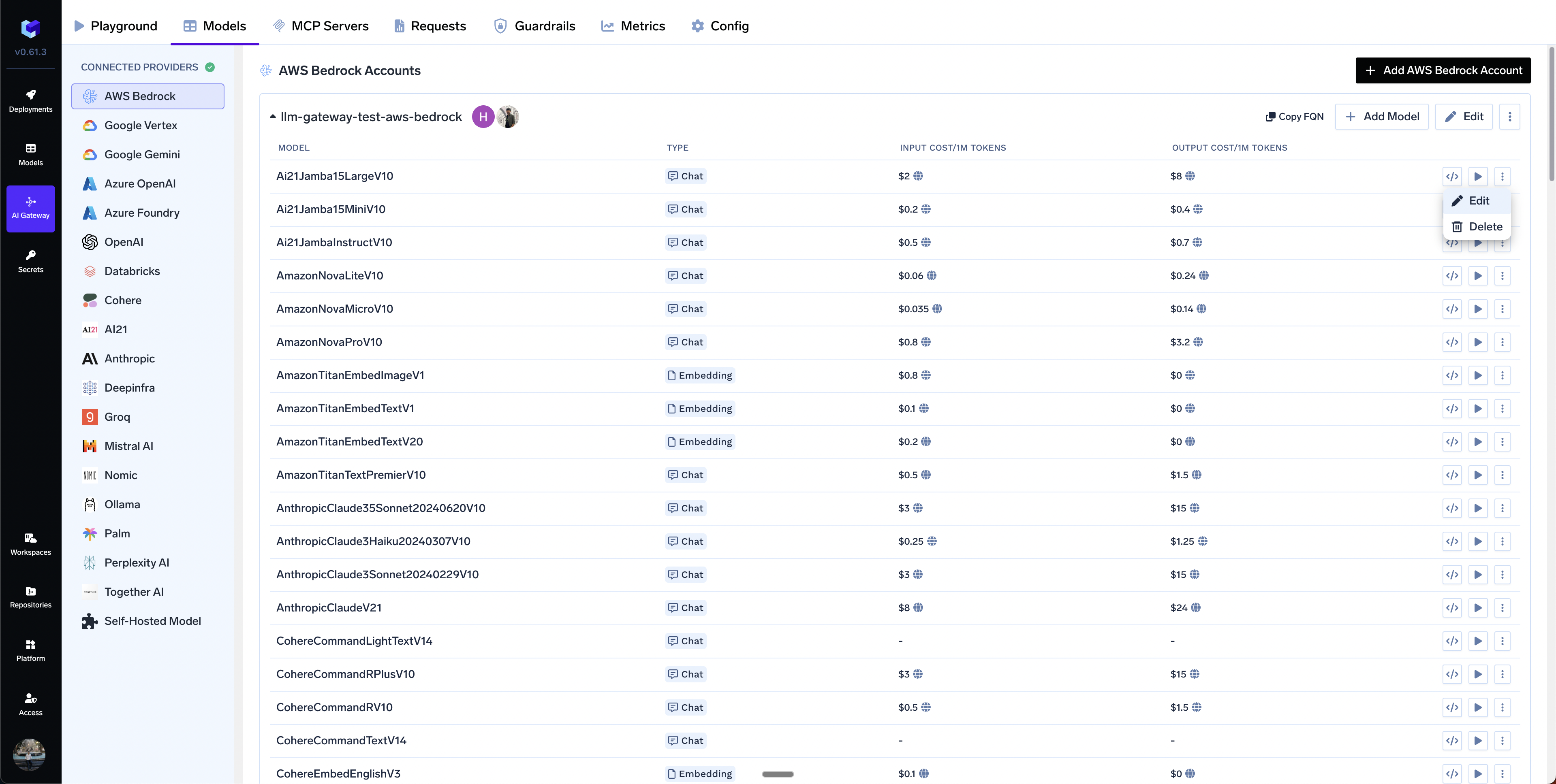
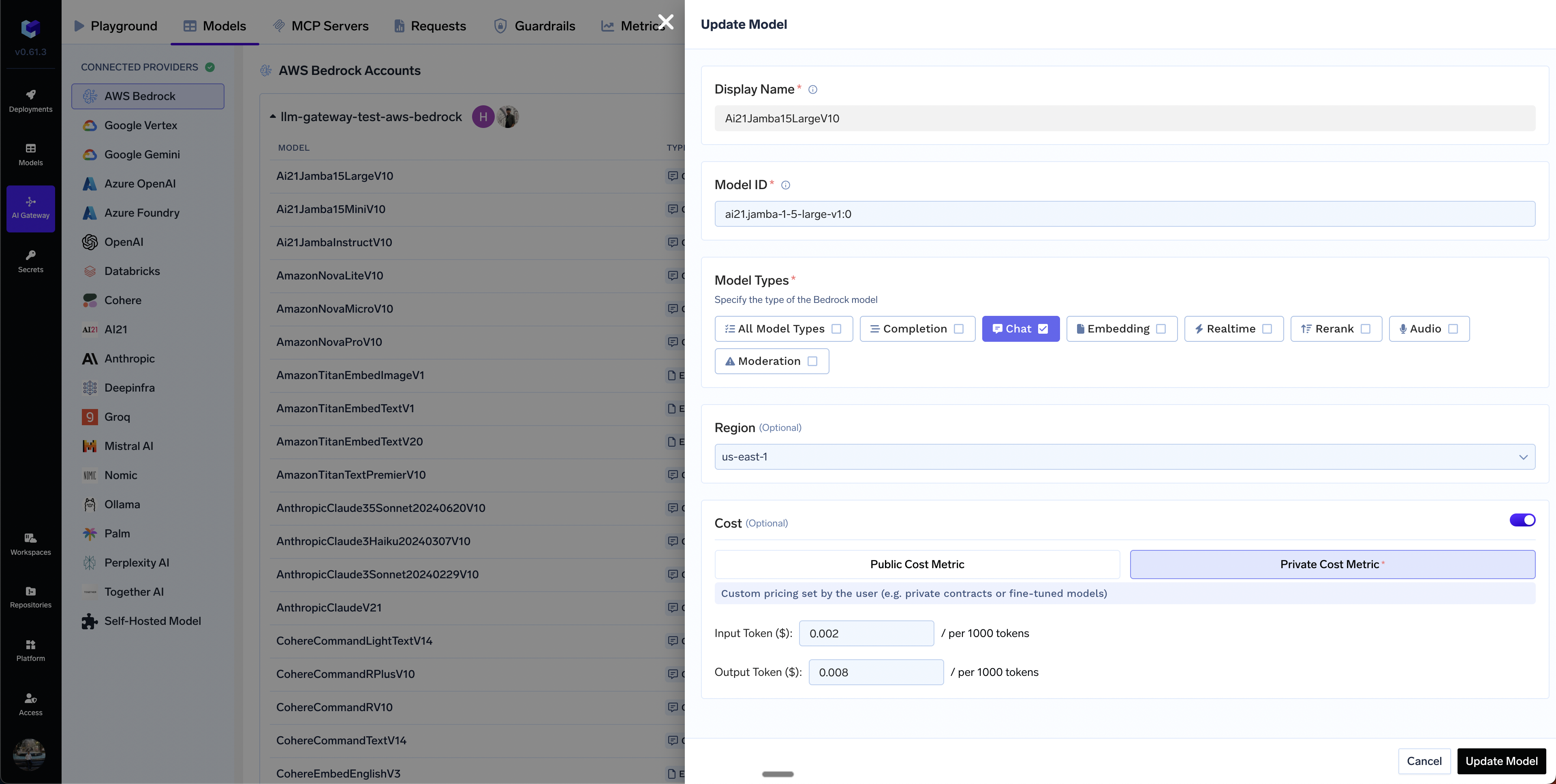
In case you have custom pricing for your models, you can override the default cost by clicking on the Edit Model button and then choosing the `Private Cost Metric` option.
### Supported APIs
Once your AWS Claude Platform provider account is configured, the following API surfaces are available through the gateway. The wire format is identical to the direct Anthropic API, so every Anthropic feature works unchanged. The table below summarizes each endpoint alongside platform feature support (tracing, cost tracking).
Legend:
* **✅** Supported by Provider and Truefoundry
* Supported by Provider, but not by Truefoundry
* Provider does not support this feature
| API | Endpoint | Tracing | Cost Tracking |
| ------------------------------------- | ------------------- | ------- | ------------- |
| [Chat Completions](#chat-completions) | `/chat/completions` | **✅** | **✅** |
| [Messages API](#messages-api) | `/messages` | **✅** | **✅** |
| [Files API](#files-api) | `/files` | **✅** | **✅** |
The chat completions endpoint is the most widely used — it supports streaming, tools, multimodal input (images, PDF), structured JSON outputs, prompt caching, and extended thinking.
Full provider capability matrix: [Chat Completions API](/docs/ai-gateway/chat-completions-overview).
```python Python lines theme={"dark"}
from openai import OpenAI
client = OpenAI(
api_key="your-truefoundry-api-key",
base_url="{GATEWAY_BASE_URL}",
)
response = client.chat.completions.create(
model="aws-claude-platform-main/claude-sonnet-4-6",
messages=[
{"role": "user", "content": "What is TrueFoundry in one line?"},
],
)
print(response.choices[0].message.content)
```
Set `stream=True` to start streaming responses and iterate over delta chunks. You may defensively check that `chunk.choices` is non-empty and `delta.content` is not `None`.
```python Python lines theme={"dark"}
stream = client.chat.completions.create(
model="aws-claude-platform-main/claude-sonnet-4-6",
messages=[{"role": "user", "content": "Count from 1 to 5."}],
stream=True,
)
for chunk in stream:
if (
chunk.choices
and len(chunk.choices) > 0
and chunk.choices[0].delta.content is not None
):
print(chunk.choices[0].delta.content, end="", flush=True)
```
Advertise a tool, hand the model's `tool_calls` back as a `tool` role message, then request the final response. Use `tool_choice` to force the model to call a specific tool when you need deterministic behaviour.
```python Python lines theme={"dark"}
import json
tools = [{
"type": "function",
"function": {
"name": "get_weather",
"description": "Get the current weather for a city.",
"parameters": {
"type": "object",
"properties": {"city": {"type": "string"}},
"required": ["city"],
},
},
}]
messages = [{"role": "user", "content": "Weather in Bengaluru?"}]
first = client.chat.completions.create(
model="aws-claude-platform-main/claude-sonnet-4-6",
messages=messages,
tools=tools,
tool_choice={"type": "function", "function": {"name": "get_weather"}},
)
assistant_msg = first.choices[0].message
tool_calls = assistant_msg.tool_calls or []
if tool_calls:
tool_call = tool_calls[0]
messages.append(assistant_msg)
messages.append({
"role": "tool",
"tool_call_id": tool_call.id,
"content": json.dumps({"city": "Bengaluru", "temp_c": 28, "summary": "partly cloudy"}),
})
second = client.chat.completions.create(
model="aws-claude-platform-main/claude-sonnet-4-6",
messages=messages,
)
print(second.choices[0].message.content)
```
Claude 3+ models support image inputs via the `image_url` content part. The URL can be a public HTTP URL or an inline `data:image/...;base64,...` URI.
```python Python lines theme={"dark"}
image_url = (
"https://upload.wikimedia.org/wikipedia/commons/thumb/d/dd/Gfp-wisconsin-madison-the-nature-boardwalk.jpg/2560px-Gfp-wisconsin-madison-the-nature-boardwalk.jpg"
)
response = client.chat.completions.create(
model="aws-claude-platform-main/claude-sonnet-4-6",
messages=[{
"role": "user",
"content": [
{"type": "text", "text": "Describe this image in one sentence."},
{"type": "image_url", "image_url": {"url": image_url}},
],
}],
)
print(response.choices[0].message.content)
```
Claude models support PDF documents via the `file` content type with base64 encoding.
```python Python lines theme={"dark"}
import base64
with open("sample.pdf", "rb") as f:
pdf_b64 = base64.b64encode(f.read()).decode("ascii")
response = client.chat.completions.create(
model="aws-claude-platform-main/claude-sonnet-4-6",
messages=[{
"role": "user",
"content": [
{"type": "text", "text": "What text is in this PDF?"},
{
"type": "file",
"file": {
"filename": "sample.pdf",
"file_data": f"data:application/pdf;base64,{pdf_b64}",
},
},
],
}],
)
print(response.choices[0].message.content)
```
Use `response_format={"type": "json_schema", ...}` to force the model to return data matching a JSON schema. Claude 4.5+ models use native JSON schema support; older models use a tool-conversion fallback.
Anthropic does not support numeric constraint parameters (`ge`, `le`, `minimum`, `maximum`) in schemas. If you use Pydantic-generated schemas, strip these constraints before passing them through.
```python Python lines theme={"dark"}
import json
schema = {
"name": "person",
"schema": {
"type": "object",
"properties": {
"name": {"type": "string"},
"age": {"type": "integer"},
"hobbies": {"type": "array", "items": {"type": "string"}},
},
"required": ["name", "age", "hobbies"],
"additionalProperties": False,
},
"strict": True,
}
response = client.chat.completions.create(
model="aws-claude-platform-main/claude-sonnet-4-6",
messages=[{"role": "user", "content": "Invent a fictional person with name, age, and three hobbies."}],
response_format={"type": "json_schema", "json_schema": schema},
)
message = response.choices[0].message
if getattr(message, "refusal", None):
print("model refused:", message.refusal)
elif not message.content:
print("model returned empty content")
else:
print(json.dumps(json.loads(message.content), indent=2))
```
Anthropic requires **explicit** `cache_control` on content blocks you want cached (unlike OpenAI's automatic caching). Cached tokens appear as `cache_creation_input_tokens` (first call) and `cache_read_input_tokens` (subsequent calls) in the usage response.
Minimum cacheable prefix: **1024 tokens** for Claude Sonnet/Opus, **2048 tokens** for Claude Haiku. Prompts shorter than this will accept the `cache_control` hint but won't actually be cached.
```python Python lines theme={"dark"}
response = client.chat.completions.create(
model="aws-claude-platform-main/claude-sonnet-4-6",
messages=[
{
"role": "system",
"content": [
{
"type": "text",
"text": "",
"cache_control": {"type": "ephemeral", "ttl": "5m"},
},
],
},
{"role": "user", "content": "What should I check in a Helm chart review?"},
],
)
usage = response.usage
extra = getattr(usage, "model_extra", {}) or {}
print("cache_creation:", extra.get("cache_creation_input_tokens", 0))
print("cache_read :", extra.get("cache_read_input_tokens", 0))
```
Claude Sonnet 3.7, Claude 4, and Claude 4.5+ series models support extended thinking. Use the `reasoning_effort` parameter — the gateway translates it into Anthropic's native `thinking` parameter format.
The gateway maps `reasoning_effort` to a `thinking.budget_tokens` ratio of the request's `max_tokens`: `none` = 0%, `low` = 30%, `medium` = 60%, `high` = 90%.
The response includes `reasoning_content` (plain text) and `thinking_blocks` (structured blocks with cryptographic signatures required for multi-turn reasoning continuity).
```python Python lines theme={"dark"}
response = client.chat.completions.create(
model="aws-claude-platform-main/claude-sonnet-4-6",
messages=[{"role": "user", "content": "A bat and ball cost $1.10. The bat costs $1.00 more than the ball. How much is the ball?"}],
reasoning_effort="high",
max_tokens=8000,
)
msg = response.choices[0].message
print("answer:", msg.content)
print("reasoning:", getattr(msg, "reasoning_content", None))
# thinking_blocks carry signatures for multi-turn continuity
for block in getattr(msg, "thinking_blocks", []) or []:
print(" block:", block.get("type"), "signature:", block.get("signature", "")[:30])
```
Always echo `thinking_blocks` exactly as returned when continuing a conversation. Blocks with missing or modified `signature` fields are rejected by Anthropic.
Anthropic's native Messages API (`/messages`) is also exposed through the gateway, letting you use the official `anthropic` Python SDK directly.
You get the same gateway features — routing, logging, rate-limiting, budget management — as with the OpenAI-compatible interface.
Full docs: [Messages API](/docs/ai-gateway/messages-overview), [Native SDK Support](/docs/ai-gateway/native-sdk-support).
The gateway accepts both Anthropic SDK auth patterns and translates internally:
* `api_key=TFY_API_KEY` — SDK sends the `x-api-key` header
* `auth_token=TFY_API_KEY` — SDK sends the `Authorization: Bearer` header
Either works; the request body is identical. `api_key` is the idiomatic Anthropic SDK pattern — use it unless you have a reason to send a Bearer token.
```python Python lines theme={"dark"}
from anthropic import Anthropic
client = Anthropic(
api_key="your-truefoundry-api-key",
base_url="{GATEWAY_BASE_URL}",
)
message = client.messages.create(
model="aws-claude-platform-main/claude-sonnet-4-6",
max_tokens=256,
# `system` is a top-level parameter in Anthropic's native API, not a message role.
system="You answer in one short sentence.",
messages=[
{"role": "user", "content": "What is TrueFoundry in one line?"}
],
)
print(message.content[0].text)
print(message.usage)
```
Use `.messages.stream()` and iterate over `text_stream` for incremental output.
```python Python lines theme={"dark"}
with client.messages.stream(
model="aws-claude-platform-main/claude-sonnet-4-6",
max_tokens=256,
messages=[{"role": "user", "content": "Count from 1 to 5, one per line."}],
) as stream:
for text in stream.text_stream:
print(text, end="", flush=True)
```
Upload, list, retrieve, and delete files held by the gateway. The gateway translates the OpenAI-compatible Files API into Anthropic's native Files API automatically.
Full docs: [Files API](/docs/ai-gateway/file-endpoints).
The Files API requires the `x-tfy-provider-name` header on the client so the gateway can route the request to the right AWS Claude Platform provider account.
File content retrieval (`files.content`) only works for files created by skills or the code execution tool. User-uploaded files cannot be downloaded back — you can only list metadata and delete them.
```python Python lines theme={"dark"}
from openai import OpenAI
files_client = OpenAI(
api_key="your-truefoundry-api-key",
base_url="{GATEWAY_BASE_URL}",
default_headers={"x-tfy-provider-name": "aws-claude-platform-main"},
)
# Upload
with open("document.txt", "rb") as f:
uploaded = files_client.files.create(file=f, purpose="assistants")
print(uploaded.id, uploaded.filename, uploaded.bytes)
# List (slice client-side; the gateway may not honour `limit`)
listed = files_client.files.list()
for f in listed.data[:5]:
print(f.id, f.purpose, f.bytes)
# Retrieve metadata
meta = files_client.files.retrieve(uploaded.id)
# Delete
deleted = files_client.files.delete(uploaded.id)
print(deleted.deleted)
```
### FAQ
This is the most common setup error. Run `aws iam enable-outbound-web-identity-federation` once for your AWS account (see [Prerequisites](#prerequisites)). This step is specific to Claude Platform on AWS and is not required for Bedrock.
Only when authenticating with an **API key**. SigV4 principals (access key / assumed role) do not need it. `aws-external-anthropic:CallWithBearerToken` is a route-less, authentication-layer action granted on `"Resource": "*"`. See [Option B](#adding-models) for the exact statement.
Workspaces are bound to a single AWS region. A workspace created in `us-west-2` is only reachable through the `us-west-2` endpoint. The account-level region you set in TrueFoundry must match the workspace's region.
In case you have custom pricing for your models, you can override the default cost by clicking on the Edit Model button and then choosing the `Private Cost Metric` option.