> ## Documentation Index
> Fetch the complete documentation index at: https://www.truefoundry.com/llms.txt
> Use this file to discover all available pages before exploring further.
# Agent API
> Learn how to use TrueFoundry's Agent API to integrate MCP servers into your applications for tool-using AI assistants.
## Overview
When we interact with the prompt in the AI gateway playground, the playground UI renders the tool calls, their arguments, results and the LLM responses as they are streamed back from the gateway. If you want to do the same in your own application, or a different UI apart from the TrueFoundry playground, you can use the Agent API described below.
## Quickstart
Get started with the Agent API in 3 simple steps:
### Set your API token and base URL
```bash lines theme={"dark"}
export TFY_API_TOKEN=your-token-here
export GATEWAY_BASE_URL=https://your-gateway-base-url
```
See [API Keys](/docs/generating-truefoundry-api-keys#personal-access-tokens-pats) for details on getting your token.
### Make your first request
```bash lines theme={"dark"}
http POST ${GATEWAY_BASE_URL}/agent/chat/completions \
Authorization:"Bearer ${TFY_API_TOKEN}" \
Content-Type:application/json \
model=openai/gpt-4o stream:=true \
messages:='[{"role":"user","content":"Help me find a model that can generate images"}]' \
mcp_servers:='[{"integration_fqn":"common-tools","enable_all_tools":false,"tools":[{"name":"web_search"}]}]'
```
```bash lines theme={"dark"}
curl --location '${GATEWAY_BASE_URL}/agent/chat/completions' \
--header 'Content-Type: application/json' \
--header "Authorization: Bearer ${TFY_API_TOKEN}" \
--data-raw '{
"model": "openai/gpt-4o",
"messages": [{"role": "user", "content": "Help me find a model that can generate images"}],
"stream": true,
"mcp_servers": [{
"integration_fqn": "common-tools",
"enable_all_tools": false,
"tools": [{ "name": "web_search" }]
}]
}'
```
### Understand the response
You'll receive a streaming response with:
* **Assistant content**: The LLM's text response
* **Tool calls**: When the assistant decides to use tools (like web search)
* **Tool results**: Output from executed tools
* **Follow-up**: The assistant processes tool results and continues
The agent will automatically use the `web_search` tool to find image generation models and provide recommendations.
## Request examples
### Call with registered MCP servers
When you have MCP servers already registered in your TrueFoundry AI Gateway, you can reference them using their `integration_fqn`:
```bash lines theme={"dark"}
http POST ${GATEWAY_BASE_URL}/agent/chat/completions \
Authorization:"Bearer ${TFY_API_TOKEN}" \
Content-Type:application/json \
model=openai/gpt-4o stream:=true \
messages:='[{"role":"user","content":"Search for Python tutorials and run a simple code example"}]' \
mcp_servers:='[{"integration_fqn":"common-tools","enable_all_tools":false,"tools":[{"name":"web_search"},{"name":"code_executor"}]}]'
```
```bash lines theme={"dark"}
curl --location '${GATEWAY_BASE_URL}/agent/chat/completions' \
--header 'Content-Type: application/json' \
--header "Authorization: Bearer ${TFY_API_TOKEN}" \
--data-raw '{
"model": "openai/gpt-4o",
"messages": [{"role": "user", "content": "Search for Python tutorials and run a simple code example"}],
"stream": true,
"mcp_servers": [{
"integration_fqn": "common-tools",
"enable_all_tools": false,
"tools": [{ "name": "web_search" }, { "name": "code_executor" }]
}]
}'
```
### Use external MCP servers
You can connect to any MCP server accessible without pre-registering it in the gateway:
```bash lines theme={"dark"}
http POST ${GATEWAY_BASE_URL}/agent/chat/completions \
Authorization:"Bearer ${TFY_API_TOKEN}" \
Content-Type:application/json \
model=openai/gpt-4o stream:=true \
messages:='[{"role":"user","content":"Search for machine learning models and packages"}]' \
mcp_servers:='[{"url":"https://huggingface.co/mcp","enable_all_tools":false,"headers":{"Authorization":"Bearer "},"tools":[{"name":"model_search"}]}]'
```
```bash lines theme={"dark"}
curl --location '${GATEWAY_BASE_URL}/agent/chat/completions' \
--header 'Content-Type: application/json' \
--header "Authorization: Bearer ${TFY_API_TOKEN}" \
--data-raw '{
"model": "openai/gpt-4o",
"messages": [{"role": "user", "content": "Search for machine learning models and packages"}],
"stream": true,
"mcp_servers": [{
"url": "https://huggingface.co/mcp",
"enable_all_tools": false,
"headers": {"Authorization": "Bearer "},
"tools": [{ "name": "model_search" }]
}]
}'
```
### Override auth headers
You can override authentication per MCP server entry using either:
1. **The `headers` field in `mcp_servers` array** (recommended): Pass headers directly in the request body for each MCP server entry
2. **The `x-tfy-mcp-headers` header**: Pass headers in the HTTP request header using FQN-based format
#### Method 1: Using `headers` field (Recommended)
```bash lines theme={"dark"}
http POST ${GATEWAY_BASE_URL}/agent/chat/completions \
Authorization:"Bearer ${TFY_API_TOKEN}" \
Content-Type:application/json \
model=openai/gpt-4o stream:=true \
messages:='[{"role":"user","content":"Think step by step and search for information about Python"}]' \
mcp_servers:='[
{
"integration_fqn":"common-tools",
"enable_all_tools": false,
"tools": [{"name":"sequential_thinking"},{"name":"web_search"}],
"headers": {"X-API-Key":"", "X-Custom-Header":"custom-value"}
}
]'
```
```bash lines theme={"dark"}
curl --location '${GATEWAY_BASE_URL}/agent/chat/completions' \
--header 'Content-Type: application/json' \
--header "Authorization: Bearer ${TFY_API_TOKEN}" \
--data-raw '{
"model": "openai/gpt-4o",
"messages": [{"role": "user", "content": "Think step by step and search for information about Python"}],
"stream": true,
"mcp_servers": [{
"integration_fqn": "common-tools",
"enable_all_tools": false,
"tools": [{"name": "sequential_thinking"}, {"name": "web_search"}],
"headers": {"X-API-Key": "", "X-Custom-Header": "custom-value"}
}]
}'
```
#### Method 2: Using `x-tfy-mcp-headers` header (Registered servers only)
For Agent API requests with **registered MCP servers**, you can also pass custom headers using the `x-tfy-mcp-headers` HTTP header. This method uses an FQN-based format where you specify headers for each MCP server using its fully qualified name (FQN).
The `x-tfy-mcp-headers` header **only works with registered MCP servers** (using `integration_fqn`). For external servers (using `url`), you must use the `headers` field within the `mcp_servers` array as shown in Method 1.
**Format**: The header value should be a JSON string with the structure:
```json theme={"dark"}
{
"server-fqn": {
"Header-Name": "header-value"
}
}
```
**Key points**:
* Use the server's full FQN as the key (e.g., `truefoundry:mcp-server-group:remote-mcp-servers:mcp-server:hf-mcp-server`)
* You can copy the FQN from the MCP server details page using the **Copy FQN** button on the top right
* For virtual servers, use the underlying remote server's FQN
* Headers specified here override any default authentication configured for the MCP server
```python lines theme={"dark"}
import json
from openai import OpenAI
client = OpenAI(
base_url="{GATEWAY_BASE_URL}/agent",
api_key="your-tfy-token"
)
# Define custom headers for registered MCP servers using FQN-based format
# Get the full FQN from the MCP server details in the UI
mcp_headers = json.dumps({
"truefoundry:mcp-server-group:remote-mcp-servers:mcp-server:hf-mcp-server": {
"Authorization": "Bearer custom-token",
"X-Custom-Header": "custom-value"
}
})
response = client.chat.completions.create(
model="openai/gpt-4o",
messages=[{"role": "user", "content": "Search for Python tutorials"}],
stream=True,
extra_headers={"x-tfy-mcp-headers": mcp_headers},
extra_body={
"mcp_servers": [{
"integration_fqn": "hf-mcp-server", # Registered server
"enable_all_tools": False,
"tools": [{"name": "model_search"}]
}]
}
)
```
```bash lines theme={"dark"}
curl --location '${GATEWAY_BASE_URL}/agent/chat/completions' \
--header 'Content-Type: application/json' \
--header "Authorization: Bearer ${TFY_API_TOKEN}" \
--header 'x-tfy-mcp-headers: {"truefoundry:mcp-server-group:remote-mcp-servers:mcp-server:hf-mcp-server":{"Authorization":"Bearer custom-token"}}' \
--data-raw '{
"model": "openai/gpt-4o",
"messages": [{"role": "user", "content": "Search for Python tutorials"}],
"stream": true,
"mcp_servers": [{
"integration_fqn": "hf-mcp-server",
"enable_all_tools": false,
"tools": [{"name": "model_search"}]
}]
}'
```
**Important differences:**
* The `x-tfy-mcp-headers` format for Agent API is different from the MCP Gateway format
* Agent API always uses full FQN as keys (e.g., `truefoundry:mcp-server-group:remote-mcp-servers:mcp-server:hf-mcp-server`)
* This method only works with registered servers (`integration_fqn`). For external servers, use the `headers` field in the `mcp_servers` array
## API Reference
#### Request parameters
| Parameter | Type | Required | Default | Description |
| ----------------- | ------- | -------- | ------- | ------------------------------------------------------ |
| `model` | string | ✓ | - | The LLM model to use (e.g., "openai/gpt-4o") |
| `messages` | array | ✗ | - | Array of message objects with `role` and `content` |
| `mcp_servers` | array | ✗ | - | Array of MCP Server configurations (see below) |
| `max_tokens` | number | ✗ | - | Maximum number of tokens to generate |
| `temperature` | number | ✗ | - | Controls randomness in the response (0.0 to 2.0) |
| `top_p` | number | ✗ | - | Nucleus sampling parameter (0.0 to 1.0) |
| `top_k` | number | ✗ | - | Top-k sampling parameter |
| `stream` | boolean | ✗ | - | Whether to stream responses (only `true` is supported) |
| `iteration_limit` | number | ✗ | 5 | Maximum tool call iterations (1-20) |
About tool call iterations: An iteration represents a full loop of user → model → tool call → tool result → model. The `iteration_limit` sets the maximum number of such loops per request to prevent runaway chains.
#### MCP server configuration
Each entry in the `mcp_servers` array should include:
| Parameter | Type | Required | Default | Description |
| ------------------ | ------- | -------- | ------- | -------------------------------------------------- |
| `integration_fqn` | string | ✗\* | - | Fully qualified name of the MCP Server integration |
| `url` | string | ✗\* | - | URL of the MCP server (must be valid URL) |
| `headers` | object | ✗ | - | HTTP headers to send to the MCP server |
| `enable_all_tools` | boolean | ✗ | `true` | Whether to enable all tools for this server |
| `tools` | array | ✗ | - | Array of specific tools to enable |
**\*Note**: Either `integration_fqn` or `url` must be provided, but not both.
#### Tool configuration
Each entry in the `tools` array should include:
| Parameter | Type | Required | Description |
| --------- | ------ | -------- | ---------------------------------------------------- |
| `name` | string | ✓ | The name of the tool as it appears in the MCP server |
### Streaming Response
The Chat API uses **Server-Sent Events (SSE)** to stream responses in real-time. This includes assistant text, tool calls (function names and their arguments), and tool results.
Both assistant content and tool call arguments are streamed incrementally across multiple chunks. You must accumulate these fragments to build complete responses.
Compatibility: The streaming format follows OpenAI Chat Completions streaming semantics. See the official guide: [OpenAI streaming responses](https://platform.openai.com/docs/guides/streaming-responses?api-mode=chat). In addition, the Gateway emits tool result chunks as extra delta events (with `role: "tool"`, `tool_call_id`, and `content`) to carry tool outputs.
#### Quick Reference
| Event | Relevant Fields | Description |
| ----------------- | ------------------------------------------------------------- | -------------------------------------------------- |
| Content | `delta.role` (first or every chunk), `delta.content` | Assistant text streamed over multiple chunks |
| Tool Call (start) | `delta.tool_calls[].function.name`, `delta.tool_calls[].id` | Announces a function call and its id |
| Tool Call (args) | `delta.tool_calls[].function.arguments` | Arguments streamed in multiple chunks; concatenate |
| Tool Result | `delta.role == "tool"`, `delta.tool_call_id`, `delta.content` | Tool output tied to a tool call id |
| Done | `choices[].finish_reason == "stop"` | Signals end of a message |
#### SSE Envelope
Each SSE line delivers a JSON payload:
```
data: {"id": "event_id", "object": "chat.completion.chunk", "choices": [...]}
```
#### Event Types
First chunk (role appears, empty content):
```json lines theme={"dark"}
{
"choices": [{ "delta": { "role": "assistant", "content": "" } }]
}
```
Subsequent chunk(s) with actual text:
```json lines theme={"dark"}
{
"choices": [{ "delta": { "content": "User Name" } }]
}
```
* Alternative: some models include the `role` on every chunk:
```json lines theme={"dark"}
{
"choices": [{ "delta": { "role": "assistant", "content": "User Name" } }]
}
```
Role emission differs by provider. Do not assume the role is only present on the first chunk. Clients should set the role on the first chunk and carry it forward for subsequent chunks, and safely ignore repeated role fields on later chunks.
* Concatenate `delta.content` across chunks to build the full assistant message.
Start of a tool call (function name announced):
```json lines theme={"dark"}
{
"choices": [{
"delta": {
"tool_calls": [{
"index": 0,
"id": "call_xxx",
"type": "function",
"function": { "name": "a_getSlackUsers", "arguments": "" },
"mcp_server_integration_id": "...",
"tool_name": "getSlackUsers"
}]
}
}]
}
```
Arguments streamed in later chunk(s):
```json lines theme={"dark"}
{
"choices": [{ "delta": { "tool_calls": [{ "index": 0, "function": { "arguments": "{}" } }] } }]
}
```
* Append `function.arguments` fragments per `index` to reconstruct full arguments.
* Completion of this phase is indicated by `finish_reason: "tool_calls"`.
Anthropic-specific behavior: Anthropic may stream an empty string for tool-call arguments (`"arguments": ""`). When invoking the tool, their API expects a valid JSON object. Normalize empty arguments to `{}` before issuing the call.
```python lines theme={"dark"}
args = tool_call.function.arguments or ""
if args.strip() == "":
args = "{}" # Anthropic requires an empty JSON object
```
```json lines theme={"dark"}
{
"choices": [{
"delta": {
"role": "tool",
"tool_call_id": "call_xxx",
"mcp_server_integration_id": "...",
"tool_name": "getSlackUsers",
"content": "{\"content\":[{\"type\":\"text\",\"text\":\"...\"}]}"
}
}]]
}
```
* `delta.role == "tool"` indicates a tool result chunk.
* The `content` is a JSON string; parse it to extract text or structured data if needed.
```json lines theme={"dark"}
{
"type": "error",
"error": { "type": "rate_limit_error", "message": "This request would exceed the rate limit..." }
}
```
## Processing Streaming events
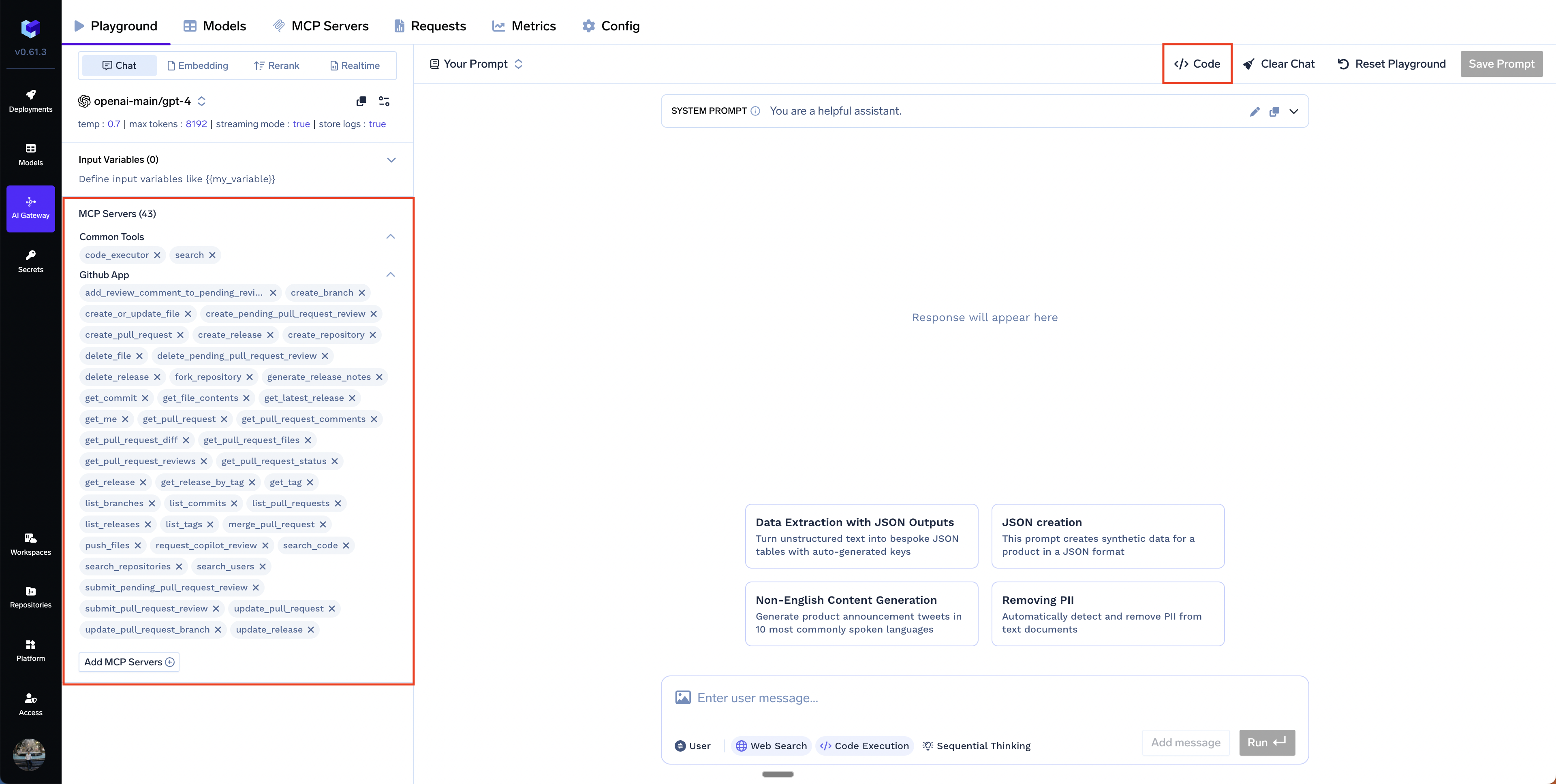
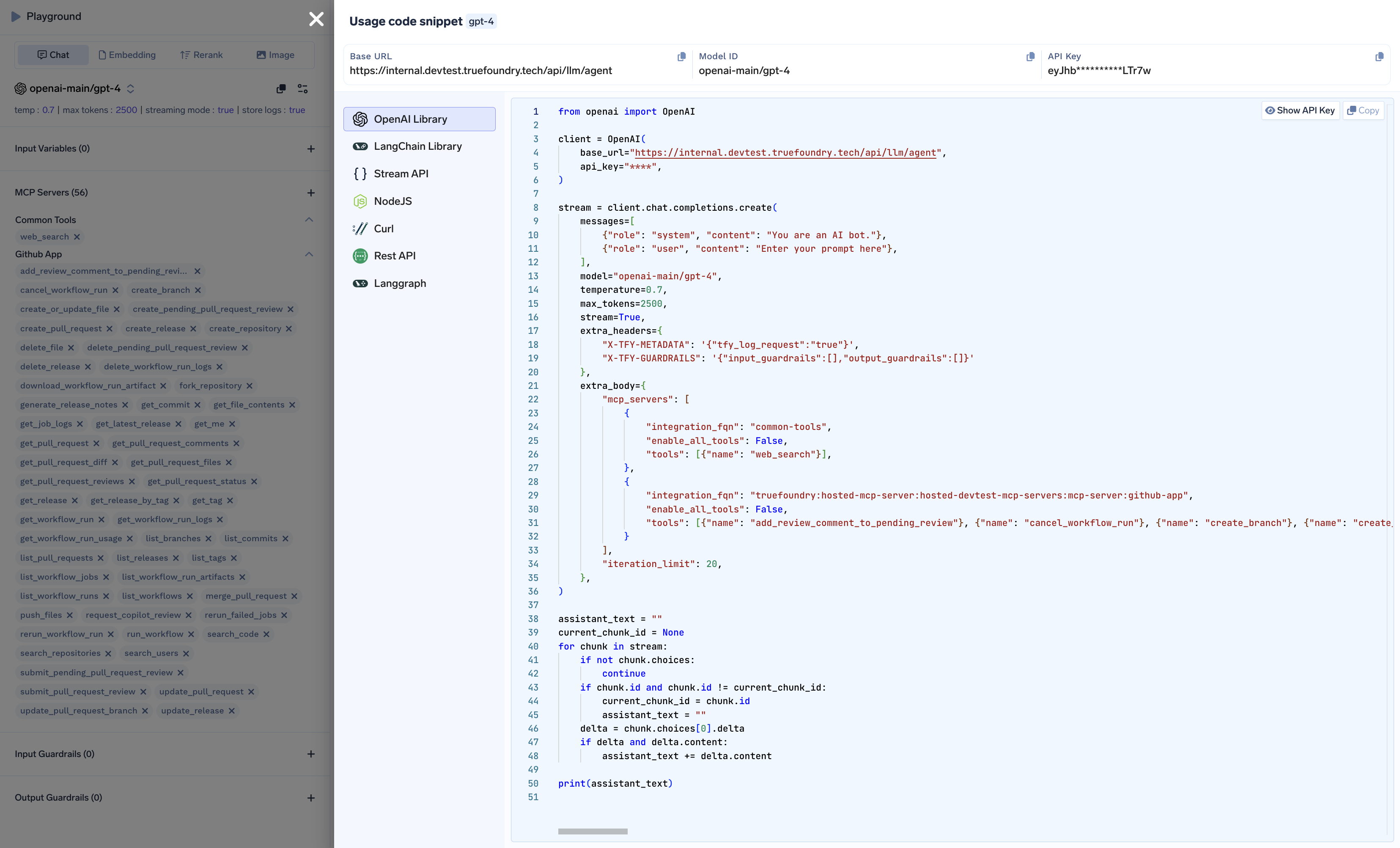
### How to Get the Code Snippet
You can generate a ready-to-use code snippet directly from the AI Gateway web UI:
1. Go to the **Playground** or your MCP Server group in the AI Gateway.
2. Click the **API Code Snippet** button.
3. Copy the generated code and use it in your application.
The generated code snippet from the playground will only show the last assistant message, and will not show tool calls and results from that conversation.
 ### Process streaming in code
#### OpenAI Client example
You can use the OpenAI client library with a custom base URL to handle the streaming response:
#### Configure client
```python lines theme={"dark"}
from openai import OpenAI
client = OpenAI(
base_url="{GATEWAY_BASE_URL}/agent",
api_key="****",
)
```
* **Base URL**: Point this to your Gateway Base URL with the `/agent` path which directly targets the Agent API.
#### Define common Agent configuration
```python lines theme={"dark"}
AGENT_CONFIG = {
"model": "openai/gpt-4o",
"stream": True,
"extra_body": {
"mcp_servers": [{
"integration_fqn": "common-tools",
"enable_all_tools": False,
"tools": [{"name": "web_search"}, {"name": "code_executor"}]
}],
"iteration_limit": 10
}
}
```
* **model**: Provider/model routed via Gateway.
* **mcp\_servers**: Select specific tools from an MCP server.
* **iteration\_limit**: Max agent tool-call iterations.
#### Collect streamed chunks into full messages
The `get_messages` function processes the streaming response to reconstruct complete messages. Let's break it down:
##### 1. Initialize and detect new messages
```python lines theme={"dark"}
def get_messages(chat_stream):
messages = []
previous_chunk_id = None
for chunk in chat_stream:
if not chunk.choices:
continue
delta = chunk.choices[0].delta
# Detect new message when chunk ID changes
if chunk.id != previous_chunk_id:
previous_chunk_id = chunk.id
messages.append({"role": delta.role, "content": ""})
current_message = messages[-1]
```
**What's happening**: Each streaming chunk has an ID. When the ID changes, it signals a new message starting (assistant, tool result, etc.). We create a new message object with the role and empty content.
##### 2. Handle tool result messages
```python lines theme={"dark"}
# Set tool_call_id for tool result messages
if delta.role == 'tool':
current_message["tool_call_id"] = delta.tool_call_id
```
**What's happening**: Tool result messages have `role: "tool"` and include a `tool_call_id` that links the result back to the specific tool call that generated it.
##### 3. Accumulate message content
```python lines theme={"dark"}
# Accumulate content for all message types (assistant text, tool results)
current_message["content"] += delta.content if delta.content else ""
```
**What's happening**: Both assistant responses and tool results stream their content incrementally. We concatenate each chunk's content to build the complete message.
##### 4. Handle tool calls (function name and arguments)
```python lines theme={"dark"}
# Process tool calls - function names and arguments are streamed
for tool_call in delta.tool_calls or []:
# Initialize tool_calls array if needed
if "tool_calls" not in current_message:
current_message["tool_calls"] = []
# Add new tool call if index exceeds current array length
if tool_call.index >= len(current_message["tool_calls"]):
current_message["tool_calls"].append({
"id": tool_call.id,
"type": "function",
"function": {
"name": tool_call.function.name,
"arguments": tool_call.function.arguments or ""
}
})
# If the first tool call event has arguments, continue to next event
if tool_call.function.arguments:
continue
# Accumulate function arguments (streamed incrementally)
current_message["tool_calls"][tool_call.index]["function"]["arguments"] += tool_call.function.arguments or ""
```
**What's happening**:
* Tool calls are streamed with function names first, then arguments in chunks
* Each tool call has an `index` to handle multiple simultaneous tool calls
* We accumulate the `arguments` string as it streams in (like `{"query": "Python tutorials"}`)
##### 5. Apply Anthropic fix for empty arguments
```python lines theme={"dark"}
# Anthropic fix: normalize empty argument strings to valid JSON
for msg in messages:
if msg["role"] == "assistant" and len(msg.get("tool_calls", [])) > 0:
for tool_call in msg["tool_calls"]:
if not tool_call["function"]["arguments"].strip():
tool_call["function"]["arguments"] = "{}"
return messages
```
**What's happening**: Anthropic models sometimes send empty strings `""` for tool arguments, but the OpenAI format expects `"{}"` for empty JSON objects. We normalize this.
#### Helper to send/merge a turn
```python lines theme={"dark"}
def chat_with_agent(messages):
stream = client.chat.completions.create(messages=messages, **AGENT_CONFIG)
messages += get_messages(stream)
return messages
```
#### Run a conversation and print outputs
```python lines theme={"dark"}
conversation = [
{"role": "user", "content": "Search for Python tutorials and run a simple hello world example"}
]
conversation = chat_with_agent(conversation)
conversation.append(
{"role": "user", "content": "Now scrape a Python documentation page and extract key concepts"}
)
conversation = chat_with_agent(conversation)
for message in conversation:
if message["role"] in ["user", "assistant"]:
print(f'{message["role"].title()}: {message["content"]}')
elif message["role"] == "tool":
print(f'Tool Result ({message["tool_call_id"]}):\n{message["content"]}')
if message["role"] == "assistant" and len(message.get("tool_calls", [])) > 0:
for tool_call in message["tool_calls"]:
print(f'Tool call id: {tool_call["id"]}')
print(f'Tool call function: {tool_call["function"]["name"]}')
print(f'Tool call arguments: {tool_call["function"]["arguments"]}\n\n')
print()
```
```python lines theme={"dark"}
from openai import OpenAI
client = OpenAI(
base_url="{GATEWAY_BASE_URL}/agent",
api_key="****",
)
# Common configuration
AGENT_CONFIG = {
"model": "openai/gpt-4o",
"stream": True,
"extra_body": {
"mcp_servers": [{
"integration_fqn": "common-tools",
"enable_all_tools": False,
"tools": [{"name": "web_search"}, {"name": "code_executor"}]
}],
"iteration_limit": 10
}
}
def get_messages(chat_stream):
messages = []
previous_chunk_id = None
for chunk in chat_stream:
if not chunk.choices:
continue
delta = chunk.choices[0].delta
# Detect new message when chunk ID changes
if chunk.id != previous_chunk_id:
previous_chunk_id = chunk.id
messages.append({"role": delta.role, "content": ""})
current_message = messages[-1]
# Set tool_call_id for tool result messages
if delta.role == 'tool':
current_message["tool_call_id"] = delta.tool_call_id
# Accumulate content for all message types (assistant text, tool results)
current_message["content"] += delta.content if delta.content else ""
# Process tool calls - function names and arguments are streamed
for tool_call in delta.tool_calls or []:
# Initialize tool_calls array if needed
if "tool_calls" not in current_message:
current_message["tool_calls"] = []
# Add new tool call if index exceeds current array length
if tool_call.index >= len(current_message["tool_calls"]):
current_message["tool_calls"].append({
"id": tool_call.id,
"type": "function",
"function": {
"name": tool_call.function.name,
"arguments": tool_call.function.arguments or ""
}
})
# If the first tool call event has arguments, continue to next event
if tool_call.function.arguments:
continue
# Accumulate function arguments (streamed incrementally)
current_message["tool_calls"][tool_call.index]["function"]["arguments"] += tool_call.function.arguments or ""
# Anthropic fix: normalize empty argument strings to valid JSON
for msg in messages:
if msg["role"] == "assistant" and len(msg.get("tool_calls", [])) > 0:
for tool_call in msg["tool_calls"]:
if not tool_call["function"]["arguments"].strip():
tool_call["function"]["arguments"] = "{}"
return messages
def chat_with_agent(messages):
stream = client.chat.completions.create(messages=messages, **AGENT_CONFIG)
messages += get_messages(stream)
return messages
# Example usage
conversation = [
{"role": "user", "content": "Search for Python tutorials and run a simple hello world example"}
]
conversation = chat_with_agent(conversation)
conversation.append(
{"role": "user", "content": "Now scrape a Python documentation page and extract key concepts"}
)
conversation = chat_with_agent(conversation)
# Print the conversation
for message in conversation:
if message["role"] in ["user", "assistant"]:
print(f'{message["role"].title()}: {message["content"]}')
elif message["role"] == "tool":
print(f'Tool Result ({message["tool_call_id"]}):\n{message["content"]}')
if message["role"] == "assistant" and len(message.get("tool_calls", [])) > 0:
for tool_call in message["tool_calls"]:
print(f'Tool call id: {tool_call["id"]}')
print(f'Tool call function: {tool_call["function"]["name"]}')
print(f'Tool call arguments: {tool_call["function"]["arguments"]}\n\n')
print()
```
### Tool call flow
The streaming API follows this flow when tools are involved:
1. **Assistant Response Start**: Initial content from the LLM (streamed)
2. **Tool Call Event**: Function name, then arguments streamed incrementally
3. **Tool Execution**: The gateway executes the complete tool call
4. **Tool Result Event**: Results are streamed back
5. **Assistant Follow-up**: The assistant processes results and continues
### Stream termination
The stream ends with either:
* A `[DONE]` message indicating completion
* An error event if something goes wrong
* Client disconnection
***
### Process streaming in code
#### OpenAI Client example
You can use the OpenAI client library with a custom base URL to handle the streaming response:
#### Configure client
```python lines theme={"dark"}
from openai import OpenAI
client = OpenAI(
base_url="{GATEWAY_BASE_URL}/agent",
api_key="****",
)
```
* **Base URL**: Point this to your Gateway Base URL with the `/agent` path which directly targets the Agent API.
#### Define common Agent configuration
```python lines theme={"dark"}
AGENT_CONFIG = {
"model": "openai/gpt-4o",
"stream": True,
"extra_body": {
"mcp_servers": [{
"integration_fqn": "common-tools",
"enable_all_tools": False,
"tools": [{"name": "web_search"}, {"name": "code_executor"}]
}],
"iteration_limit": 10
}
}
```
* **model**: Provider/model routed via Gateway.
* **mcp\_servers**: Select specific tools from an MCP server.
* **iteration\_limit**: Max agent tool-call iterations.
#### Collect streamed chunks into full messages
The `get_messages` function processes the streaming response to reconstruct complete messages. Let's break it down:
##### 1. Initialize and detect new messages
```python lines theme={"dark"}
def get_messages(chat_stream):
messages = []
previous_chunk_id = None
for chunk in chat_stream:
if not chunk.choices:
continue
delta = chunk.choices[0].delta
# Detect new message when chunk ID changes
if chunk.id != previous_chunk_id:
previous_chunk_id = chunk.id
messages.append({"role": delta.role, "content": ""})
current_message = messages[-1]
```
**What's happening**: Each streaming chunk has an ID. When the ID changes, it signals a new message starting (assistant, tool result, etc.). We create a new message object with the role and empty content.
##### 2. Handle tool result messages
```python lines theme={"dark"}
# Set tool_call_id for tool result messages
if delta.role == 'tool':
current_message["tool_call_id"] = delta.tool_call_id
```
**What's happening**: Tool result messages have `role: "tool"` and include a `tool_call_id` that links the result back to the specific tool call that generated it.
##### 3. Accumulate message content
```python lines theme={"dark"}
# Accumulate content for all message types (assistant text, tool results)
current_message["content"] += delta.content if delta.content else ""
```
**What's happening**: Both assistant responses and tool results stream their content incrementally. We concatenate each chunk's content to build the complete message.
##### 4. Handle tool calls (function name and arguments)
```python lines theme={"dark"}
# Process tool calls - function names and arguments are streamed
for tool_call in delta.tool_calls or []:
# Initialize tool_calls array if needed
if "tool_calls" not in current_message:
current_message["tool_calls"] = []
# Add new tool call if index exceeds current array length
if tool_call.index >= len(current_message["tool_calls"]):
current_message["tool_calls"].append({
"id": tool_call.id,
"type": "function",
"function": {
"name": tool_call.function.name,
"arguments": tool_call.function.arguments or ""
}
})
# If the first tool call event has arguments, continue to next event
if tool_call.function.arguments:
continue
# Accumulate function arguments (streamed incrementally)
current_message["tool_calls"][tool_call.index]["function"]["arguments"] += tool_call.function.arguments or ""
```
**What's happening**:
* Tool calls are streamed with function names first, then arguments in chunks
* Each tool call has an `index` to handle multiple simultaneous tool calls
* We accumulate the `arguments` string as it streams in (like `{"query": "Python tutorials"}`)
##### 5. Apply Anthropic fix for empty arguments
```python lines theme={"dark"}
# Anthropic fix: normalize empty argument strings to valid JSON
for msg in messages:
if msg["role"] == "assistant" and len(msg.get("tool_calls", [])) > 0:
for tool_call in msg["tool_calls"]:
if not tool_call["function"]["arguments"].strip():
tool_call["function"]["arguments"] = "{}"
return messages
```
**What's happening**: Anthropic models sometimes send empty strings `""` for tool arguments, but the OpenAI format expects `"{}"` for empty JSON objects. We normalize this.
#### Helper to send/merge a turn
```python lines theme={"dark"}
def chat_with_agent(messages):
stream = client.chat.completions.create(messages=messages, **AGENT_CONFIG)
messages += get_messages(stream)
return messages
```
#### Run a conversation and print outputs
```python lines theme={"dark"}
conversation = [
{"role": "user", "content": "Search for Python tutorials and run a simple hello world example"}
]
conversation = chat_with_agent(conversation)
conversation.append(
{"role": "user", "content": "Now scrape a Python documentation page and extract key concepts"}
)
conversation = chat_with_agent(conversation)
for message in conversation:
if message["role"] in ["user", "assistant"]:
print(f'{message["role"].title()}: {message["content"]}')
elif message["role"] == "tool":
print(f'Tool Result ({message["tool_call_id"]}):\n{message["content"]}')
if message["role"] == "assistant" and len(message.get("tool_calls", [])) > 0:
for tool_call in message["tool_calls"]:
print(f'Tool call id: {tool_call["id"]}')
print(f'Tool call function: {tool_call["function"]["name"]}')
print(f'Tool call arguments: {tool_call["function"]["arguments"]}\n\n')
print()
```
```python lines theme={"dark"}
from openai import OpenAI
client = OpenAI(
base_url="{GATEWAY_BASE_URL}/agent",
api_key="****",
)
# Common configuration
AGENT_CONFIG = {
"model": "openai/gpt-4o",
"stream": True,
"extra_body": {
"mcp_servers": [{
"integration_fqn": "common-tools",
"enable_all_tools": False,
"tools": [{"name": "web_search"}, {"name": "code_executor"}]
}],
"iteration_limit": 10
}
}
def get_messages(chat_stream):
messages = []
previous_chunk_id = None
for chunk in chat_stream:
if not chunk.choices:
continue
delta = chunk.choices[0].delta
# Detect new message when chunk ID changes
if chunk.id != previous_chunk_id:
previous_chunk_id = chunk.id
messages.append({"role": delta.role, "content": ""})
current_message = messages[-1]
# Set tool_call_id for tool result messages
if delta.role == 'tool':
current_message["tool_call_id"] = delta.tool_call_id
# Accumulate content for all message types (assistant text, tool results)
current_message["content"] += delta.content if delta.content else ""
# Process tool calls - function names and arguments are streamed
for tool_call in delta.tool_calls or []:
# Initialize tool_calls array if needed
if "tool_calls" not in current_message:
current_message["tool_calls"] = []
# Add new tool call if index exceeds current array length
if tool_call.index >= len(current_message["tool_calls"]):
current_message["tool_calls"].append({
"id": tool_call.id,
"type": "function",
"function": {
"name": tool_call.function.name,
"arguments": tool_call.function.arguments or ""
}
})
# If the first tool call event has arguments, continue to next event
if tool_call.function.arguments:
continue
# Accumulate function arguments (streamed incrementally)
current_message["tool_calls"][tool_call.index]["function"]["arguments"] += tool_call.function.arguments or ""
# Anthropic fix: normalize empty argument strings to valid JSON
for msg in messages:
if msg["role"] == "assistant" and len(msg.get("tool_calls", [])) > 0:
for tool_call in msg["tool_calls"]:
if not tool_call["function"]["arguments"].strip():
tool_call["function"]["arguments"] = "{}"
return messages
def chat_with_agent(messages):
stream = client.chat.completions.create(messages=messages, **AGENT_CONFIG)
messages += get_messages(stream)
return messages
# Example usage
conversation = [
{"role": "user", "content": "Search for Python tutorials and run a simple hello world example"}
]
conversation = chat_with_agent(conversation)
conversation.append(
{"role": "user", "content": "Now scrape a Python documentation page and extract key concepts"}
)
conversation = chat_with_agent(conversation)
# Print the conversation
for message in conversation:
if message["role"] in ["user", "assistant"]:
print(f'{message["role"].title()}: {message["content"]}')
elif message["role"] == "tool":
print(f'Tool Result ({message["tool_call_id"]}):\n{message["content"]}')
if message["role"] == "assistant" and len(message.get("tool_calls", [])) > 0:
for tool_call in message["tool_calls"]:
print(f'Tool call id: {tool_call["id"]}')
print(f'Tool call function: {tool_call["function"]["name"]}')
print(f'Tool call arguments: {tool_call["function"]["arguments"]}\n\n')
print()
```
### Tool call flow
The streaming API follows this flow when tools are involved:
1. **Assistant Response Start**: Initial content from the LLM (streamed)
2. **Tool Call Event**: Function name, then arguments streamed incrementally
3. **Tool Execution**: The gateway executes the complete tool call
4. **Tool Result Event**: Results are streamed back
5. **Assistant Follow-up**: The assistant processes results and continues
### Stream termination
The stream ends with either:
* A `[DONE]` message indicating completion
* An error event if something goes wrong
* Client disconnection
***