> ## Documentation Index
> Fetch the complete documentation index at: https://www.truefoundry.com/llms.txt
> Use this file to discover all available pages before exploring further.
# Introduction to AI Deployment
> Deploy models, services, jobs, LLMs, and workflows on Kubernetes clusters in your own cloud or on-prem infrastructure with TrueFoundry.
TrueFoundry AI Deployment is the platform layer for running your AI workloads on your own infrastructure. It lets data scientists and ML engineers deploy models, services, training jobs, LLMs, and workflows on Kubernetes clusters in your cloud account or on-prem data center — without needing to be Kubernetes experts.
You describe what you want to deploy through the UI, CLI, or Python SDK, and TrueFoundry handles containerization, autoscaling, GPU scheduling, monitoring, and rollouts on your clusters.
## How It Works
TrueFoundry follows a split-plane architecture. The **control plane** is the orchestration layer where you manage and monitor deployments — it can be TrueFoundry-hosted SaaS or self-hosted in your VPC. The **compute plane** is one or more Kubernetes clusters in your own environment where your workloads actually run. Your code, models, and data never leave your infrastructure.
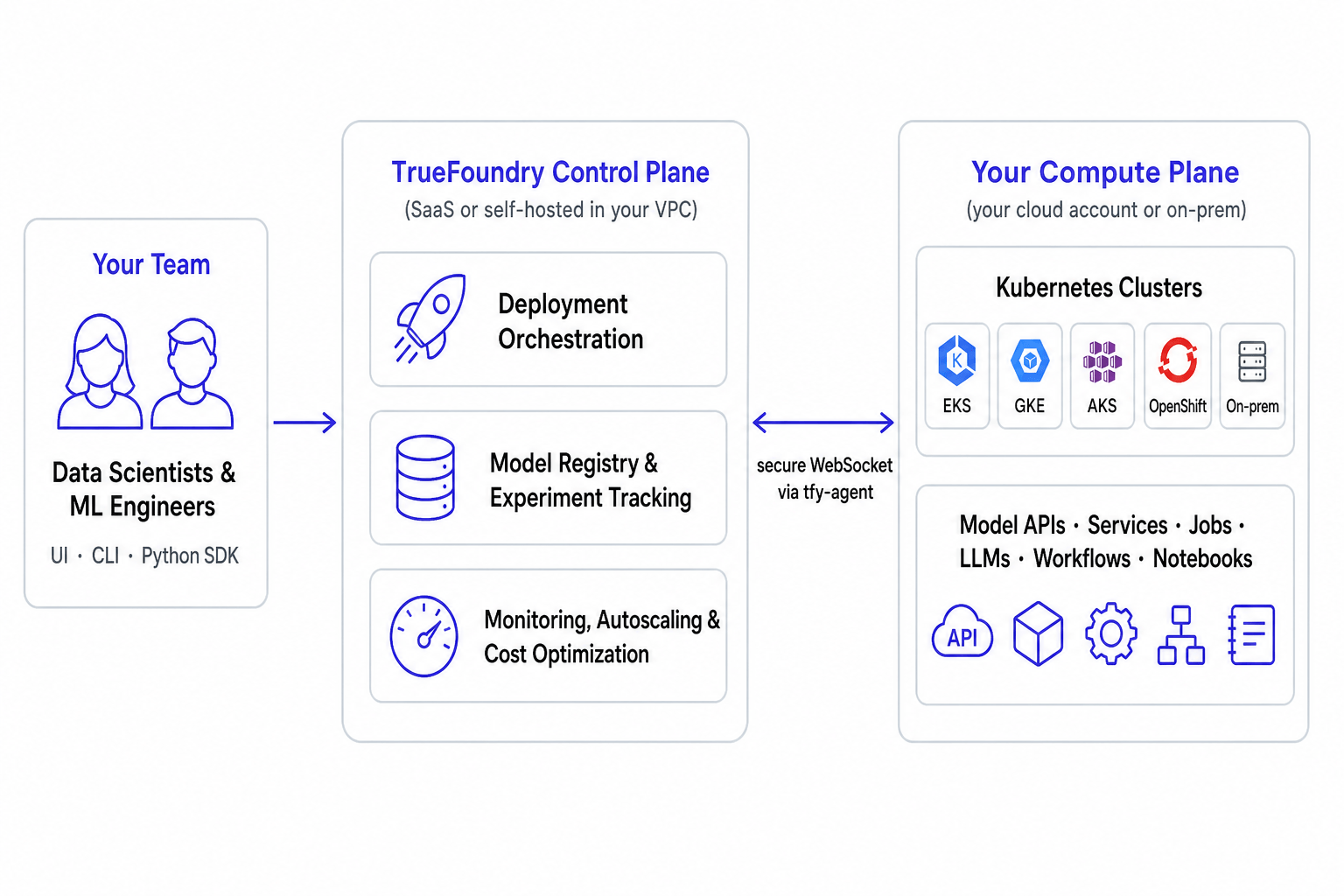 The control plane never accesses your clusters directly. A lightweight agent (`tfy-agent`) runs in each compute plane cluster and connects outbound to the control plane over a secure WebSocket, receiving deployment instructions and streaming back the state of your workloads. See [TrueFoundry Architecture](/docs/platform/architecture) for the full picture.
## Bring Your Own Compute
AI Deployment requires you to bring your own compute. TrueFoundry does not sell or resell GPUs or CPUs — the compute plane always runs in your environment:
* **Your cloud account**: AWS EKS, Google Cloud GKE, or Azure AKS clusters. TrueFoundry can provision a new cluster for you using OpenTofu/Terraform, or attach to an existing one.
* **On-prem or other clouds**: any standard Kubernetes or OpenShift cluster, including on-prem GPU clusters and neoclouds.
This means you keep full control over data residency, security boundaries, and cloud spend, and you can use your existing cloud commitments and discounts. To set up a cluster, see [Deploy Compute Plane](/docs/infrastructure/deploy-compute-plane).
## When Should You Use AI Deployment?
AI Deployment is the right fit when you need to run AI workloads on infrastructure you control:
* **Self-host open-source or fine-tuned LLMs** on your own GPUs instead of (or alongside) calling provider APIs, for cost, latency, or data privacy reasons.
* **Serve classical ML models as APIs** — scikit-learn, XGBoost, PyTorch, TensorFlow, or any framework — with autoscaling and monitoring built in.
* **Run training jobs and pipelines** on schedules or on demand, including distributed and GPU workloads.
* **Give your team self-serve infrastructure** — notebooks, SSH servers, and deployment workflows on shared clusters, with access control and cost visibility for platform teams.
* **Optimize compute costs** with autoscaling, scale-to-zero, spot instances, and fractional GPUs.
If you only need governed access to hosted LLM providers, the [AI Gateway](/docs/ai-gateway/intro-to-llm-gateway) alone is sufficient and does not require a compute plane. The two products work together: models you deploy with AI Deployment can be [registered on the gateway](/docs/ai-gateway/self-hosted-models) and consumed through the same unified API.
## What You Can Deploy
Deploy models from the registry or Hugging Face as real-time APIs.
Deploy web services and APIs from your code or Docker images.
Run training and batch jobs manually or on a schedule.
Deploy open-source LLMs from the model catalogue on your GPUs.
Fine-tune LLMs on your own data and compute.
Orchestrate multi-step ML pipelines with Python.
Queue-backed services for long-running inference.
Jupyter notebooks and SSH servers on cluster compute.
Deploy MCP servers from code or npx/uvx packages.
Persistent storage for models, datasets, and caches.
Track runs, metrics, artifacts, and models.
Deploy Helm charts and raw Kubernetes manifests.
## Next Steps
1. Understand the core abstractions — clusters, workspaces, repositories, and environments — in [Key Concepts](/docs/key-concepts).
2. Set up a compute plane cluster by following [Deploy Compute Plane](/docs/infrastructure/deploy-compute-plane).
3. Install and authenticate the CLI using [Setup For CLI](/docs/setup-cli).
4. Deploy your first workload with the [service deployment guide](/docs/deploy-first-service) or the [model deployment guide](/docs/model-deployment/overview).
The control plane never accesses your clusters directly. A lightweight agent (`tfy-agent`) runs in each compute plane cluster and connects outbound to the control plane over a secure WebSocket, receiving deployment instructions and streaming back the state of your workloads. See [TrueFoundry Architecture](/docs/platform/architecture) for the full picture.
## Bring Your Own Compute
AI Deployment requires you to bring your own compute. TrueFoundry does not sell or resell GPUs or CPUs — the compute plane always runs in your environment:
* **Your cloud account**: AWS EKS, Google Cloud GKE, or Azure AKS clusters. TrueFoundry can provision a new cluster for you using OpenTofu/Terraform, or attach to an existing one.
* **On-prem or other clouds**: any standard Kubernetes or OpenShift cluster, including on-prem GPU clusters and neoclouds.
This means you keep full control over data residency, security boundaries, and cloud spend, and you can use your existing cloud commitments and discounts. To set up a cluster, see [Deploy Compute Plane](/docs/infrastructure/deploy-compute-plane).
## When Should You Use AI Deployment?
AI Deployment is the right fit when you need to run AI workloads on infrastructure you control:
* **Self-host open-source or fine-tuned LLMs** on your own GPUs instead of (or alongside) calling provider APIs, for cost, latency, or data privacy reasons.
* **Serve classical ML models as APIs** — scikit-learn, XGBoost, PyTorch, TensorFlow, or any framework — with autoscaling and monitoring built in.
* **Run training jobs and pipelines** on schedules or on demand, including distributed and GPU workloads.
* **Give your team self-serve infrastructure** — notebooks, SSH servers, and deployment workflows on shared clusters, with access control and cost visibility for platform teams.
* **Optimize compute costs** with autoscaling, scale-to-zero, spot instances, and fractional GPUs.
If you only need governed access to hosted LLM providers, the [AI Gateway](/docs/ai-gateway/intro-to-llm-gateway) alone is sufficient and does not require a compute plane. The two products work together: models you deploy with AI Deployment can be [registered on the gateway](/docs/ai-gateway/self-hosted-models) and consumed through the same unified API.
## What You Can Deploy
Deploy models from the registry or Hugging Face as real-time APIs.
Deploy web services and APIs from your code or Docker images.
Run training and batch jobs manually or on a schedule.
Deploy open-source LLMs from the model catalogue on your GPUs.
Fine-tune LLMs on your own data and compute.
Orchestrate multi-step ML pipelines with Python.
Queue-backed services for long-running inference.
Jupyter notebooks and SSH servers on cluster compute.
Deploy MCP servers from code or npx/uvx packages.
Persistent storage for models, datasets, and caches.
Track runs, metrics, artifacts, and models.
Deploy Helm charts and raw Kubernetes manifests.
## Next Steps
1. Understand the core abstractions — clusters, workspaces, repositories, and environments — in [Key Concepts](/docs/key-concepts).
2. Set up a compute plane cluster by following [Deploy Compute Plane](/docs/infrastructure/deploy-compute-plane).
3. Install and authenticate the CLI using [Setup For CLI](/docs/setup-cli).
4. Deploy your first workload with the [service deployment guide](/docs/deploy-first-service) or the [model deployment guide](/docs/model-deployment/overview).