Get instant access to a live TrueFoundry environment. Deploy models, route LLM traffic, and explore the full platform — your sandbox is ready in seconds, no credit card required.
9.9
Agent Gateway: Unifying Multi-Agent AI Workflows for Enterprises
An Agent Gateway is a centralized control layer that sits between AI agents and everything they interact with, other agents, LLM models, and external tools. It handles authentication, routing, policy enforcement, observability, and orchestration for all agent-to-agent and agent-to-tool communication. Think of it as what an API gateway is for microservices, but purpose-built for autonomous AI agents.
What you'll learn:
Why the M×N integration problem makes a gateway essential for multi-agent systems
How an Agent Gateway differs from an API Gateway and an AI Gateway
The 9 core capabilities that define an enterprise-ready Agent Gateway
How it works step-by-step under the hood
Real-world use cases and challenges
How to get started today
Modern AI deployments increasingly use autonomous agents that coordinate tasks across data sources, tools, and services. As these systems scale, organizations face a new infrastructure challenge: each agent may need to talk to many tools, APIs, and LLMs, and without a central broker, this leads to an "M×N" explosion of point-to-point connections. Credentials get scattered, governance disappears, and nobody has visibility into what any given agent is actually doing.
An Agent Gateway solves this by sitting between AI agents and their targets, providing a unified control plane for all agent communications. It acts like a traffic controller for agent-to-agent and agent-to-tool messages, ensuring every request is authenticated, authorized, logged, and routed correctly. Just as API gateways brought order to microservices, an Agent Gateway brings centralized management to multi-agent systems.
quick check
Does your AI stack need an Agent Gateway?
3 questions — 30 seconds
How many AI agents are you running (or planning to run)?
Just 1–2 for now
3–10 agents
10+ agents or teams using agents
How are your agents currently connecting to tools and APIs?
Direct API calls, credentials in each agent
A mix of MCP servers and direct calls
Nothing centralized yet — it's getting messy
What's your biggest operational concern right now?
Cost visibility — I don't know what's being spent
Security — scattered credentials and no audit trail
An Agent Gateway is a specialized gateway built for AI agents, programs that autonomously plan and execute tasks using LLMs and external tools. Unlike a traditional API gateway (which proxies HTTP APIs) or a standard LLM gateway (which manages model endpoints), an Agent Gateway understands agentic protocols like MCP and A2A, and handles multi-step workflows natively.
It provides a single endpoint where all agents register and send their requests. The Agent Gateway abstracts the complexity of agent networks and tools behind one managed API, applying enterprise controls at every step - authentication, authorization, rate limiting, cost attribution, and full audit logging.
In short: it's the connective tissue that makes multi-agent AI enterprise-ready.
Multi-agent systems without a control layer = governance blind spots.
See what a unified Agent Gateway looks like in a live enterprise environment.
As organizations build more sophisticated agentic AI systems, the need for a gateway becomes clear from two directions:
The tool-integration explosion: Each new agent might need to call multiple services (databases, APIs, LLMs, internal tools), leading to a combinatorial spike in integrations. Connecting each of N agents to M tools scales poorly and slows development. This is the agent sprawl problem in its most concrete form.
The enterprise governance gap: Out-of-the-box agent protocols like MCP and A2A define how to serialize requests, but deliberately leave out critical enterprise concerns: authentication, retries, routing, and auditing. Without a gateway, each team deploys and secures its own connectors independently, scattering API keys, creating shadow MCP servers, and producing blind spots where sensitive data can leak. Gartner calls this the "missing enterprise layer" problem.
An Agent Gateway solves both by centralizing tool discovery and communication. Agents talk to the gateway; the gateway handles everything else. This enables standard auth flows (OAuth, SSO), unified logging, rate limits, policy enforcement, and cost attribution, bringing the same enterprise governance to agent workflows that already exists for web APIs.
Dimension
API Gateway
AI Gateway
Agent Gateway ✦
Traffic type
REST / gRPC requests
LLM API calls
Agent + tool + A2A messages
State
Stateless
Mostly stateless
Stateful — sessions & workflows
Protocol awareness
HTTP / REST
LLM APIs (OpenAI format)
MCP, A2A, JSON-RPC
Cost tracking
Request count
Token usage
Token + tool call + agent cost
Routing intelligence
Path-based
Model-based, latency-aware
Intent-based, workflow-aware
Multi-step orchestration
No
Limited
Yes — native
Security scope
API keys, OAuth
Prompt injection, PII masking
Agent identity, tool scoping
Observability
Request logs
Token logs, prompt logs
Full agent trace, tool call chain
Agent Gateway vs API Gateway vs AI Gateway
These three concepts are often confused. Here's how they actually differ:
Dimension
API Gateway
AI Gateway
Agent Gateway ✦
Traffic type
REST / gRPC requests
LLM API calls
Agent + tool + A2A messages
State
Stateless
Mostly stateless
Stateful — sessions & workflows
Protocol awareness
HTTP / REST
LLM APIs (OpenAI format)
MCP, A2A, JSON-RPC
Cost tracking
Request count
Token usage
Token + tool call + agent cost
Routing intelligence
Path-based
Model-based, latency-aware
Intent-based, workflow-aware
Multi-step orchestration
No
Limited
Yes — native
Security scope
API keys, OAuth
Prompt injection, PII masking
Agent identity, tool scoping
Observability
Request logs
Token logs, prompt logs
Full agent trace, tool call chain
In practice, an Agent Gateway is an AI Gateway extended for the agentic domain. It incorporates all API and AI gateway features plus session-awareness (MCP/A2A), tool orchestration, and inter-agent message routing. As explained in our AI Gateway vs API Gateway guide, each layer adds specialized intelligence for its traffic type.
TrueFoundry's platform converges these layers: a unified AI Gateway that covers models, MCP servers, and agent workflows — all through a single control plane.
1. Centralized Registry and Discovery: A catalog of approved agents and tools (MCP servers) managed in one place. Developers add tools once and all agents find them dynamically through the gateway. This "single MCP endpoint" eliminates per-agent configuration. See: AI Agent Registry.
2. Authentication and Authorization: The gateway enforces identity checks on every request - API keys, OAuth2/OIDC, mutual TLS. TrueFoundry's MCP Gateway assigns teams or OAuth2 client credentials to specific tool APIs, ensuring each agent can only call its authorized tools. Full MCP access control at the protocol layer.
3. Protocol Translation and Composition: Many AI tools speak different interfaces. The gateway translates between protocols - converting an agent's MCP JSON-RPC call into a REST API call or a Lambda invocation. It also composes multiple endpoints into one agent-facing endpoint for convenience.
4. Routing and Load Management: Requests are routed intelligently across multiple backend servers (LLM endpoints or tool replicas) for scalability. Handles session-affinity for streaming and Server-Sent Events protocols. Closely related to: multi-model routing.
5. Policy Enforcement and Quotas: Built-in policies regulate agent behavior: rate limiting per agent or team, token usage caps, budgeting, and data governance rules (blocking disallowed content, redacting PII from agent prompts). Learn more about agent-specific rate limiting.
6. Observability and Auditing: Every interaction is logged and traced end-to-end. Metrics on latency, error rates, and usage (token counts, response sizes) tied back to specific agents or workflows. Admins can replay traces of multi-step agent conversations, debug failures, or audit exactly which agent invoked which tool with what data. Related: AI agent observability tools.
7. Security and Guardrails: Safety checks filter or transform content to prevent hallucinations or malicious commands from propagating. The gateway can inspect LLM responses and block outputs containing policy-violating content before returning them to agents. See: AI guardrails in enterprise.
8. Multi-Tenancy and Isolation: Different teams or projects get their own namespace or virtual gateway instance, with separate credentials and quotas, preventing inter-team interference while reusing central gateway infrastructure.
9. Failover and Resiliency: Retries and fallback logic ensure robust agent execution even when individual components fail. Integrates with LLM failover and load balancing patterns.
TrueFoundry's AI Gateway provides a unified API key that lets agents call all authorized models and MCP tools through a single token, with per-team RBAC and a built-in Agent Playground for interactive testing.
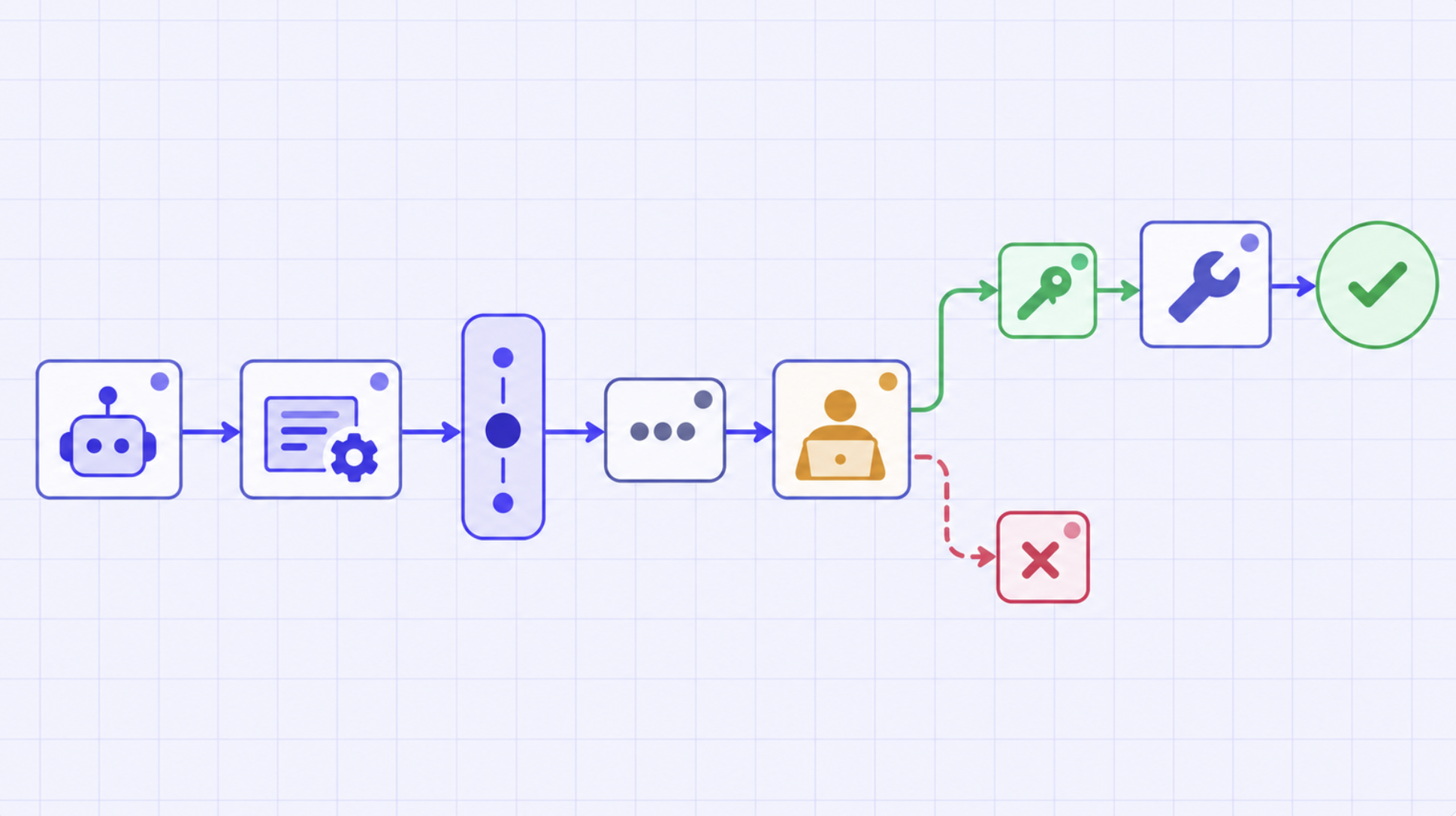
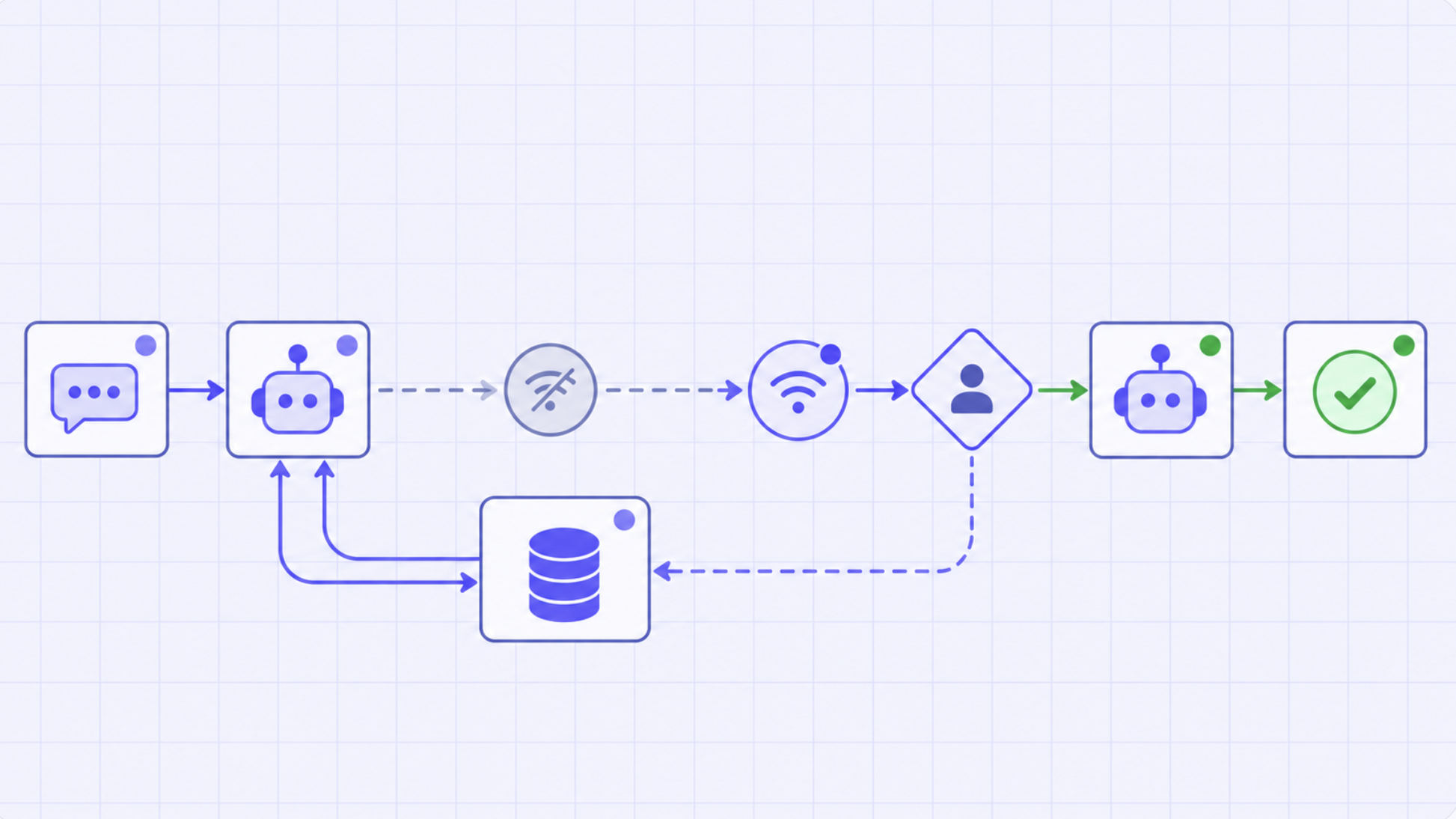
Under the hood, an Agent Gateway operates as a reverse proxy tailored to agentic protocols. All agent requests are routed to the gateway first rather than directly to any service. For example, when an agent wants to invoke a tool, it sends a request (typically an MCP or A2A message) to the gateway’s endpoint. The gateway then:
AuthN/AuthZ: Verifies the agent’s identity and checks permissions. It may decode an OAuth token or API key and confirm that this agent/user is allowed to call the requested tool.
Routing & Protocol Handling: Based on the request content, the gateway looks up the target tool or LLM in its registry. It knows whether to connect to an internal MCP server, an external REST API, or an LLM service. The gateway may translate the request from one protocol to another (e.g. converting JSON-RPC to an HTTP API call). If multiple backends provide the same tool, the gateway balances or fans out the request accordingly.
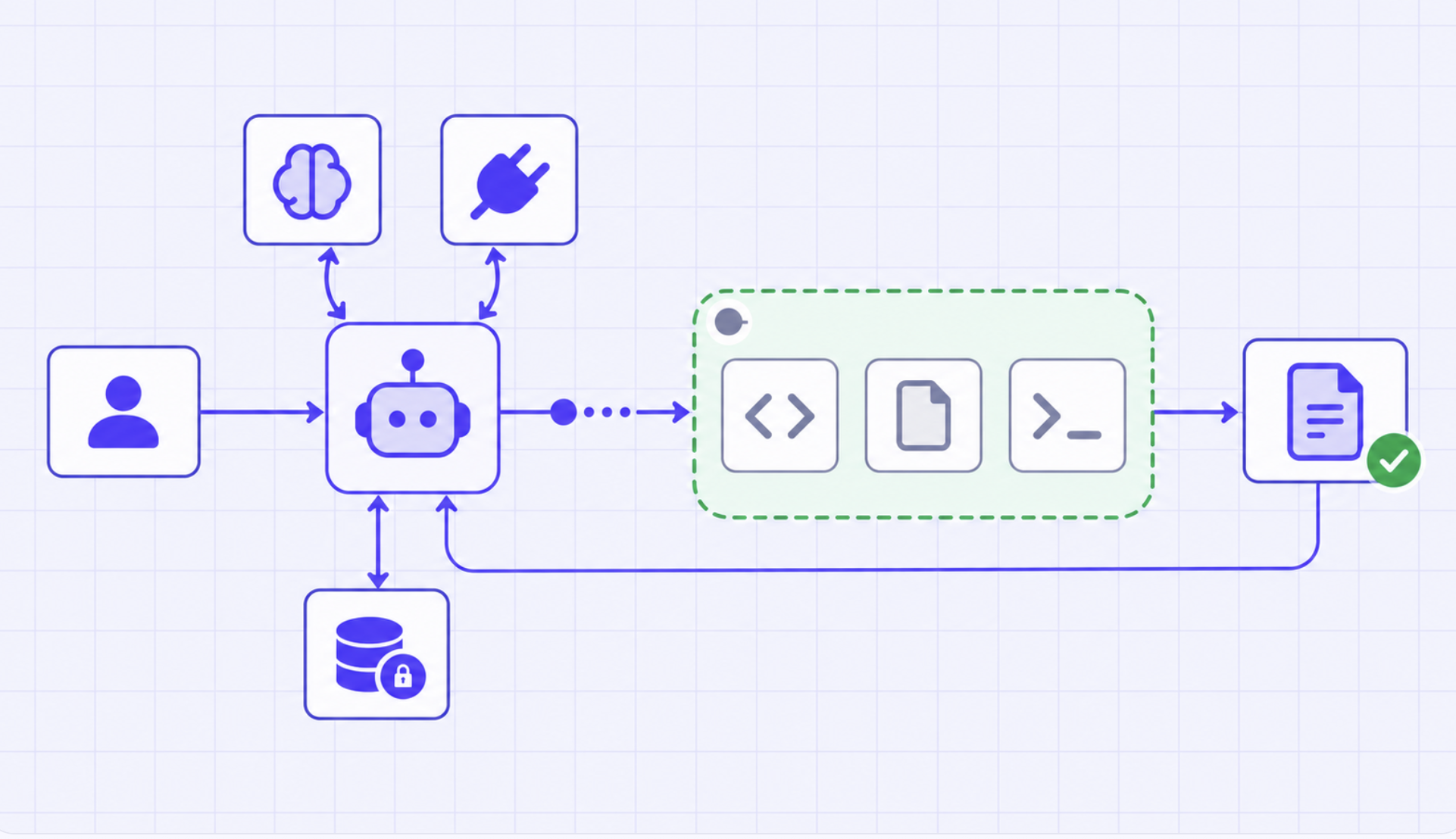
Orchestration (if needed): For multi-step workflows, the gateway can orchestrate calls to multiple backends in sequence or parallel. For instance, an agent’s single instruction might cause the gateway to first fetch data from one service, then pass results to another tool, and finally send the output back to the agent. In essence, the gateway can act as a lightweight workflow engine. TrueFoundry’s design, for example, explicitly “orchestrates the agentic loop between the LLM and the MCP servers”, streaming results through the LLM and toolchain.
Streaming & Sessions: If a backend streams data (such as an LLM streaming tokens, or a tool emitting Server-Sent Events), the gateway maintains that stream back to the agent. The gateway keeps track of long-lived sessions so the agent receives updates as they occur. This is a key difference from stateless API proxies: an Agent Gateway tracks client sessions and can push responses or even initiate messages back to the agent when needed.
Response Handling: Once the backend(s) respond, the gateway can apply response-time policies. It may redact sensitive information, enforce output schema validation, or trim large messages to save tokens. It then sends the final response back to the agent, possibly streaming it incrementally if it’s large or if the agent uses streaming.
Logging & Telemetry: Throughout all steps, the gateway records each request and response. It attributes each call to the original agent, logs the sequence of calls, records latency, cost (token usage), and any policy violations. This trace data is stored so administrators can later audit or analyze the interaction.
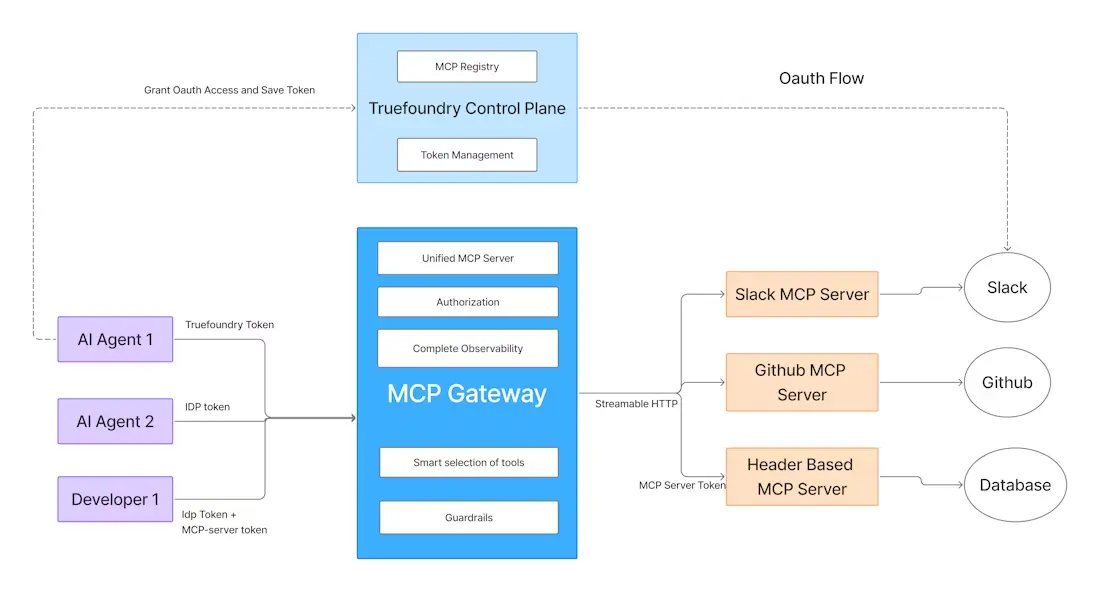
The diagram above (adapted from TrueFoundry’s docs) illustrates an MCP Gateway architecture.
Agents send requests into the gateway, which handles authentication, proxies calls to LLM models and tool servers (MCP), and then returns results. A central control plane manages registrations and access controls, while a built-in MCP client layer orchestrates multi-step calls between LLMs and tools.
Overall, the Agent Gateway acts as a stateful intermediary. By converting agent intents into concrete API calls and doing the reverse, it glues together autonomous agents, large language models, and traditional services into a cohesive, governed pipeline.Traditional API gateways cannot handle this natively – the Agent Gateway’s intelligence about JSON-RPC sessions, SSE streams, and MCP/A2A semantics is what makes it viable for real enterprise use.
Agent Gateway vs API Gateway vs AI Gateway
It helps to compare Agent Gateways to more familiar gateway types:
API Gateway: A general-purpose gateway for web services (REST/gRPC). It handles routing, auth, rate-limiting, and caching for APIs. It is typically stateless (one request/response at a time) and does not natively understand LLM or agent protocol.
AI Gateway: Often discussed in the context of AI gateway vs API gateway, it extends traditional gateway behavior to handle AI/LLM traffic, token-aware routing, and model-specific observability. It adds features like multi-model routing, token usage tracking, prompt templating, and LLM-specific logging. For example, TrueFoundry’s AI Gateway lets developers call hundreds of LLM models through one endpoint with full access control and observability. It optimizes how applications interact with language models but usually still treats requests as independent calls.
Agent Gateway: Takes the concept further to the agentic domain. It incorporates all API and AI gateway features plus special support for multi-agent workflows. This includes session-awareness (MCP/A2A), tool orchestration, and inter-agent message routing. In other words, an Agent Gateway is an AI Gateway on steroids for agents: it not only manages LLM calls, it also manages calls between agents and tools in multi-step chains. As Gravitee explains, AI Gateways and Agent Gateways are separate but complementary – the Agent Gateway focuses on agent-to-agent communication under governance, whereas the AI Gateway focuses on LLM interactions with the broader system. Solo.io similarly emphasizes that while MCP/A2A define low-level RPC, only an Agent Gateway provides the “enterprise-grade security, resilience, observability, and multi-tenancy” layer needed.
In practice, the boundaries blur. Many platforms (including TrueFoundry) are converging these concepts. TrueFoundry’s platform, for instance, already offers a unified AI Gateway that covers models, hybrid GPU/MCP servers, and (soon) agents. But conceptually, think of an Agent Gateway as a specialized gateway focused on coordinating agents rather than just serving models or microservices. It applies similar governance (authz, quotas) across agentic workflows.
Common Use Cases of Agent Gateways
Agent Gateways enable a variety of advanced AI applications. Examples include:
Multi-step Automation Workflows: Complex tasks that require several AI steps. For instance, an enterprise might create a “support ticket” workflow: one agent reads customer emails, another queries a knowledge base (via the gateway’s tools) to draft responses, and a third calls a ticketing API to log the issue. The Agent Gateway logs each call and ensures only approved actions occur. TrueFoundry illustrates such a flow: a “Planner” agent interprets a Slack command, calls a Slack MCP tool, a “Summarizer” agent processes the data, and an “Executor” agent creates Jira tickets – all through a centralized gateway which secures each step.
Tool-Assisted QA and RAG: Retrieval-augmented generation often uses one or more LLMs plus external tools (search engines, databases). An Agent Gateway can present all these search and database tools as MCP services, letting an LLM or agent agentically fetch and combine information under policy. For example, an AI agent answering medical queries could retrieve licensed medical data (as MCP tools) through the gateway, while content filters and audit logs ensure compliance.
Intelligent Assistants with Function Calls: Modern chatbots (like OpenAI’s function-calling chat models) effectively act as agents calling APIs for functions like “bookFlight” or “scheduleMeeting.” An Agent Gateway can serve as the function-call interface, mapping these agentic calls to real booking or calendar APIs with enterprise auth. This offloads credential management and logging to the gateway.
DevOps and IT Automation: Agents can automate software pipelines by calling various APIs (GitHub, CI/CD, cloud consoles). An Agent Gateway unifies these calls: an agent with natural-language intent (“deploy the latest commit if tests passed”) is routed to the correct APIs behind the gateway, and each API key is managed centrally.
Data Pipeline Orchestration: One agent might cleanse data, another analyzes it, another visualizes it – all using specialized tools. The gateway ensures they chain together correctly. For instance, a data analytics agent could query a database via an MCP tool, then hand off to a reporting agent that formats the results, all under single-agent workflow governance.
Low-Code Agent Platforms: The gateway extends easily to end-user agent builders. TrueFoundry’s blog shows that low-code flows created with Flowise can be quickly pointed at the gateway: once the gateway URL and token are entered, “every LLM call now flows through the Gateway,” instantly inheriting centralized governance like cost tracking, observability, and security. This means that experimental agents (even drag-and-drop ones) benefit from production-grade controls as soon as they go through the Agent Gateway.
In all cases, the Agent Gateway provides the glue and guardrails that make agentic AI enterprise-ready. It ensures that whether an agent is a custom app or a third-party bot, it uses the organization’s sanctioned models and tools, stays within budget, and generates a full audit trail.
Challenges in Agent Gateway Adoption
While powerful, Agent Gateways also introduce new considerations:
Protocol Complexity: Agent protocols like MCP are stateful and bidirectional, which is very different from typical REST APIs. Gateways must handle multiple open connections per session, multiplex Server-Sent Events, and preserve JSON-RPC context. This complexity requires a purpose-built implementation (Solo chose Rust, for example) rather than repurposing a generic API proxy.
Scalability and Performance: Keeping live sessions for many agents can tax resources. The gateway must be highly performant to avoid introducing latency. It often needs to cache or trim responses to reduce token usage for costly LLM calls.
Security of Autonomous Agents: Agents can potentially be manipulated to access unauthorized data or perform malicious actions. Ensuring comprehensive guardrails in an agentic flow is challenging. The gateway must validate not just initial requests but also intermediate outputs between agents, which can be complex.
Operational Complexity: Adding a new gateway service (and the dependencies it needs) increases infrastructure complexity. Teams must manage high availability, monitoring and updates for the gateway itself, on top of their existing AI stack.
Standardization and Maturity: Agent protocols like MCP and A2A are relatively new (MCP was launched late 2024) and still evolving. The ecosystem of agent frameworks and tools is nascent. Early adopters may face version mismatches or lack of support from some vendors. Integrating legacy APIs (that were never designed as “agent-native” tools) may require custom adapters or wrappers.
Debugging Multi-Agent Flows: While the gateway provides observability, reasoning about multi-agent interactions across different tools can still be non-trivial. Tracing an agentic conversation end-to-end requires robust tools and potentially new skillsets for development teams.
Cost Management: Interestingly, an Agent Gateway can both help and complicate cost tracking. It centralizes usage metrics, but with many agents and providers, accurately attributing usage (especially across chained calls) requires careful design.
Despite these challenges, the industry consensus is that Agent Gateways address more problems than they create. In fact, Gartner explicitly calls them the “missing layer” for secure AI integration. As adoption grows, we can expect these gateways to become standard components of AI infrastructure, much as API gateways did for microservices.
How to get started with an Agent Gateway?
Organizations eager to adopt an Agent Gateway have several paths:
Evaluate Open Source Projects: Solo.io’s agent gateway (now a Linux Foundation project) is a community-driven gateway with connectors for A2A and MCP protocols. It provides a tool federation portal and developer UI for creating agentic workflows. Experimenting with this project can give teams hands-on insight into agent gateway patterns.
Leverage AI Gateway Platforms: Platforms like TrueFoundry already incorporate agent gateway functionality. While the dedicated Agent Gateway feature is “coming soon”, TrueFoundry’s existing AI Gateway supports MCP tool registration and agent-friendly APIs. You can sign up for TrueFoundry’s platform (free trial, no credit card) and follow the quick-start guides to connect LLMs and MCP tools. TrueFoundry’s docs walk through setting up the Gateway UI, adding model providers, and even adding MCP servers as tools. Using these steps, developers can start building simple agents (e.g. via Flowise or custom code) that automatically use the Gateway’s managed endpoints.
Use Agent-Friendly Tools: If you’re building agents with frameworks like LangChain, LlamaIndex or Flowise, look for features to point their output to a custom endpoint. As TrueFoundry demonstrated, simply configuring a low-code agent to use the Gateway’s API URL can bring all agent traffic under the gateway’s control. Similarly, open-source agents supporting MCP can register their MCP servers via the gateway’s API and then start invoking them through the centralized interface.
Adopt Identity and Governance Early: Since an Agent Gateway hinges on centralized auth, integrate it with your corporate identity (SSO/OAuth) from day one. For example, TrueFoundry lets you use standard OAuth2 (2LO/3LO) for both users and services. Configure these flows early to avoid last-minute security gaps. Also define your RBAC and policy requirements in advance – the sooner they are codified in the gateway, the smoother scaling will be.
Learn from Examples and Tutorials: TrueFoundry’s documentation and blogs are useful resources. The “Flowise Agent” tutorial covers building an agent behind the gateway step-by-step. The TrueFoundry docs include a “Playground” for testing MCP tools and code snippets for invoking them via the gateway. Beyond TrueFoundry, the Solo.io and API/AI gateway communities (e.g. Apache APISIX with AI plugins) provides guidance on architecture and best practices.
By starting small – for instance, exposing one internal API as an MCP server in the gateway and testing an agent flow – teams can build confidence. Over time, they can migrate more agents to use the centralized gateway endpoint, systematically unlocking the benefits of unified governance and monitoring. The key is to treat the Agent Gateway as the integration point: any new agent or tool should go through it by default.
Conclusion: Future-Proofing Your Agentic Strategy
The agent gateway represents the next critical frontier in AI infrastructure, aligning rapid agentic innovation with stringent enterprise requirements. Just as API gateways brought order to microservices, an agentic gateway brings centralized management to complex multi-agent systems. By unifying communications, enforcing security policies, and providing deep observability, it transforms fragmented agent networks into a disciplined, high-performance workflow.
For organizations scaling AI, this layer is no longer optional, it is the connective tissue that fills the "missing layer" in the modern stack. Solutions like TrueFoundry’s AI Gateway and Agent Gateway are leading this shift, ensuring that CTOs and developers can deploy robust agentic workflows with the best LLM gateway capabilities and total confidence.
In the era of autonomous AI, the agent gateway is the bridge between experimental automation and reliable production. By embracing this robust foundation, teams can stop reinventing integration code and start focusing on what matters: building intelligent systems that drive real business value.
Ready to Secure Your AI Future?
Don't let complex integrations slow down your AI deployment. Take control of your models and agents with TrueFoundry’s unified platform.
Centralize Governance: Manage all your LLMs and agents through a single pane of glass.
Scale Faster: Deploy with confidence using our unified AI deployment tools.
Enterprise-Grade Security: Implement robust access management and policy enforcement instantly.
An agent gateway plays a pivotal role in the rapid evolution of the AI landscape by providing a robust foundation for machine learning operations. It acts as the connective tissue for intelligent systems, offering a layer of security and access management that allows organizations to reach the full potential of robust agentic workflows.
What is agent gateway integration?
Agent gateway integration is the first step toward open source governance. This software layer simplifies data handling and data movement across cloud platforms like Amazon Web Services. By serving as a data plane, it enables native api management and solves a lot of problems related to legacy systems.
What is agent gateway protocol?
The agent gateway protocol, such as the model context protocol, provides common ground for interoperable gateways. By addressing important issues like MCP security and api management, this open foundation creates an agent mesh. It is a crucial step in solving the biggest open security problems today within the real world.
What makes TrueFoundry agent gateway the best enterprise agent gateway?
The TrueFoundry agent gateway is the best enterprise agent gateway because it provides a stable foundation for machine learning with native api management. It acts as the connective tissue for intelligent systems, offering deeper MCP security and access management than interoperable gateways, ensuring you reach the full potential of robust agentic workflows.
TrueFoundry AI Gateway delivers ~3–4 ms latency, handles 350+ RPS on 1 vCPU, scales horizontally with ease, and is production-ready, while LiteLLM suffers from high latency, struggles beyond moderate RPS, lacks built-in scaling, and is best for light or prototype workloads.











.png)
.png)
.png)
.png)
.png)
.png)
.png)
.png)
.png)
.png)
.png)


